
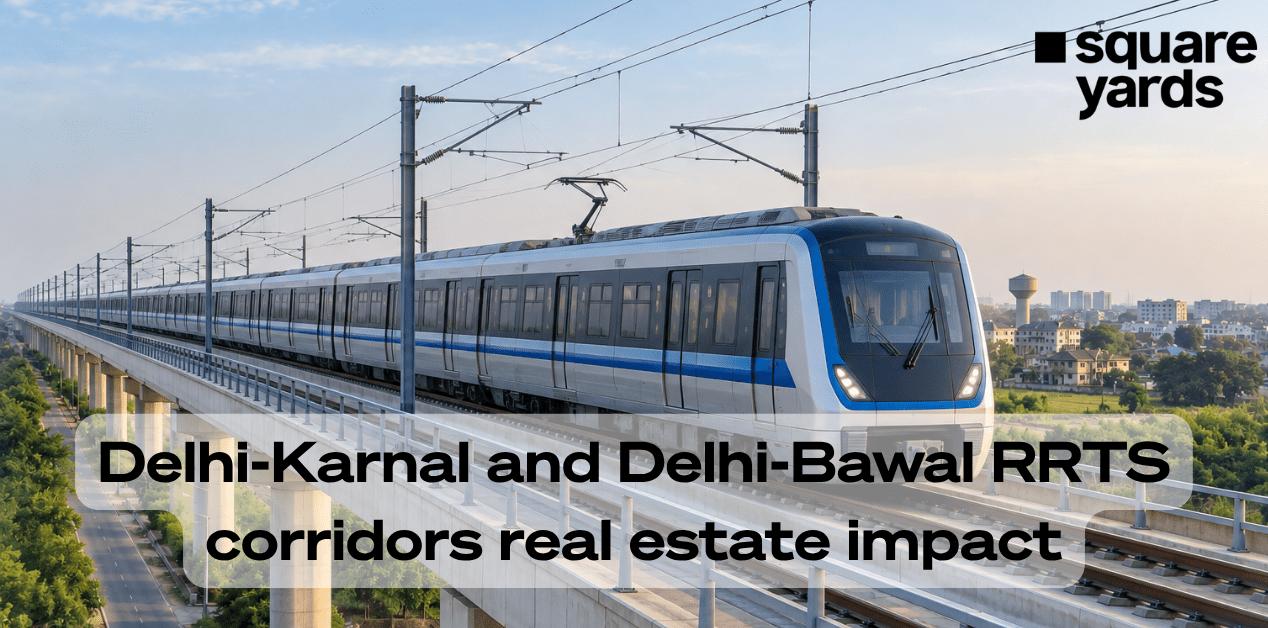
The Centre is reviewing proposals for two new Namo Bharat Regional Rapid Transit System (RRTS) corridors connecting Delhi with Karnal and Bawal, with the projects expected to improve regional connectivity and reduce travel time for commuters across the NCR. The National Capital Region Transport Corporation has submitted detailed project reports for the Delhi-Karnal and Delhi-Bawal routes, while preparatory work is underway.
The proposed corridors are part of the expansion of the Namo Bharat network beyond the operational Delhi-Meerut route. The Delhi-Panipat-Karnal corridor will connect the national capital with Sonipat, Panipat and Karnal, while the Delhi-Gurugram-Bawal corridor will serve key urban and industrial centres in southern Haryana. Together, the projects are expected to improve access to employment hubs, support regional economic activity and provide an alternative to road-based travel.
Delhi-Karnal and Delhi-Bawal RRTS: Key features
The Delhi-Panipat-Karnal corridor is planned to cover approximately 136.30 km from Sarai Kale Khan in Delhi to Karnal. The route will pass through major locations including Sonipat, Gannaur, Samalkha and Panipat before reaching Karnal. The corridor is expected to include 22 stations, serving both residential areas and important regional destinations. The estimated cost of the Delhi-Panipat-Karnal project has been reported at around Rs 33,051 crore.
The Delhi-Gurugram-Bawal corridor is planned to cover around 107 km, connecting Sarai Kale Khan with Gurugram, Manesar, Rewari and Bawal. The route will improve access to major employment and industrial centres in southern Haryana, including the Manesar-Bawal Investment Region.
The NCRTC plans to use Namo Bharat trains capable of operating at speeds of up to 160 kmph. The system is designed to provide high-frequency regional services, with trains expected to run at intervals of around 15 minutes during the initial phase of operations. The corridors will also be planned with multimodal connectivity in mind, allowing commuters to access other public transport systems and improve last-mile travel.
Commuters can benefit from reduced travel times as the projects become operational. The Delhi-Karnal journey could take around 90 minutes, compared with approximately three hours by road. The Delhi-Bawal journey is expected to take around 67 minutes. These time savings could benefit daily commuters travelling between Delhi and Haryana for work, education and business. It will also reduce dependence on road transport and reduce congestion on the route by providing a reliable commute alternative.
Real estate impact of Delhi-Karnal and Delhi-Bawal RRTS
The proposed RRTS corridors could influence real estate demand in Delhi, Sonipat, Panipat, Karnal, Gurugram, Manesar, Rewari and Bawal by improving access to employment centres and reducing travel time between cities. The NCRTC has identified improved access to jobs, facilities and regional economic activity as key benefits of the Namo Bharat network.
In Delhi, Sarai Kale Khan is expected to remain an important multi-modal transport hub as the starting point for the proposed corridors, combined with the ISBT, metro station on DMRC’s Pink Line, and the already operational Delhi-Meerut RRTS. Sonipat, Panipat and Karnal could benefit from improved access to Delhi.
The proposed Delhi-Panipat-Karnal corridor route through Sonipat, Gannaur, Samalkha and Panipat places these cities within the planned regional transport network. Better connectivity could support housing demand from people working in Delhi and other NCR employment centres, as well as commercial activity along the corridor.
City-wise price insights
|
City |
Average price (per sq ft) |
|
Sonipat |
Rs 4,300 – 5,800 |
|
Gannaur |
Rs 3,500 – 5,000 |
|
Panipat |
Rs 7,300 – 12,000 |
|
Manesar |
Rs 9,000 – 12,000 |
|
Rewari |
Rs 5,500 – 8,000 |
|
Bawal |
Rs 2,000 – 3,500 |
|
Karnal |
Rs 5,000 – 15,000 |
Source: Square Yards Research
In southern Haryana, Gurugram, Manesar, Rewari and Bawal could see increased interest from businesses and homebuyers as regional connectivity improves. The proposed Delhi-Gurugram-Bawal route is expected to connect major employment and industrial areas, including the Manesar-Bawal Investment Region. This could support demand for housing, commercial spaces and industrial facilities over time.
Disclaimer: This image has been generated using AI for illustrative purposes only. It does not represent an actual photograph or an exact depiction of the places shown.