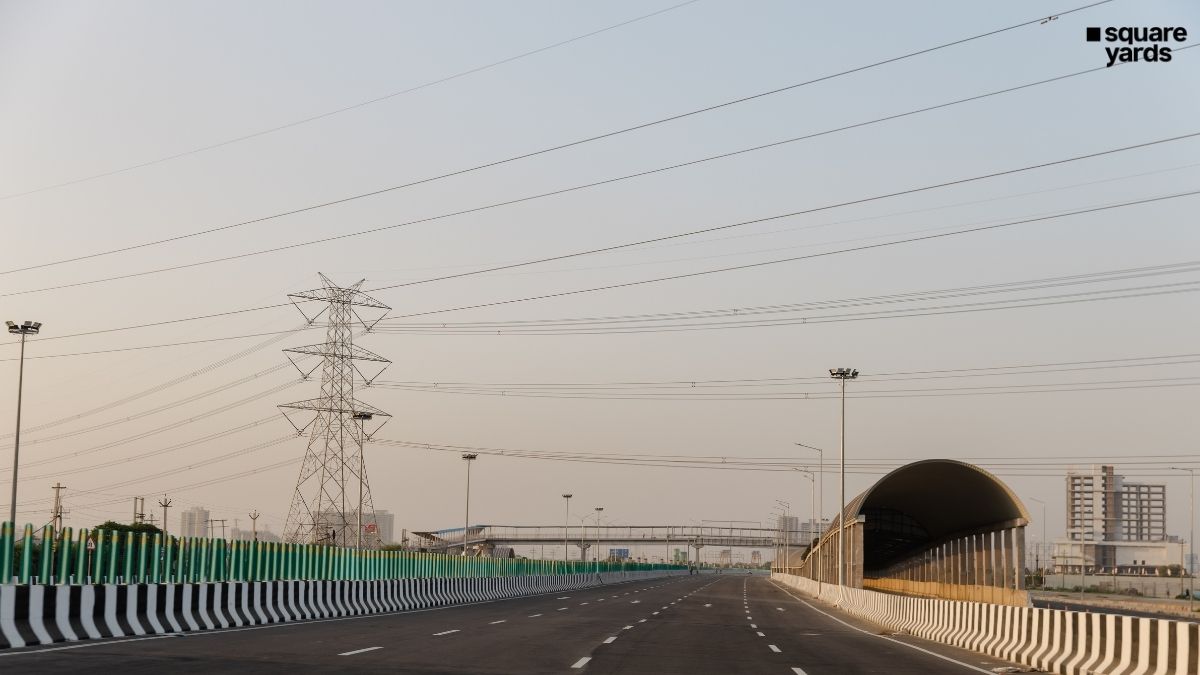
The Union Cabinet recently approved two major highway projects worth Rs 14,115 crore to improve road connectivity in Delhi and Uttar Pradesh. The projects include an 8.1-km six-lane tunnel connecting Dwarka Expressway with Nelson Mandela Marg in South Delhi and a 117.7-km greenfield highway between Kanpur and Kabrai in Uttar Pradesh.
In Delhi-NCR, the tunnel is set to improve connectivity between Dwarka, Vasant Kunj, Gurugram and the Indira Gandhi International Airport. In Uttar Pradesh, the new highway is expected to improve access across Bundelkhand, a region where industrial and infrastructure investments have picked up in recent years.
The tunnel project in Delhi is estimated to cost around Rs 6,969.67 crore. The highway project in UP will cost around Rs 7,145.14 crore.
Six-lane Delhi tunnel to target a key NCR bottleneck
The 8.1-km tunnel will be built along NH-148AE and will connect the Dwarka Expressway to Nelson Mandela Marg in Vasant Kunj, South Delhi. Of the total stretch, 3.14 km will run underground beneath the Southern Ridge.
It is designed to bypass two of Delhi’s most congested points: Mahipalpur Junction and the Dhaula Kuan stretch. A flyover near Mahipalpur and an elevated U-turn at the Mahipalpur-Chhatarpur junction are also planned.
The project has been approved for Rs 6,969.67 crore and is expected to be completed in about 5 years. It will be developed under the Hybrid Annuity Mode, where the government pays 40% of the cost during construction and the rest afterward in installments.
For the property market, the development is significant because it shortens travel between some of the most active residential and commercial hubs in Delhi-NCR. It is expected to improve accessibility for homebuyers, office commuters and businesses operating along the corridor.
Dwarka Expressway gets another infrastructure push
The Dwarka Expressway has already established itself as one of the fastest-growing residential markets in Delhi NCR. The Cabinet’s approval of the tunnel adds another connectivity project to a corridor that has already benefited from major infrastructure investments.
According to Square Yards research, average residential prices along the Dwarka Expressway have increased 3.5 times in the past 5 years, rising from around Rs 6,300 per sq ft in 2020 to Rs 21,700-24,000 per sq ft in 2025. The growth has been driven by infrastructure improvements, increased buyer demand, and a pipeline of new projects.
Here’s a quick snapshot of the Dwarka Expressway property market:
|
Particulars |
Details |
|
Average property rate (2020) |
Rs 6,300/sq ft |
|
Average property rate (2025) |
Rs 21,700-24,000/sq ft |
|
5-year appreciation |
3.5x |
|
Number of new projects |
430+ |
|
Average rental rate |
Rs 28/sq ft |
|
Rental yield |
+ 2.40% |
Source: Square Yards Research
The proposed tunnel is expected to improve the appeal of this already active market. It will strengthen buyer preference for projects located along the expressway, particularly among professionals who commute between Gurugram, Delhi and the airport corridor.
Areas that could benefit from the tunnel connectivity
The tunnel is expected to improve connectivity for areas such as Dwarka, Vasant Kunj, Mahipalpur and Rangpuri by providing a more direct link between the Dwarka Expressway and South Delhi. The project is designed to ease congestion on key routes around Mahipalpur, Rangpuri and the Dhaula Kuan-IGI Airport corridor, which currently witness heavy traffic during peak hours.
For the real estate market, improved connectivity will enhance the appeal of these locations for both residential and commercial development. The property rates and rents are expected to rise gradually as construction progresses.
The current property rates in these localities are as follows:
|
Locality |
Average Sale Price (2026) |
|
Dwarka |
Rs 15,300/sq ft |
|
Vasant Kunj |
Rs 23,550/sq ft |
|
Mahipalpur |
Rs 6,697/sq ft |
|
Rangpuri |
Rs 11,100/sq ft |
Source: Square Yards Research
Improved connectivity to support commercial growth
The Dwarka Expressway has gradually evolved beyond a purely residential market. The developers are introducing retail high streets, office spaces and mixed-use projects. The new tunnel is expected to strengthen the corridor’s appeal for commercial projects by making them more accessible for both employees and visitors.
For businesses, smoother connectivity means lower travel time and easier movement of people. For hospitality and retail businesses, improved movement between Gurugram, Dwarka and South Delhi could also support higher footfall over the longer term.
Commercial space near the airport should also see more interest. Warehousing and logistics businesses serving the airport area are likely to benefit as well, given improved freight movement between West and South Delhi.
Kanpur-Kabrai Highway puts focus on Bundelkhand
The Cabinet has also approved a 117.7-km greenfield highway connecting Kanpur and Kabrai at an estimated cost of Rs 7,145.14 crore. It will cut travel time between the two towns from about 3.5 hours to roughly 90 minutes. The project is aimed at improving connectivity across Bundelkhand, a region that has seen increased public investment through the Defence Corridor and other infrastructure projects.
The highway will pass through Kanpur, Hamirpur and Mahoba and will form part of the larger Bhopal-Kanpur Economic Corridor, which will extend connectivity to Sagar and Bhopal in Madhya Pradesh. It will connect to NH-34, NH-35, the Bundelkhand Expressway and the Kanpur Ring Road.
It will start as a four-lane road and can be expanded to six lanes later. The project will be developed on a Build-Operate-Transfer toll model, meaning a private company will fund construction and recover its cost through tolls. It is expected to take about 2.5 years to complete.
Highway expected to support industrial real estate
The Kanpur-Kabrai highway adds to a series of infrastructure projects announced for Bundelkhand over the past few years.
Unlike the Delhi project, the impact is likely to be felt more in the industrial and logistics segments than in the residential market. Improved road connectivity will streamline the movement of raw materials and finished goods, thereby increasing demand for industrial land, warehousing, and logistics facilities along the corridor.
As industrial activity expands, demand for supporting commercial development, including retail, hospitality, and rental housing, could also increase over time. The new highway will link such businesses more efficiently with Kanpur, one of Uttar Pradesh’s key industrial centers.
Execution timeline remains an important factor
The impact of both projects on the property market will depend on execution timelines, supporting infrastructure and the pace of development around the new corridors.
For Delhi-NCR, the tunnel strengthens connectivity across an already active housing market. For Bundelkhand, the highway has the potential to improve industrial access and support long-term commercial development. If completed on schedule, both projects will add to the long-term infrastructure-led growth that has shaped several real estate markets across North India over the past decade.