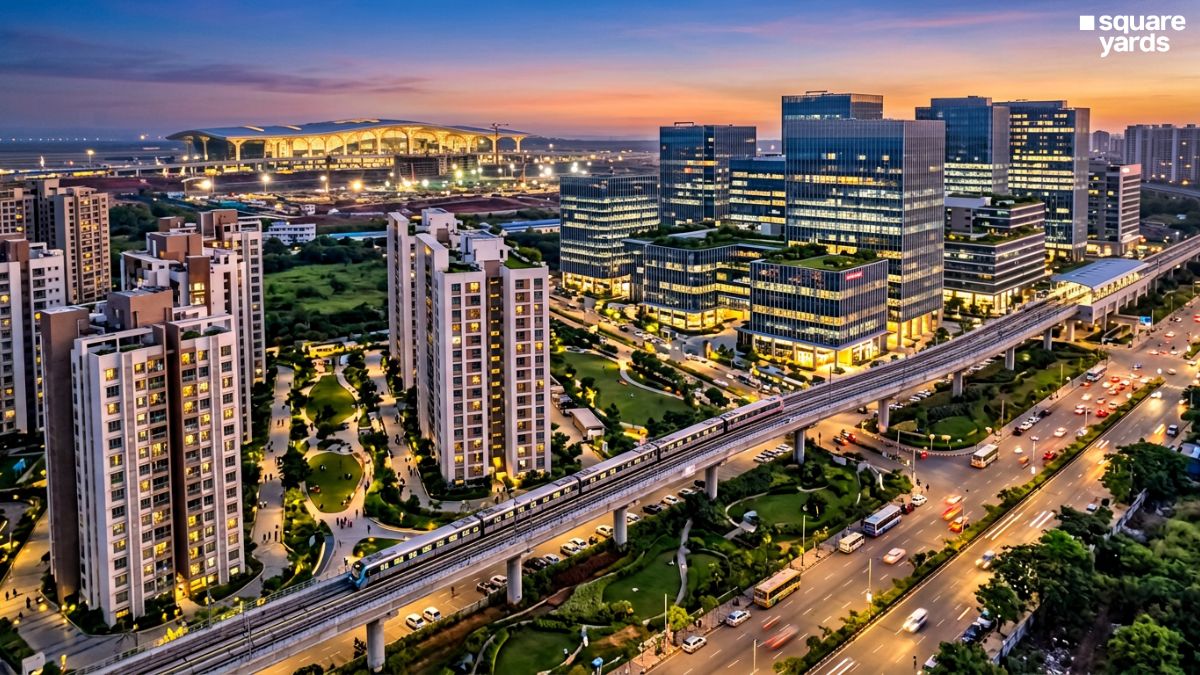
The announcement of the proposed Tata Innovation City, a planned 300-acre, USD 11 billion technology hub unveiled at the World Economic Forum in Davos—adds a substantial employment-led catalyst to Navi Mumbai’s changing housing market. Planned near the upcoming Navi Mumbai International Airport (NMIA), the project is envisioned to house artificial intelligence data centres, high-performance computing facilities, semiconductor design enclaves, and multinational Global Capability Centres (GCCs).
For the residential property market, the significance of this development does not rest on investment announcements or capital outlay figures alone. Its true impact depends on whether this proposed employment ecosystem converts into actual corporate hiring, payroll additions, and sustained housing demand. If delivered as planned, the influx of technology professionals, engineers, researchers, and operations personnel could create end-user demand across executive housing, mid-income family residences, and workforce rentals. However, the geographic distribution and timing of this demand will be determined by project execution schedules, commuter transit delivery, and the availability of everyday social infrastructure.
The Transition: From Aviation Corridor to Technology-Linked Housing
The Navi Mumbai International Airport has already expanded the region’s property narrative beyond that of a traditional suburban bedroom community for Mumbai. The airport serves as a primary logistical and transport anchor, creating a broader economic belt combining passenger aviation, air cargo, commercial services, and new residential sectors.
The planned addition of an advanced technology cluster shifts the nature of future residential demand:
- Regional transit anchors such as the Navi Mumbai International Airport, Atal Setu (MTHL), and the Navi Mumbai Metro network will improve connectivity across the region.
- The planned employment hub, driven by AI and cloud infrastructure, semiconductor R&D, and corporate GCC operations, could generate sustained employment-led housing demand.
- This demand is likely to translate into different residential catchments, with Kharghar and Panvel catering to executive housing, Ulwe and Panvel absorbing professional rentals, and Pushpak Nagar, Karanjade and Taloja serving more value-oriented workforce housing.
This residential absorption will not spread evenly across Navi Mumbai. Senior management and research heads are expected to prioritize established nodes with operating schools, hospitals, and lifestyle amenities. In contrast, technical staff, airport crews, and operational personnel will gravitate toward emerging, value-oriented localities located closer to the workplace.
What Will Determine the Real-World Impact?
Converting an ambitious commercial master plan into permanent residential demand is conditional on measurable progress on the ground. Analysts, developers, and prospective homebuyers should monitor six primary indicators:
- Site Execution & Infrastructure Commissioning: Tangible progress on land allocation, grading, and the provision of dedicated utility grids—particularly uninterrupted high-voltage power and industrial water lines essential for data centres—will signal when corporate occupiers can realistically begin campus fit-outs.
- Commercial Pre-Leasing & Corporate Footprints: The scale of housing requirements will directly mirror the net square footage absorbed by anchor technology firms, GCCs, and cloud operators.
- Pace and Seniority of Job Creation: The volume and income distribution of newly created positions—ranging from high-earning data science architects to round-the-clock facility maintenance teams—will dictate whether local absorption leans toward long-term home ownership or transient rental accommodation.
- Transit and Last-Mile Integration: Everyday livability depends on seamless arterial connections, including feeder routes to the Atal Setu, local suburban railway frequency, and the timely expansion of the Navi Mumbai Metro network to the airport and technology gates.
- Social Infrastructure Delivery: Housing demand cannot stabilize into family communities without functional neighborhood infrastructure: accredited schools, tertiary healthcare centers, supermarkets, and civic green spaces.
- Rental Yield and Occupancy Absorption: Rather than speculative land trades, sustained residential health will be evidenced by declining vacancy rates and steady rental yields across newly delivered residential inventory.
Evaluating the Residential Catchments
Each residential node surrounding the planned innovation hub and airport features distinct pricing parameters, product availability, and demographic orientations.
Navi Mumbai Residential Nodes: Benchmarks
|
Micro-market |
Primary Housing Profile |
Average Asking Price |
|
Ulwe |
Airport-adjacent apartments |
₹15,600-₹17,700 / sq ft |
|
Panvel & New Panvel |
Integrated gated townships |
₹12,850-₹14,450 / sq ft |
|
Pushpak Nagar |
Compact greenfield formats |
₹10,650-₹11,900 / sq ft |
|
Karanjade |
Budget & support housing |
₹18,500-₹19,150 / sq ft |
|
Taloja |
Metro-connected suburb |
₹11,400-₹12,600 / sq ft |
|
Dronagiri |
Port & freight spoke |
₹10,500-₹11,500 / sq ft |
|
Kharghar |
Established executive hub |
₹17,150-₹19,150 / sq ft |
Ulwe: Airport Proximity and the Shift to End-User Livability
Ulwe is the most directly exposed residential market to both the airport and the southern employment corridor. Having experienced rapid appreciation following the approval of the Atal Setu (MTHL) and coastal suburban rail links, the node is now entering a phase where price stability depends on actual resident occupancy.
- Pricing & Configurations: Average asking prices range between INR 15,600 and INR 17,700 per sq ft. Entry-level 1 BHK apartments typically start around INR 38 lakh, standard 2 BHK units range from INR 70 lakh to INR 95 lakh, and 3 BHK family apartments start from roughly INR 1.35 crore.
- Demand Profile: Suited for aviation crew, IT operations staff, and corporate professionals requiring quick transit access to both the airport corridor and South Mumbai via the MTHL.
- Ground Reality: Because early expectations are already largely factored into current capital values, future appreciation will be moderate and closely tied to community livability—specifically the operational delivery of primary schools, healthcare clinics, and daily neighborhood retail.
Panvel and New Panvel: The Self-Sustaining Urban Anchor
Unlike newly surveyed sectors, Panvel functions as a mature, self-contained city center. It offers established intercity rail terminals, immediate access to the Mumbai–Pune Expressway and NH-48, and a complete social fabric of reputed schools, multi-specialty hospitals, and markets.
- Pricing & Configurations: New Panvel records average asking rates of roughly INR 14,450 per sq ft, while Old Panvel averages around INR 12,850 per sq ft. Entry-level properties begin near INR 38 lakh, with 2 BHK family homes generally commanding INR 1.10 crore to INR 1.25 crore, and 3 BHK residences ranging upward from INR 1.38 crore.
- Demand Profile: Large gated townships provide established living options for mid- to senior-level managers who prefer operational urban conveniences over nascent construction zones.
- Rental Outlook: Thanks to its existing housing stock, Panvel is positioned to absorb immediate rental demand as corporate offices and project management teams begin setup phases in the corridor.
Pushpak Nagar: Greenfield Affordability for Emerging Workforces
Planned by CIDCO directly within the airport-influence zone, Pushpak Nagar represents an early-stage residential sector characterized by modern, compact apartment developments and accessible entry capital points.
- Pricing & Configurations: Average asking rates are among the lowest in the immediate airport vicinity, typically spanning INR 10,650 to INR 11,900 per sq ft. Compact 1 BHK apartments begin around INR 47 lakh, functional 2 BHK units trade near INR 70 lakh, and select 3 BHK units in organized developments cross INR 1.80 crore.
- Demand Profile: Designed primarily for junior engineers, technical operators, and airport ground staff seeking affordable entry into modern buildings.
- Ground Reality: While a lower baseline offers room for organic price movement, actual appreciation will be contingent on road paving, utility energization, and the speed at which families physically occupy the sectors over the coming three to five years.
Karanjade: Value Housing for Operational Personnel
Situated along the western perimeter of Panvel, Karanjade has developed into a dense, budget-focused residential pocket offering compact homes at manageable absolute ticket sizes.
- Pricing & Configurations: Active asking rates average between INR 18,500 and INR 19,150 per sq ft, reflecting a product profile dominated by compact floor plans. Absolute prices for 1 BHK units range between INR 28 lakh and INR 52 lakh, while 2 BHK homes are available from INR 50 lakh to INR 65 lakh.
- Demand Profile: Functions as an affordable housing catchment for logistics coordinators, transport staff, and service personnel supporting the broader airport belt. Demand is driven by practical rental affordability rather than capital speculation.
Taloja: Metro-Connected Value Catchment
Taloja provides a hybrid industrial and residential environment positioned along the operational Navi Mumbai Metro Line 1, which links it directly to the established social infrastructure of Kharghar.
- Pricing & Configurations: Average apartment asking rates sit around INR 11,400 to INR 12,600 per sq ft. Entry-level 1 BHK homes range from INR 20 lakh to INR 40 lakh, 2 BHK units trade between INR 49 lakh and INR 67 lakh, and mid-sized 3 BHK configurations start from roughly INR 73 lakh.
- Demand Profile: Although Taloja’s physical distance from the proposed Innovation City makes its connection secondary compared to Panvel or Ulwe, direct metro transit enables it to serve as a cost-effective residential base for back-office and technical employees.
- Market Note: While selective listing databases recorded strong asking-rate increases over recent cycles (with certain datasets reflecting movement of up to 41%), historical figures represent past adjustments and should not be interpreted as forecasts of future appreciation. Long-term absorption will depend on industrial buffer management and local civic infrastructure.
Dronagiri: Long-Horizon Port and Freight Spoke
Located at the southern terminus of Navi Mumbai, Dronagiri’s long-term residential profile is anchored by the Jawaharlal Nehru Port Authority (JNPA), maritime logistics zones, and special economic enclaves.
- Pricing & Configurations: Baseline listings average around INR 10,500 to INR 11,500 per sq ft, with 1 and 2 BHK configurations generally priced between INR 39 lakh and INR 75 lakh.
- Demand Profile: Caters primarily to cargo handling, shipping, and port-adjacent workforces. Its role relative to the proposed Innovation City is peripheral, remaining an early-stage market whose residential transition will unfold over an extended timeline as southern transit routes mature.
Kharghar: The Mature Executive Lifestyle Standard
While not located directly along the airport perimeter, Kharghar represents the established cultural, educational, and lifestyle benchmark for South Navi Mumbai.
- Pricing & Configurations: Average asking prices stand at INR 17,150 per sq ft, with premium golf-facing and prime sector developments commanding INR 18,500 to INR 19,500+ per sq ft.
- Market Role: Anchored by Central Park, a public golf course, reputed higher-education campuses, and corporate hospitals, Kharghar is the logical primary residential choice for C-suite executives, project heads, and senior researchers who prioritize complete, high-quality family living over proximity to industrial zones.
Conclusion
The proposed Tata Innovation City could emerge as a significant long-term employment catalyst for Navi Mumbai’s evolving residential ecosystem. By seeking to bring high-value technology sectors—including artificial intelligence, cloud computing and semiconductor research—into a concentrated hub near an international airport, the development has the potential to generate sustained demand for both commercial space and housing.
However, the real estate impact is likely to unfold progressively rather than immediately. In the near term, residential demand is expected to be driven largely by rental absorption and workforce housing in established locations such as Panvel and well-connected areas such as Ulwe, supported by project planners, engineers and early-stage operational staff. Over the medium to long term, more durable capital appreciation and end-user housing demand will depend on tangible milestones: corporate occupancies, sustained campus employment and the coordinated development of schools, healthcare, retail and local mobility infrastructure.
For homebuyers, developers and industry observers, the key takeaway is that project announcements alone do not create lasting residential value. The true real estate opportunity will ultimately be determined by how effectively proposed employment translates into operational workplaces, permanent households and well-serviced, liveable communities.