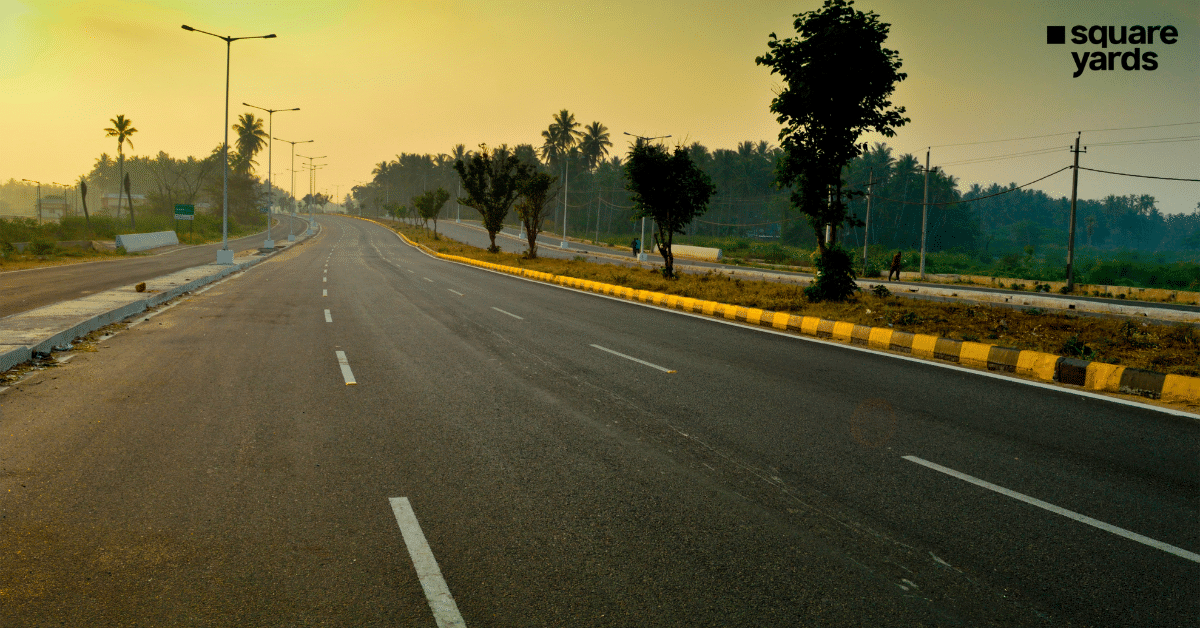
Property in Aligarh is entering a new growth phase as NHAI moves ahead with a 150-km greenfield highway to Moradabad. The 4-lane, access-controlled road will cut travel time between the two cities from 3 to 4 hours to about 90 minutes.
Today, the Aligarh to Moradabad distance is about 150 to 160 km by road. Most traffic uses the older NH-509 route, which passes through busy towns and local markets. The new Moradabad Aligarh expressway, officially a greenfield national highway, will run on a fresh alignment through Amroha, Sambhal and Bulandshahr before joining the Aligarh Ring Road.
Land acquisition is already under way in Moradabad and Aligarh. As a result, buyer interest is moving to the city’s edges. Demand is strongest for plots for sale in Aligarh near the Ring Road and Gabhana, along with plots in Tappal and plots in Jattari near the Yamuna Expressway.
The table below compares the current route with the new corridor.
|
Parameter |
Current NH-509 route |
Greenfield corridor |
|
Road type |
Two-lane national highway with frequent bottlenecks |
4-lane access-controlled greenfield highway |
|
Distance |
About 150 to 160 km |
About 150 km |
|
Travel time |
About 3 to 4 hours |
About 90 minutes |
|
Speed |
50 to 60 km/h average |
100 km/h design speed |
|
Access |
Open access, with local traffic |
Fully access-controlled |
|
Junctions |
Local intersections |
Grade-separated interchanges |
|
Network links |
Standard state road network |
Ganga Expressway (Badaun link), Aligarh Ring Road, Agra-Aligarh 4-lane |
Route plan and land acquisition across Western UP
The National Highways Authority of India (NHAI) is building the Moradabad-Aligarh expressway on a new alignment, away from existing roads. The route and the land acquisition plan are explained below.
Where the highway starts and ends
The zero point of the highway is at Gajgola Nanakbari village, near the CNG station before Pakbara on NH-24 in Moradabad. From there, the road heads south through Amroha, Sambhal and Bulandshahr districts. It ends at a grade-separated interchange on the Aligarh Ring Road, which is still under construction.
The highway will be fully access-controlled. Vehicles will enter and exit only at set interchanges, and two-wheelers and three-wheelers will not be allowed on the main road.
Why the route avoids Chandausi
The final alignment skips Chandausi and uses the Anoopshahr Bypass instead. This keeps highway traffic out of crowded town centers. It also lets vehicles keep a steady design speed of 100 km/h for most of the route, which is how the 90-minute travel time becomes possible.
District-wise land acquisition
Land is being acquired in four districts. The notified stretches break down as follows:
- Moradabad: 15.60 km across 22 villages in Sadar and Bilari tehsils, covering about 190 hectares.
- Sambhal: 56.75 km across 69 villages, with 38 in Sambhal tehsil and 31 in Gunnaur tehsil.
- Amroha: A short 100-meter crossing through one village, Imratpur, in Hasanpur tehsil.
- Aligarh: 45 villages across Gabhana and Koil tehsils.
Together, these come to 137 villages. Land is being acquired under Sections 3A and 3D of the National Highways Act, 1956. Compensation will be paid directly into the bank accounts of farmers and other landowners.
The new road will also tie into the wider highway network. It will connect to the Ganga Expressway through the Badaun link. Near Aligarh, it links with the Agra-Aligarh 4-lane project, where work on the first 28-km package toward Hathras is under way and is expected to finish by 2028. Once both are ready, property in Aligarh will sit at the meeting point of routes to Moradabad, Agra and the Ganga Expressway.
Property in Aligarh and Moradabad: top micro-markets along the route
The highway will not lift every area by the same amount. Buyer demand is gathering in a few specific pockets, and each one suits a different budget and buyer type.
Tappal and Jattari: the Jewar airport link
Tappal and Jattari sit in Khair tehsil, northwest of Aligarh city and close to the Yamuna Expressway. They are about 15 to 20 km from the new corridor’s catchment. This places them between two growth drivers: the Noida International Airport at Jewar on one side and the new eastern highway on the other.
Demand for plots in Tappal has grown with work on the airport and planning for YEIDA Phase-II. Plots in Jattari draw buyers who want a lower entry price than land directly on the Yamuna Expressway. Gated plotted communities in this belt offer 100 sq yd plots priced from Rs 20 lakh to Rs 39 lakh. Premium plots can cross Rs 78 lakh.
Buyers comparing options closer to the airport can also look at plots for sale in yamuna expressway. Those who prefer to stay within the district can browse plots for sale in Aligarh across both city and outer-ring locations.
Gabhana and Ramghat Road: entry point for property in Aligarh
Gabhana is where highway traffic will turn toward Aligarh city. Much of the land here is still farmland. However, organized residential plotting is picking up along Ramghat Road as buyers expect better access once the highway opens.
Entry prices range from about Rs 8.4 lakh to Rs 30 lakh or more. This makes it the most affordable of the three areas. Most buyers are end users and local investors who plan to build homes over the next few years. For those who want property in Aligarh close to the Ring Road interchange, this belt has the lowest entry cost.
Pakbara and New Moradabad: where the highway begins
At the northern end, Pakbara and New Moradabad sit within 0 to 5 km of the highway’s zero point. Plotted supply is spread along Delhi Road and the New Moradabad sectors, including Sectors 10, 12 and 16.
Standard resale plots start at about Rs 16 lakh. Prime plots with commercial frontage can go above Rs 1.04 crore. Buyers searching for property for sale in Moradabad will find the widest price range here, from small home plots to high-street commercial land.
Plot price matrix and projected growth
The table below compares current plot rates and projected three-year growth for each area. The growth figures are market projections, not guaranteed returns.
|
Micro-market |
Distance to highway |
Plot price range |
Main buyer type |
Projected 3-year growth |
|
Tappal and Jattari |
15 to 20 km (airport link) |
Rs 20,000 to Rs 39,000 per sq yd |
Retail investors and second-home buyers |
25% to 30% |
|
Gabhana and Ramghat Road |
Direct entry point |
Rs 8,000 to Rs 30,000 (psy) |
End users and local investors |
18% to 22% |
|
Pakbara and New Moradabad |
0 to 5 km (northern end) |
Rs 16,000 to Rs 1,00,000+ (psy) |
Commercial and premium residential buyers |
20% to 25% |
Tappal and Jattari have the highest projected growth at 25% to 30%, mainly because of the airport link. Gabhana remains the cheapest way in, with plots starting at about Rs 8,000 (psy).
Master plans and growth drivers for property in Aligarh
Better roads are not the only reason land prices may rise along this corridor. City master plans and new industry in nearby districts also play a big role, as the sections below show.
Aligarh GIS Master Plan 2031
The old city of Aligarh is crowded, and very little open land is left inside it. The Aligarh GIS Master Plan 2031, prepared by the Aligarh Development Authority (ADA), covers 748 sq km and directs new growth outward toward Gabhana, Koil and the Ring Road.
This matters for buyers because the highway passes through the same belt. New housing, roads and civic services are planned for these zones. Plots that fall within planned growth areas are also more likely to get approved layouts over time.
Bulandshahr-Sikandrabad logistics belt
The highway passes through Bulandshahr district, where the logistics market is growing quickly. The UP government has raised circle rates along the Bulandshahr link to the Yamuna Expressway. Higher circle rates set a firm minimum value for land, which gives investors more confidence about pricing.
Warehousing, cold storage and logistics companies are moving into the belt to support the air cargo hub planned at Jewar Airport. These jobs are likely to add to housing demand in nearby towns, including Aligarh.
Moradabad Master Plan 2031
Moradabad, known as the Brass City, depends heavily on handicraft and metalware exports. The Moradabad Master Plan 2031 connects this export industry to a Special Economic Zone (SEZ), a proposed Handicraft Village and a 36-meter industrial corridor.
By keeping highway traffic out of the dense city, the new road helps freight reach these areas faster. The 1,200-hectare Shivalik Smart City corridor is also planned nearby, which could bring new residential demand to the Moradabad end of the route.
For buyers, the main lesson is location. In past highway projects, land closest to where a new corridor meets a city ring road has usually gained the most. Buying before the corridor is finished can mean a lower entry price. It also means a longer wait and more exposure to project delays, so the right timing depends on how long a buyer is willing to hold property in Aligarh.
Legal checks for buyers: Understanding the land registry freeze
Highway news often brings a rush of land deals, and not all of them are safe. Anyone buying property in Aligarh or Moradabad near the route should complete a few legal checks before paying any advance.
Registry freeze in notified villages
Authorities have restricted the sale, purchase and registration of land in villages notified for the highway, starting with the affected areas of Moradabad. The aim is to stop speculative deals and make compensation easier to settle. Land inside the notified alignment cannot be legally sold until the acquisition process is complete.
The acquisition notifications under Sections 3A and 3D list Khasra numbers village by village. Buyers should match these with the plot’s records to confirm it sits fully outside the alignment. It is also worth checking the current registry status at the local tehsil office, since restrictions can extend to other districts on the route.
How to check land records on UP Bhulekh
Ownership records can be checked online on the UP Bhulekh portal (upbhulekh.gov.in). The process takes a few minutes:
- Select the district, tehsil and village where the plot is located.
- Search using the Khasra number or the owner’s name.
- Open the Khatauni record and confirm that the seller’s name matches the listed owner.
- Check the mutation entries for any recent change in ownership or any noted dispute.
Land use conversion under Section 80
Farmland cannot be legally divided into residential plots unless its land use is changed. This requires an order from the Sub-Divisional Magistrate (SDM) under Section 80 of the UP Revenue Code, 2006, which replaced the older Section 143. Buyers should ask the seller for a copy of this order and confirm that its Khasra number matches the plot being sold.
What the highway means for property in Aligarh
The Moradabad-Aligarh highway will cut travel time between the two cities to about 90 minutes. For property in Aligarh, the biggest effect will be on the city’s edges, not its crowded center. Gabhana, Koil and the Ring Road belt sit where the new highway meets the growth zones of the Aligarh GIS Master Plan 2031. Plots for sale in Aligarh in these areas are likely to see the strongest demand.
Further out, Tappal and Jattari gain from their position between the new corridor and the Jewar airport belt. Logistics growth in Bulandshahr is also adding jobs along the route. At the Moradabad end, Pakbara and New Moradabad stand to benefit from faster freight links planned under the Moradabad Master Plan 2031.
Most of the price impact will show up as construction moves ahead. Until then, buyers should focus on plots with clear titles that sit fully outside the notified alignment.