
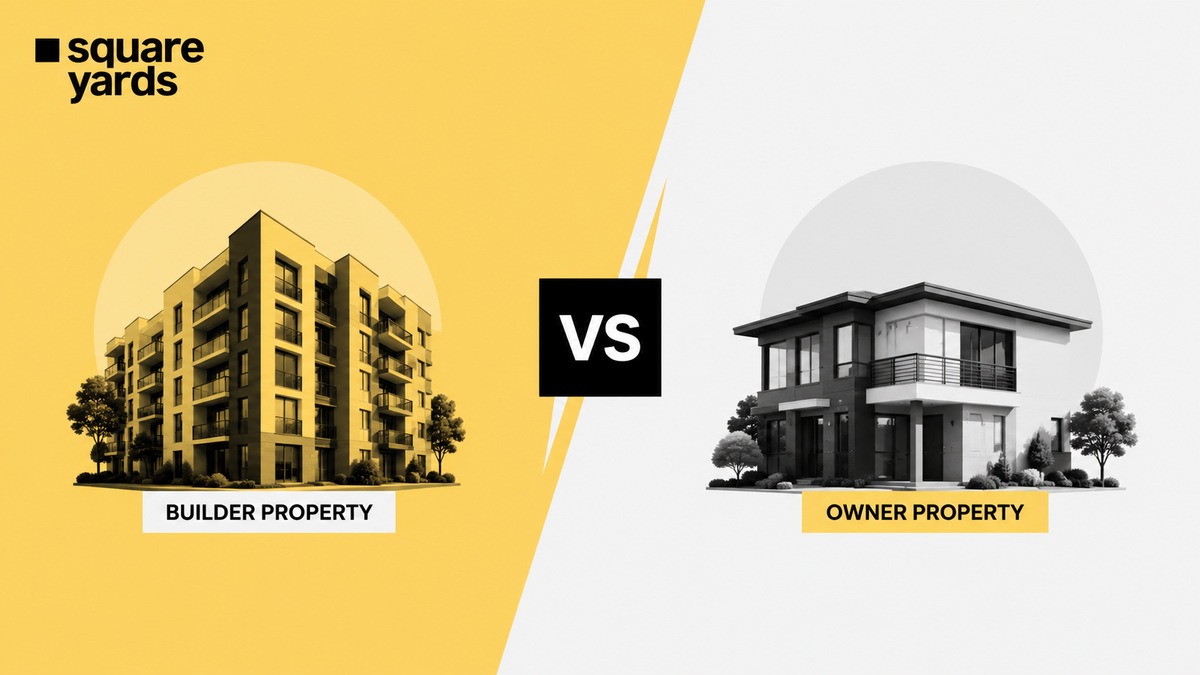
- What does builder vs owner property actually mean?
- Builder vs owner property: the price gap is real, but smaller than it looks
- RERA 2.0 and legal safety: where builder vs owner property splits hardest
- Documentation: the part where owner buyers actually do more work
- Possession timeline and the waiting risk
- Residential plot vs residential flat: the bigger comparison hiding inside this one
- Amenities, community, and the resale future
- How a Hyderabad family decided between a builder launch and a resale unit
- Builder vs owner property: the quick decision matrix
What does builder vs owner property actually mean?
Strip the jargon and the choice is simple. Buying from a builder means buying a fresh unit, usually in an under-construction or recently completed project, directly from the developer. The chain is short: builder, you, the bank if a loan is involved. Buying from an owner means buying a resale unit from an individual seller who has held it for some years. The chain is longer: original builder, previous owner, current owner, you, the bank. Both lead to the same outcome (you, owning a flat). The path is different. The legal exposure is different. The price is different. And the negotiation is very different.
Builder vs owner property: the price gap is real, but smaller than it looks
Headline prices show builder units quoted at a 8 to 18 percent premium over comparable resale units in the same micro-market. The actual all-in price gap is narrower for three reasons.
- GST applies only to under-construction builder units. 5 percent on non-affordable, 1 percent on affordable. Ready-to-move builder units and resale owner units carry no GST. A ₹1 crore under-construction builder flat carries a ₹5 lakh GST line; a comparable resale owner flat does not.
- Stamp duty applies to both. 5 to 7 percent depending on the state. Add registration of 1 percent. This is unchanged whether you buy from a builder or an owner.
- Society transfer charges apply to owner resale. Typically ₹25,000 to ₹1 lakh depending on the society. Builder transfer is built into the cost.
- Negotiation room. Builder pricing on flagship inventory is mostly fixed, with discounts limited to closing-period offers (5 to 8 percent). Owner pricing has more room, especially if the seller has timeline pressure (15 to 20 percent has happened on motivated sellers).
Run the all-in number both ways before comparing. Builder asking price plus GST plus brokerage plus stamp duty. Owner asking price plus stamp duty plus society transfer plus brokerage. The gap often collapses by half once you do the math honestly.
RERA 2.0 and legal safety: where builder vs owner property splits hardest
This is the part most buyers underestimate. Builder property under RERA 2.0 (March 2026). Pre-launch compliance certificate is mandatory. 70 percent of buyer funds sit in escrow. Third-party audits run on every project. The national portal collects complaints. Defect liability runs five years. If the builder fails to deliver on the promised date, you are entitled to refund plus interest. The safety floor in 2026 is the highest it has been in a decade. Owner (resale) property. The original project may or may not be RERA-registered. The transaction itself is not protected by RERA. You verify the title chain, the encumbrance certificate, the society NOC, the original sale deed, the mutation record, and any litigation pending against the property. That work is real and it costs lawyer time and registry fees. None of it is impossible. All of it is yours to do. If the original project was RERA-registered and the previous owner is selling within RERA’s defect-liability window, you inherit some protection. If it was an older project, you do not. Our how to check builder reputation guide walks through the verification checklist for resale buyers.
Documentation: the part where owner buyers actually do more work
The document set for both purchases overlaps about 70 percent. The other 30 percent is where the work concentrates. Builder property documents. Allotment letter, builder-buyer agreement, RERA registration certificate, approved building plan, commencement certificate, occupancy certificate (for ready units), completion certificate, title deed of the project land, NOCs from the relevant authorities. The builder provides almost all of these. Owner property documents. Everything above, plus: chain of title (every previous sale deed in the lineage), encumbrance certificate (typically last 13 to 30 years depending on state), mutation record, share certificate or membership of the society, society no-objection-certificate for the sale, latest electricity and water bills, latest property tax receipts, no-dues certificate from the society, and an indemnity bond from the seller for any future claims. If any link in the chain is missing, the title is questionable. Our documents required for property registration guide lists the complete buyer-side document set.
Possession timeline and the waiting risk
Builder property splits into two sub-categories that buyers often blur together. Under-construction builder units come with a possession timeline that has historically slipped by 18 to 30 months on average across major Indian cities. RERA 2.0 has tightened this, but slippage still happens. If you are buying a 36-month possession project, plan for 42 to 48 months in your financial life. Ready-to-move builder units carry no waiting risk. They also carry no GST. The trade-off is fewer payment-plan options and a slightly thinner inventory. Owner property is, by definition, ready. You can move in within 60 to 90 days of agreement-to-sale, subject to society NOC and registration timelines. For buyers in a hurry (job relocation, school admission, lease expiry), owner property removes the timeline anxiety entirely. Our ready-to-move vs under-construction property guide unpacks the timeline math in detail.
Residential plot vs residential flat: the bigger comparison hiding inside this one
While we are on builder vs owner, the question that often runs alongside is residential plot vs residential flat. Both can come from a builder (a registered layout sells plots) or an owner (a plot already in private hands). The plot vs flat decision changes the entire builder vs owner conversation. Plots from a builder come with a registered layout, approved by the local authority, with utilities laid out. Plots from an individual owner carry the same title-chain verification problem as resale flats, but amplified, because plots are often older land parcels with longer title histories. A residential plot vs residential flat decision usually pivots on three lenses. Land share (a plot is 100 percent land, a flat is a fraction of the building’s land share). Timeline (a flat is move-in ready, a plot needs construction). Risk profile (plot title chains are longer, flat title chains are shorter). For most first-time buyers in tier-1 cities, a flat is the lower-friction option. For long-horizon investors in tier-1 outskirts, plots compound on land value. Our flat vs plot which is better guide covers this comparison end-to-end.
Amenities, community, and the resale future
Builder property in 2026 typically sits in a gated society with amenities baked in: clubhouse, gym, pool, kids’ play area, security, power backup. The amenities are new, the systems are under warranty, and the maintenance fund is fresh. Owner property in a 7-to-15-year-old society has lived-in amenities. Sometimes that means more mature trees and a quieter neighbour profile. Sometimes that means a clubhouse that has not been refurbished since handover. Walk the society at three different times of day before deciding. For resale future, builder property in a brand-new project depreciates as a building over the first 5 to 7 years, then stabilises as the location matures. Owner property in a 10-year-old society has already absorbed most of that depreciation and trades closer to land value. Over a 10-year hold, the total returns often converge.
How a Hyderabad family decided between a builder launch and a resale unit
This is the comparison conversation we have most often. They were a Hyderabad couple in their late thirties, both senior data engineers at a financial-services firm in Gachibowli, two children in international school, family budget ₹1.6 crore with a 6-year timeline before a possible Bengaluru move. They came in with two shortlists in Whitefield-equivalent Hyderabad (Kondapur and Tellapur). One was a builder launch with a 30-month possession timeline at ₹1.55 crore plus GST plus the usual extras. The other was a 4-year-old owner resale unit at ₹1.35 crore all-in, in a society that already had a working gym, school bus pickup, and a stable maintenance committee. The advisor asked them to put two numbers next to each other. The all-in price of the builder unit including GST, brokerage, and 30 months of rent they would continue paying. The all-in price of the resale unit including stamp duty, society transfer, and zero rent (because they would move in within 60 days). The gap reversed. The resale unit came out ₹6 lakh cheaper after the rent-paid-during-waiting was added. The advisor also walked them through the title chain of the resale unit (clean, two previous owners, encumbrance verified). They bought the resale unit. Three weeks later they moved in. School bus changes were easier because the society already had the route.
“We had bookmarked the builder launch for two months. It looked cheaper on paper. The Square Yards advisor showed us the all-in cost including 30 months of paying rent while the project completed. The resale unit was actually the better deal, the title was clean, and we moved in within three weeks. Builder is not automatically the safer choice. Owner is not automatically the cheaper one. The math only shows up when you do it properly.”
A small note on this story. The buyer’s real name and a few identifying details have been changed to protect the privacy of our customers. The story and the outcome are real, shared with the buyer’s written consent.
Builder vs owner property: the quick decision matrix
If the rest of the guide is too long, this is the cheat sheet.
- Lean builder property if you want RERA 2.0 protection, do not have a date-certain move-in deadline, want fresh amenities, and prefer a fixed sticker price over negotiation.
- Lean owner property if you need to move in within 90 days, have negotiation appetite, can verify a title chain (or hire a lawyer who can), and prefer a lived-in neighbourhood with predictable maintenance.
- Pick “either, but verified” if you are an NRI or a first-time buyer. The asset type matters less than the title chain, the RERA status, and the legal review. Both can be safe. Neither is automatically safe.
If you would like a side-by-side comparison run on a builder shortlist and an owner shortlist in the same micro-market, Square Yards’ buyer advisors will produce both with the all-in numbers and the title verification status at no charge. For follow-on reading, our apartment vs independent house guide covers the parallel decision, our flat vs builder floor guide unpacks an underrated middle option, and our how to sell property without broker guide is the mirror read for understanding the seller side.
Builder vs Owner Property: Price, RERA, Negotiation and Resale FAQs
1. What is the main difference between builder vs owner property?
Builder property is a fresh unit purchased directly from the developer, with RERA 2.0 protection, fixed pricing, and a possession timeline. Owner property is a resale unit from an individual seller, with negotiation room, immediate possession, and most of the verification work falling on the buyer.
2. Is builder property safer than owner property?
For under-construction units in 2026, yes. RERA 2.0 mandates pre-launch compliance, 70 percent escrow, third-party audits, and five-year defect liability. Owner property safety depends on the buyer’s title verification quality, not on regulation.
3. Which is cheaper, builder or owner property?
Headline builder prices run 8 to 18 percent above comparable resale, but the all-in numbers often converge. Builder adds GST. Owner adds society transfer but offers 15 to 20 percent negotiation room on motivated sellers.
4. Can I get a home loan on owner property?
Yes. Banks finance resale routinely, provided the title chain is clean. Some banks cap loans at 80 percent LTV for resale. Bank-approved valuer reports may discount the asking price by 5 to 10 percent.
5. What documents differ between builder and owner property purchase?
Builder purchases need allotment letter, builder-buyer agreement, RERA certificate, approved plan, commencement certificate, OC, and CC. Owner purchases additionally need chain of previous sale deeds, encumbrance certificate, society NOC, mutation record, no-dues certificate, and seller indemnity bond.
6. What is residential plot vs residential flat in this context?
Plots from a registered builder layout carry approved utilities and cleaner title. Plots from individual owners carry longer verification work. Flats are quicker to move into. For long-horizon investors plots compound on land; for move-in-soon buyers flats reduce friction.
7. How long does possession take for builder vs owner property?
Under-construction builder units carry 24 to 48 month possession timelines (with historical slippage of 18 to 30 months). Ready-to-move builder units hand over in 60 days. Owner property registers and hands over in 60 to 90 days.
8. Is resale property a good investment in 2026?
For buyers seeking immediate possession, lived-in amenities, and negotiation leverage, yes. Resale property in a 7-to-15-year-old society has absorbed most building-depreciation and tracks closer to land value, delivering comparable 10-year returns with less timeline risk.