
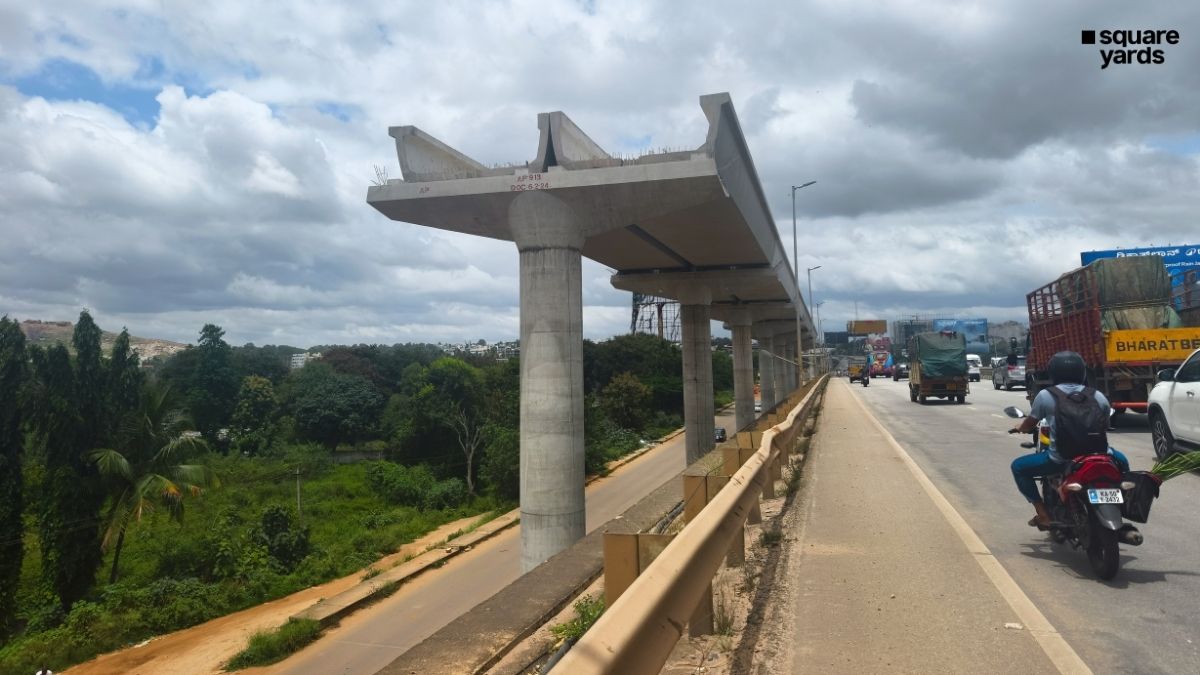
Once primarily Bengaluru’s airport suburb, Devanahalli is now emerging as one of India’s most closely watched urban expansion corridors. As infrastructure projects, industrial investments and deep-tech ambitions accelerate across North Bengaluru, Devanahalli is increasingly being discussed as Bengaluru’s potential equivalent of Gurugram. An airport-led growth corridor where infrastructure, employment and real estate expansion converge to reshape the metropolitan landscape.
But unlike Gurugram’s largely market-driven rise, Devanahalli’s transformation is unfolding through a more deliberate combination of state-backed infrastructure planning, industrial policy and metropolitan decentralization. Between 2024 and 2035, the corridor is steadily positioning itself as Bengaluru’s largest long-horizon urban growth zone, integrating airports, logistics, manufacturing, semiconductor ambitions and township development into a single emerging economic ecosystem.
From peripheral land to strategic growth corridor
At the center of this transformation lies Karnataka’s broader satellite city strategy. The state government has identified Devanahalli and the surrounding northern clusters as key pressure-release zones for Bengaluru’s increasingly saturated urban core.
The objective is not merely outward expansion, but the creation of self-sustaining economic districts supported by transport integration, employment decentralization and planned urbanization.
Infrastructure sequencing is differentiating Devanhalli from many of Bengaluru’s earlier growth corridors. Historically, much of Bengaluru’s expansion occurred in reverse order: residential density arrived first, while roads, transit systems, sewage capacity and civic infrastructure struggled to catch up years later. North Bengaluru, however, is being anchored first by large-scale infrastructure investment before full-scale population absorption takes place.
Key drivers include the expansion of Kempegowda International Airport, connectivity to the Satellite Town Ring Road (STRR), integration of peripheral and suburban rail, proposed metro connectivity, Aerospace and hardware manufacturing clusters, and emerging semiconductor and deep-tech investment zones. Together, these projects are gradually transforming the region from speculative peripheral land into a strategic employment and logistics corridor.
Beyond IT parks: The rise of a hybrid economic ecosystem
One of the biggest shifts driving renewed attention toward Devanahalli is the emergence of industrial and technology ecosystems beyond Bengaluru’s traditional IT park model. Karnataka’s proposed deep-tech park near Jangamakote is expected to support sectors such as semiconductors, robotics, aerospace, EV manufacturing and defense technology. Simultaneously, airport-linked logistics, warehousing, and industrial activity continue to expand across the northern belt. This distinction matters because Devanahalli’s urbanization trajectory differs fundamentally from Whitefield’s original IT-led growth cycle.
Rather than being dependent on a single office-sector economy, the corridor is evolving into a hybrid structure that combines logistics, manufacturing, airport-economy functions, and technology-linked employment. As a result, urban demand may emerge in a more distributed manner across plotted developments, integrated townships, rental housing, hospitality and commercial support infrastructure.
In many ways, the region reflects a broader shift underway across Indian cities, where infrastructure and industrial policy are beginning to shape urban growth as much as conventional residential demand does.
Real estate markets are already pricing in the future
Real estate markets have already begun responding aggressively to Devanahalli’s long-term infrastructure and employment potential. According to multiple market trackers, average residential prices across the broader Devanahalli belt have appreciated significantly over the past five to six years, driven by airport-led development, industrial expansion, and growing investor interest.
What is particularly notable, however, is the emergence of pricing differentiation within North Bengaluru’s micro-markets themselves. Recent locality-level data indicate that several pockets along the corridor are already crossing the ₹10,000- ₹12,000 per sq ft range. Chikkajala has reportedly touched nearly ₹14,400 per sq ft, while areas such as Navarathna Agrahara, Sadahalli and Budigere continue to witness strong appreciation trends linked to infrastructure connectivity and airport proximity.
This matters because mature urban corridors typically begin to show micro-market stratification only after infrastructure and employment clusters begin to influence land valuation patterns differently across locations.
In Devanahalli’s case, that transition appears to already be underway. At the same time, much of the current market activity remains fundamentally future-oriented. Large sections of demand continue to be driven by anticipated infrastructure and employment growth rather than existing liveability or mature urban density. This creates both opportunity and risk.
Can Devanahalli avoid Gurugram’s urban mistakes?
The biggest question surrounding Devanahalli is no longer whether growth will happen; that process is already visible. The more important question is whether Bengaluru can execute metropolitan-scale decentralization without repeating the fragmented urban patterns seen across parts of Gurugram and East Bengaluru.
Water sustainability, speculative land inflation, transit dependency and disconnected urban planning remain central concerns. Across investor and urban planning discussions, questions continue to emerge about liveability gaps, oversupply risks, and pricing that may be outpacing actual population absorption.
The corridor’s success will therefore depend not only on infrastructure announcements but on the synchronization of governance, civic capacity and employment generation.
If infrastructure delivery and economic activity remain aligned over the next decade, Devanahalli could evolve into Bengaluru’s first truly integrated airport-led satellite urban district.
If not, the region risks becoming another fragmented speculative growth belt characterized by disconnected residential inventory, infrastructure lag and uneven urbanization.
Bengaluru’s most important urban experiment
Devanahalli today is becoming one of India’s clearest examples of infrastructure-led urban transformation unfolding in real time, where airports, highways, industrial policy, logistics networks and technology investment are collectively reshaping the future geography of metropolitan Bengaluru.
The larger urban question, therefore, is not whether North Bengaluru will grow. It is whether Bengaluru can finally execute planned decentralization at a metropolitan scale before congestion, speculation and infrastructure stress once again outpace the city’s ability to sustain them.