

Buy a flat in Gachibowli or a plot in Kokapet, and the price you negotiate is only part of the bill. Before the property is legally yours, the state wants its cut too, and in Hyderabad that cut is about 6 percent. On a Rs 1 crore flat, that means you lose close to Rs 6 lakh before you even think about GST on an under-construction unit.
This piece walks through what you’ll actually pay in 2026, how the number is worked out, and two things buyers keep googling right after: gift deed charges and stamp duty on a car loan, which is an entirely different animal.
- What is Stamp Duty?
- Stamp Duty and Registration Charges in Hyderabad
- Registration Rates and Stamp Duty Value of Property in Hyderabad
- How Do You Calculate Stamp Duty Charges?
- What stamp duty actually is
- The 2026 rates
- Is there a women’s concession?
- Working the numbers
- About that registration cap
- Gifting property to family costs a lot less
- GST on under-construction flats
- What you’ll need at the Sub-Registrar Office
- How to pay the Stamp Duty and Registration Fee in Hyderabad
- A tax deduction you can actually claim
- Quick Reference
- Conclusion
What is Stamp Duty?
Governments impose a charge known as stamp duty on legal papers, typically when assets or property are transferred. Documents required to legally record specific sorts of transactions are subject to stamp charges, usually referred to as stamp taxes, by governments. Legal records of weddings, military commissions, and the sale or transfer of property are included in this category. Similar to income tax, stamp duty is also collected by the government. A stamp duty is a paid document or instrument considered legal and can be admitted as evidence in courts. Documents that have not been properly stamped are not admissible as evidence by the court. Stamp Duty under Section 3 of the Indian Stamp Act, 1899 is payable and must be paid in full and on time. A penalty is levied if there’s a delay in the payment of stamp duty.
Stamp Duty and Registration Charges in Hyderabad
While purchasing a property, a salient factor to consider is the registration and stamp duty charges. The combination of Stamp Duty and Registration Charges increases your budget considerably, and they differ in different states. They are mandated primarily to validate the sale of the property and maintain a record of the purchase.
The stamp duty in Hyderabad and registration charges are mentioned in the table below:
| Type of Fee | Amount |
| Registration Fees | 0.5 percent of the property value |
| Stamp duty | 4 percent of the property value |
| Transfer duty | 1.5 percent on property value |
| Transfer and Stamp duty due on | Consideration or MV, whichever would be higher |
Registration Rates and Stamp Duty Value of Property in Hyderabad
It is a must for buyers to be aware of the stamp duty and registration rates in Hyderabad before proceeding to purchase a particular property since the amount can add significantly to the final price. Stamp duty remains the same throughout the state. Individuals need to pay a stamp duty worth 4% of the property value on all kinds of property purchases in Hyderabad. Besides, individuals also need to pay property registration charges in Hyderabad, applicable at 0.5% of the property value.
How Do You Calculate Stamp Duty Charges?
A person needs to calculate the stamp duty and registration rates in Hyderabad to calculate the final property price. Here is a simple example demonstrating the calculation process.
If a person plans to buy an apartment or a house worth Rs. 40 lakh, they would need to pay the stamp duty at 4%.
On top of that, the buyer also needs to pay 0.5% of the house registration charges in Hyderabad. Hence, the buyer must pay the stamp duty of 4% of Rs.40 lakh, which will be Rs.1.6 lakh.
Additionally, they will need to pay the plot registration charges, which will be 0.5% of Rs.40 lakh, which amounts to Rs.20,000. Hence, the person will incur an additional Rs. 1,80,000 as stamp duty and registration rates in Hyderabad on top of the original property price.
What stamp duty actually is
Stamp duty is a tax the Telangana government charges on the document that transfers property, usually the sale deed. It’s collected under the Indian Stamp Act, 1899, and it makes your deed hold up as legal evidence if anyone ever disputes it.
Registration is a separate thing. Under the Registration Act, 1908, the deed gets recorded at the Sub-Registrar Office, which puts it into the public record. Stamp duty makes the paper legal. Registration is what gets it on file. And because Hyderabad sits inside GHMC or another municipal limit, there’s a third charge on top: transfer duty, which most other Indian cities don’t bother with.
So you’re paying three things, all on the same base value. Stamp duty legalises it, registration records it, and transfer duty goes to the local municipal body.
The 2026 rates
Here’s the breakdown for a standard urban sale deed in Hyderabad:
|
Charge |
Rate |
Goes to |
|
Stamp duty |
4% |
State government |
|
Transfer duty |
1.5% |
GHMC / local municipal body |
|
Registration fee |
0.5% |
Recording the deed |
|
Total |
~6% |
Paid by the buyer |
All three get calculated on whichever is higher: your agreement value or the government’s guidance value for that locality (sometimes called market value or circle rate). You can’t get around this by writing a lower figure on the deed; the sub-registrar checks the guidance value regardless.
You’ll sometimes see a site quote 5.5 percent instead of 6. That’s not a discount; it’s just people lumping the 4 percent stamp duty and 1.5 percent transfer duty together before adding registration separately. Add it up either way and you land at the same 6 percent.
Is there a women’s concession?
No, and this rule trips up many buyers coming from Delhi or Maharashtra, where women get a lower rate. Hyderabad doesn’t do that. Everyone pays the same 4 + 1.5 + 0.5, whether the property is registered in a man’s name or a woman’s. If a calculator online shows you a lower rate for a female buyer, it’s wrong. Check IGRS Telangana directly before you trust a number.
Working the numbers
Rs 50 lakh flat, Kukatpally
- Stamp duty (4%): Rs 200,000
- Transfer duty (1.5%): Rs 75,000
- Registration (0.5%): Rs 25,000
- Total: Rs 300,000
Rs 80 lakh apartment, Gachibowli
- Stamp duty (4%): Rs 320,000
- Transfer duty (1.5%): Rs 120,000
- Registration (0.5%, cap applies): Rs 30,000
- Total: Rs 470,000
Rs 1 crore property
- Stamp duty (4% ): Rs 400,000)
- Transfer duty (1.5%): Rs 150,000
- Registration (0.5% cap applies): Rs 30,000
- Total: Rs 580,000
Worth keeping in mind for your budget: home loans generally don’t cover these costs. Keep the 6% ready from your own pocket, and if the flat is under construction, add GST on top of that.
About that registration cap
The 0.5% registration fee isn’t unlimited. It starts at around Rs 1,000 minimum and tops out around Rs 30,000, so once your property crosses roughly Rs 60 lakh in value, you’re paying the capped amount rather than a growing percentage. On a Rs 1 crore flat, a straight 0.5 percent would be Rs 50,000, but the cap brings it down to about Rs 30,000. Stamp duty and transfer duty don’t have this cap, so they’re what really drives the cost up as property values rise. Confirm the exact cap on IGRS Telangana since it does get revised.
Gifting property to family costs a lot less
A gift deed transfers property with no money changing hands, and the rate depends entirely on who’s receiving it.
Gift it to a close blood relative, and you’re looking at a concessional rate, commonly cited around 1 to 2 percent, plus a nominal Rs 1,000 or so registration fee. On a Rs 50 lakh property that’s roughly Rs 50,000 to Rs 100,000, against Rs 300,000 for a straight sale. Big difference.
Gift it to anyone outside the family, though, and it’s treated exactly like a sale: 4% stamp duty, 1.5% transfer duty, and 0.5% registration. Sources differ a bit on the exact family concession rate, so check IGRS Telangana and state the relationship clearly on the deed before you go ahead. And a gift from a specified relative is exempt from income tax under Section 56(2)(x), which is a handy bonus most people don’t know about.
GST on under-construction flats
If you’re buying something that is still being built, GST is added on top of all these costs. Developers charge 5% GST without input tax credit, or 12% with it, and affordable housing gets a lower slab. Ready-to-move flats with an occupation certificate skip GST entirely. Add it up on an under-construction purchase and your total acquisition cost can run to 11 or 12% above the base price, once stamp duty and GST are both in.
What you’ll need at the Sub-Registrar Office
Both buyer and seller, plus two witnesses, need to show up in person for biometric verification. Bring originals and self-attested photocopies of everything, or the registration simply won’t happen that day.
Personal documents: Aadhaar, PAN, recent photographs, and a second ID like voter card or driver’s license for everyone present.
Property documents: the sale deed itself (drafted at the correct value and e-stamped beforehand), the stamp duty challan paid via SBI ePay, a fresh Encumbrance Certificate from IGRS showing no pending charges, the chain of earlier registered deeds establishing ownership, and the latest property tax receipts with nothing outstanding. New or completed projects also need the Occupation Certificate or RERA registration.
Before you agree on a price, look up the guidance value for that exact street or layout on IGRS Telangana. You can avoid a surprise reassessment at the counter by matching the guidance value, since duty is charged on whichever is higher.
How to pay the Stamp Duty and Registration Fee in Hyderabad
Hyderabad uses IGRS Telangana, so you can do registration online at home comfortably instead of going to the registrar’s office again and again.
Step 1: Go to the Telangana Registration and Stamps department portal and look under the “Online Services” section for “E-payments.”
Step 2: A new page, registration.telangana.gov.in/estamps.htm, will be opened for you to access. when three choices are presented to you are presented to you as:
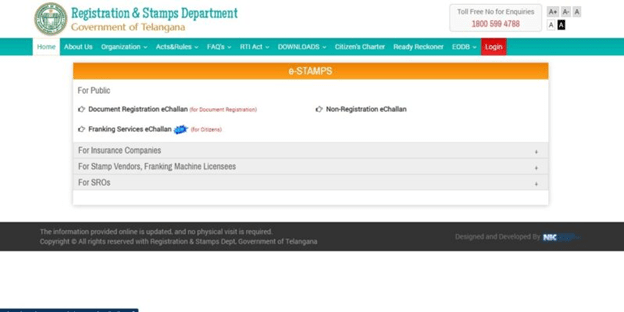
- E-challan for document registration
- E-challan for non-registration
- Services e-challan for franking
To register documents for property, select the first choice, enter the necessary information (including the remitter’s information, the party’s information, the document’s information, and the amount remitted), and then click the “register” button.
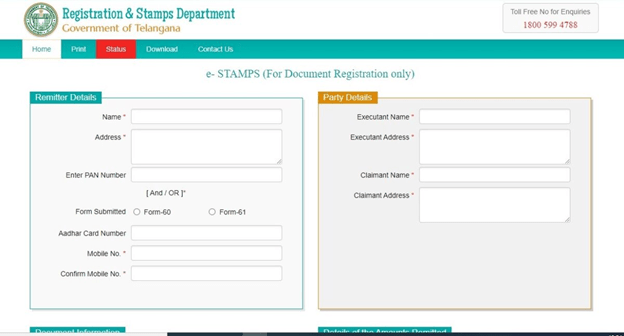
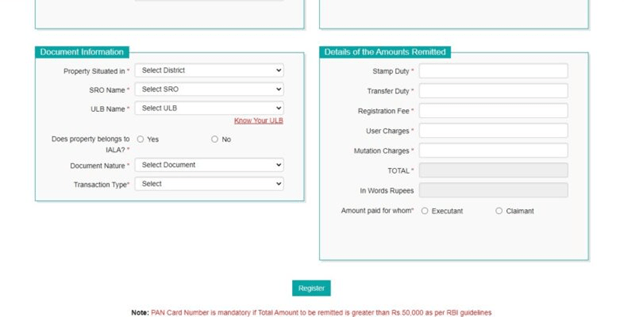
Step 3: Register your profile. You’ll receive an SMS with a 12-digit challan number and a five-digit passcode when you do this. Save this information for a future use.
Step 4: After signing up, go to the payment choice form to print the details of the challan number and passcode.
Step 5: After visiting the disclaimer page and accepting it, you will be led to SBI ePay, where you may choose to make your payment either online or offline.
Step 6: To make an online payment, choose NEFT, Net Banking, or a debit or credit card.
Step 7: The user receives a “successful” status message after inputting the payment credentials and providing the required information. The system will then generate a duplicate challan with the SBIePay confirmation reference number. During the property registration, the User must print the challan and deliver the SRO copy to the sub-registrar along with the required paperwork.
Please be aware that the Registration & Stamps Department does not license any intermediaries to conduct transactions relating to registration and stamp duty. The only person to whom you must directly pay the duties and fees related to the property is the SRO.
Stamp Duty Charges in Other States
| State | Stamp Duty Charges |
| Mumbai | Stamp Duty in Mumbai |
| Goa | Stamp Duty in Goa |
| Kerala | Stamp Duty in Kerala |
| Punjab | Stamp Duty in Punjab |
| Jammu & Kashmir | Stamp Duty in Jammu & Kashmir |
| Noida | Stamp Duty in Noida |
| Rajasthan | Stamp Duty in Rajasthan |
| Chhattisgarh | Stamp Duty in Chhattisgarh |
| Bangalore | Stamp Duty in Bangalore |
| Gujarat | Stamp Duty in Gujarat |
| Jharkhand | Stamp Duty in Jharkhand |
A tax deduction you can actually claim
Stamp duty and registration on a residential property qualify for a deduction of up to Rs 150,000 under Section 80C in the year you pay it. It only applies to residential property (not commercial or a bare plot) and only if you’re on the old tax regime; the new regime doesn’t allow it. Joint buyers can each claim their share within the overall limit, so it’s worth checking with a tax adviser which regime actually works out better for you.
Quick Reference
|
Property value |
Stamp duty (4%) |
Transfer duty (1.5%) |
Registration |
Total |
|
Rs 40 lakh |
Rs 160,000 |
Rs 60,000 |
Rs 20,000 |
Rs 240,000 |
|
Rs 50 lakh |
Rs 200,000 |
Rs 75,000 |
Rs 25,000 |
Rs 300,000 |
|
Rs 80 lakh |
Rs 320,000 |
Rs 120,000 |
Rs 30,000 |
Rs 470,000 |
|
Rs 1 crore |
Rs 400,000 |
Rs 150,000 |
Rs 30,000 |
Rs 580,000 |
These figures assume your value matches or beats the guidance value for that locality. Rates and caps do get revised, so confirm the current numbers on IGRS Telangana before you finalize a budget.
Conclusion
Property in Hyderabad costs about 6 percent more than the sticker price once stamp duty, transfer duty, and registration are added; there is no gender concession and no way around the guidance value. Gifting to family is far cheaper than selling. Car loan stamp duty has nothing to do with any of these fees. And if you’re buying under construction, GST is a separate line item again.
Check the guidance value first, pay everything online through SBI ePay, book your slot, and don’t forget mutation after registration. Do all that, and the actual registration day is fairly painless.