
Budget for around 7 percent over and above the price you agree on, if you’re a man buying property in Odisha. Women get a slightly better deal at 6 percent. That gap alone is worth knowing before you start negotiating, because it changes how much cash you need on hand at the Sub-Registrar Office.
Odisha splits this cost into two separate charges: stamp duty on the sale deed itself and a registration fee for recording that deed in government records. Miss either one, and the transfer isn’t legally valid, no resale, no loan against the property, nothing. Here’s how the numbers actually work, where people get confused, and what the process looks like end to end.
- Stamp Duty vs Registration: Two Different Things
- Stamp Duty in Odisha: The Basic Rates
- Wait, Is Registration 1 Percent or 2 Percent?
- The Women’s Concession
- Benchmark Value: The Number That Actually Decides Your Bill
- Running the Numbers
- Gift Deeds Work Differently
- How to Calculate Stamp Duty Registration Charges in Odisha?
- Stamp Duty Online Payment for E-Samping
- Property Registration Charges: The Same for Everyone
- Rates by Deed Type
- What’s Changed in 2026
- Documents You’ll Need
- How the Process Actually Runs
- A Tax Break You Might Be Missing
- Quick Reference
- Conclusion
Stamp Duty vs Registration: Two Different Things
Worth untangling before the numbers, because people use these terms interchangeably and they’re not the same charge. Stamp duty is a tax on the document the sale deed collected under the Indian Stamp Act, 1899 as it applies in Odisha. The Revenue and Disaster Management Department runs this through the Inspector General of Registration, IGR for short.
Registration is a separate matter, governed by the Registration Act, 1908. Paying it is what gets your deed physically entered into government land records at the local Sub-Registrar Office. Stamp duty makes the document legal. Registration is what gives it legal effect. You need both, and in Odisha, both are calculated the same way based on the higher of your sale price or the benchmark value.
Stamp Duty in Odisha: The Basic Rates
Stamp duty in Odisha depends on who’s buying.
- Male buyer: 5 percent
- Female buyer: 4 percent
- Joint ownership (male and female together): 4.5 percent
On top of that, everyone pays a 2 percent registration fee, regardless of gender. Add it up and a man pays about 7 percent total, a woman pays about 6 percent, and a joint purchase lands at 6.5 percent. These charges apply to whichever is higher your actual sale price, or the government’s benchmark value for that land. More on that below.
Wait, Is Registration 1 Percent or 2 Percent?
This trips up many buyers, and honestly, it’s not their fault. Search around and you’ll find calculators quoting 1 percent registration for Odisha. That number is correct for plenty of other states, but not this one. Odisha charges 2 percent, full stop, and it’s confirmed by the IGR Odisha rate structure.
The gap matters more than it sounds. On an Rs 60 lakh property, that’s a difference of Rs 60,000 money you’d rather not discover you’re short of on registration day. When planning your budget, make sure any calculator you use is pulling from the official IGR Odisha tool, not a generic pan-India estimate.
The Women’s Concession
Odisha has offered women a 1 percent discount on stamp duty since 2014 as a nudge toward getting more property registered in women’s names. A woman pays 4 percent stamp duty instead of 5 percent. The registration fee doesn’t change that 2 percent applies to everyone equally so the entire benefit shows up in the stamp duty line.
On a Rs 50 lakh flat, that’s Rs 200,000 in stamp duty for a woman against Rs 250,000 for change; That’s Rs 50,000 saved, just by whose nameequally,the deed. Families sometimes register jointly or in the wife’s name purely for this reason, and honestly, given the size of the saving, it’s a reasonable thing to think about early rather than after the deed is drafted.
Benchmark Value: The Number That Actually Decides Your Bill
Here’s the part people skip and then regret. Odisha calculates stamp duty and registration on whichever is higher: your negotiated price or the government’s benchmark value (what other states call “circle rate” or “guideline value”). This benchmark isn’t set per plot; it’s fixed at the village and Kisam (land classification) level, so two plots in the same village with the same classification carry the identical benchmark figure.
Say you agree to buy land for Rs 15 lakh, but the benchmark value for that village and Kisam works out to Rs 18 lakh. You don’t pay duty on Rs 15 lakh. You pay it on Rs 18 lakh. That’s a real budget shock if you find out at the counter instead of beforehand. Check the benchmark value on the IGR Odisha portal before you finalize a price, not after.
Running the Numbers
A Rs 50 lakh property, male buyer:
|
Item |
Amount |
|
Stamp duty (5%) |
Rs 250,000 |
|
Registration fee (2%) |
Rs 100,000 |
|
Total |
Rs 350,000 |
Same property, female buyer:
|
Item |
Amount |
|
Stamp duty (4%) |
Rs 200,000 |
|
Registration fee (2%) |
Rs 100,000 |
|
Total |
Rs 300,000 |
And for a Rs 1 crore property, a male buyer is looking at Rs 500,000 in stamp duty plus Rs 200,000 in registration, for a total of Rs 700,000. That’s not a small number, and home loans typically don’t cover it. Keep that cash separate from your down payment.
Gift Deeds Work Differently
Transferring property as a gift instead of a sale? Gift deed stamp duty in Odisha is generally around 3 percent of the benchmark value, still calculated on whichever figure is declared or whichever benchmark comes out higher. The 2 percent registration fee applies here too.
Where it gets less clear-cut is family transfers. Gifting property to a close relative can be treated differently from gifting to someone outside the family, and the exact treatment depends on the deed category and current rules, which do shift. The IGR Odisha calculator has a dedicated Gift option, so run your specific numbers there rather than assuming the 3 percent figure applies exactly to your situation. Worth knowing too: a gift received from a specified relative is exempt from income tax under Section 56(2)(x), which is separate from the stamp duty question but often comes up in the same conversation.
How to Calculate Stamp Duty Registration Charges in Odisha?
These are the step-by-step methods to use the stamp duty calculator to compute the transactions in Odisha.
Step 1: Visit the official homepage of the Odisha Revenue Department Portal.
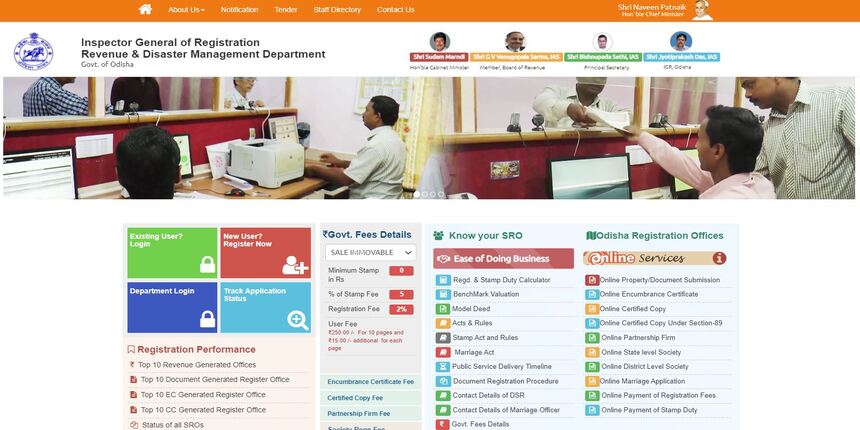
Step 2: Tap on the citizen corner for the option of Stamp Duty and Registration Calculator.
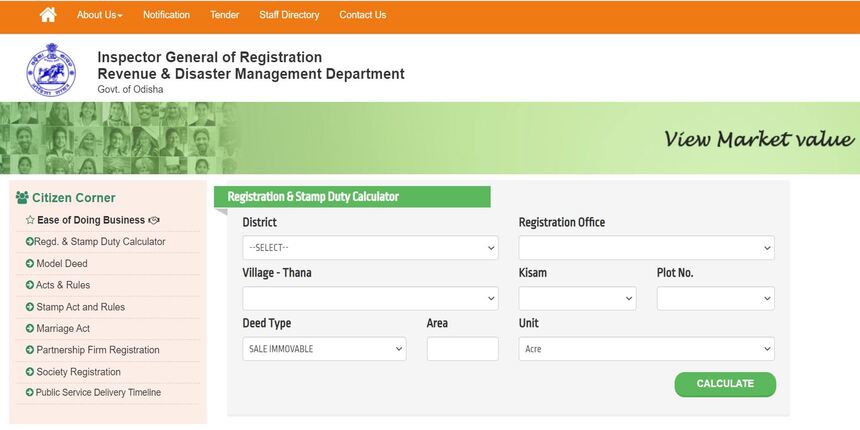
Step 3: Fill in the mandatory information such as the district or village and the registration office from the given dropdown.
Step 4: Next, you need to provide the plot number allotted to you.
Step 5: Tap on the ‘Search Button’.
Step 6: You will now be able to see the stamp duty charge for your particular property on your screen.
Another method that can be used for payment of your stamp duty and registration charge is through the SHCIL portal i.e. the agency allotted by the government for your e-stamping.
Stamp Duty Charges in Other States
| State | Stamp Duty Charges |
| Maharashtra | Stamp Duty in Maharashtra |
| Gujarat | Stamp Duty in Gujarat |
| Uttar Pradesh | Stamp Duty in Uttar Pradesh |
| West Bengal | Stamp Duty in West Bengal |
| Delhi | Stamp Duty in Delhi |
| Haryana | Stamp Duty in Haryana |
| Rajasthan | Stamp Duty in Rajasthan |
| Mumbai | Stamp Duty in Mumbai |
| Gurgaon | Stamp Duty in Gurgaon |
| Pune | Stamp Duty in Pune |
Stamp Duty Online Payment for E-Samping
“These are the step-by-step methods that can easily help you in paying your stamp duty for e-stamping:
Step 1: In case you are new to the SHCIL portal, simply tap on the ‘Register Now’ tab and proceed further.
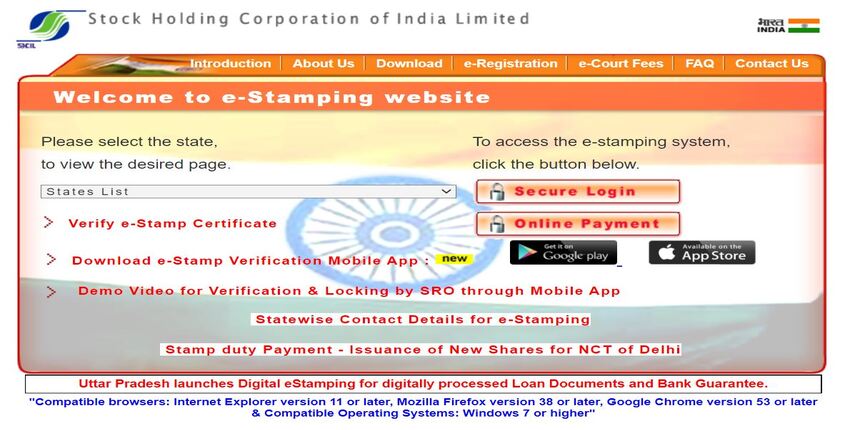
Step 2: Fill up all the necessary information.
Step 3: Select your user ID and password along with filing the security questions asked, next fill up your bank details, and move forward.
Step 4: Once you are done selecting your user ID and password, you can now log in using the same.
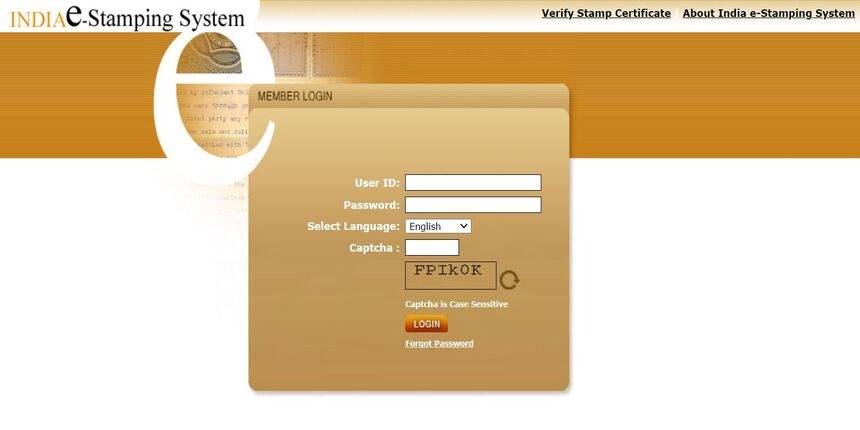
Step 5: Choose the state from the given drop down for which you require to pay the stamp duty.
E.g.: If it’s for Uttar Pradesh, you will select the same from the drop-down and then further choose the ‘Nearest SHCIL Branch’ after which you are required to fill in some details such as:
⮚ First Party Name
⮚ Second Party Name
⮚ Article Number
⮚ The name of the person who paid the stamp duty.
⮚ The amount of the stamp duty
All the above details need to be filed accurately in order to generate your ‘Online Reference Acknowledgement Number’.”
This is done to pay any kind of amount through modes of Net Banking, RTGS, Debit Card, EFT, and NEFT.
Step 6: A citizen is then required to print this ‘Online Reference Acknowledgment Number’ and pay a visit to his/her most accessible SHCIL Branch to get its final copy of the e-stamp certificate.
Services Provided on Odisha Portal
There are various services that the IGR Odisha has come up with to make the job of homeowners easy:
⮚ Land Records of the Owners Property
⮚ Sale deed structure for Odisha property registration.
⮚ Provides with e-stamping certification.
⮚ Stamp Duty Charge Calculator
Property Registration Charges: The Same for Everyone
Unlike stamp duty, property registration charges in Odisha don’t change based on who’s buying or what kind of property it is. It’s 2 percent across the board, man, woman, joint ownership, flat, or plot, it doesn’t matter. You can pay it online through Odisha Treasury or e-Challan, or in person at the Sub-Registrar Office.
On an Rs 75 lakh property, that’s Rs 150,000 just for registration, separate from stamp duty. It’s what gets your name into the public record which is what makes the property yours in any way that holds up later, for resale or for a loan. One thing people forget: registration doesn’t automatically update land records. You still need to apply for mutation separately once the deed is registered.
Rates by Deed Type
Sale deeds get most of the attention, but the IGR Odisha calculator handles several other instrument types too.
- Sale/conveyance deed: 5% (male), 4% (female), 4.5% (joint), plus 2% registration
- Gift deed: around 3% of benchmark value, plus registration
- Exchange deed: charged per the schedule, on benchmark value
- Partition deed: on the value of the separated shares
- Settlement deed: depends on the deed schedule and relationship
- Power of attorney with possession: charged on property value
Rates for these get revised now and then, so confirm the current figure for your exact deed type on the calculator before you draft anything.
What’s Changed in 2026
A few reforms have made registration less painful this year. Tehsil-level registration offices now exist, so you no longer have to travel to a district headquarters. Part-plot registration is available for plots under 500 square metres, which used to be a real hassle. Apartment buyers get clearer rules on registering common areas. And you can now book your Sub-Registrar slot online through eRegistration Odisha instead of showing up and waiting. E-stamping through authorised vendors and SBI gives you a certificate that you can verify instantly, too.
Documents You’ll Need
Bring originals plus self-attested photocopies of everything. Buyer, seller, and two witnesses all need to show up in person.
For identity: Aadhaar for everyone involved, PAN card (mandatory for both buyer and seller), recent passport-size photographs of buyer, seller and both witnesses, and a secondary address or ID proof voter ID, driving licence or passport for every party and witness.
For the property itself: the sale or gift deed drafted for the correct value and executed on the e-stamp, a khata certificate from the seller confirming the record is in their name, an encumbrance certificate the buyer should check confirms there are no prior liabilities, the Record of Rights or Patta pulled from Bhulekh Odisha, and property tax receipts showing no dues pending. You’ll also want to have the benchmark value reference on hand, and apartments or any built-up property additionally need the sanctioned building plan.
Missing even one of these usually means you’re not registering that day so it’s worth double-checking a week ahead, not the morning of.
How the Process Actually Runs
Start by checking the benchmark value and running your numbers on the IGR Odisha calculator. Pay the stamp duty through e-Stamping and the registration fee via Odisha Treasury or e-Challan. Book your Sub-Registrar Office slot on eRegistration Odisha. Show up with both parties, two witnesses, and every document listed above. Once verification’s done, you’ll get an e-receipt, an e-stamp certificate, and eventually the registered deed. Last step, and don’t skip it: apply for mutation so the land records actually reflect your ownership.
A Tax Break You Might Be Missing
If you’re on the old tax regime, stamp duty and registration on a residential property can be claimed as a deduction under Section 80C, up to Rs 1,50,000, in the year you pay it. This only applies to residential property, not commercial space or a bare plot, and the new tax regime doesn’t allow it at all. Joint buyers can each claim their share, within the overall cap. Given how much Odisha’s total charges run to, the situation is worth checking with a tax adviser rather than assuming either way.
Quick Reference
|
Property Value |
Male Stamp Duty |
Female Stamp Duty |
Registration |
Male Total |
|
Rs 30 lakh |
Rs 150,000 |
Rs 120,000 |
Rs 60,000 |
Rs 210,000 |
|
Rs 50 lakh |
Rs 250,000 |
Rs 200,000 |
Rs 100,000 |
Rs 350,000 |
|
Rs 75 lakh |
Rs 375,000 |
Rs 300,000 |
Rs 150,000 |
Rs 525,000 |
|
Rs 1 crore |
Rs 500,000 |
Rs 400,000 |
Rs 200,000 |
Rs 700,000 |
For female buyers, swap in the 4 percent stamp duty column and keep registration the same. These numbers assume your sale value is at or above the benchmark; check the actual benchmark figure for your village and Kisam before you lock in a budget.
Stamp duty and registration charges in Odisha can be significant, especially at 7 percent for a straightforward male purchase. Get the benchmark value right, know which 1 percent you’re saving if the property’s in a woman’s name, and use the official IGR Odisha calculator rather than a generic estimate. Do that, and the actual registration day is mostly paperwork.
Conclusion
Buying property in Odisha involves more than paying the purchase price—you also need to budget for stamp duty and registration charges. In most cases, male buyers pay around 7%, female buyers 6%, and joint buyers 6.5%, calculated on the higher of the sale price or the government’s benchmark value. Using the correct 2% registration fee and checking the benchmark value beforehand can save you from unexpected expenses on registration day.
Before completing your purchase, calculate the applicable charges on the official IGR Odisha portal, keep your documents ready, and complete the registration and mutation process without delay. A little preparation can help ensure a smooth, legally secure property transaction in Odisha.
Frequently Asked Questions:
1. What is the stamp duty and registration charge in Odisha in 2026?
Stamp duty is 5 percent for men, 4 percent for women and 4.5 percent for joint male and female ownership, plus a 2 percent registration fee. So the total is about 7 percent for men and 6 percent for women, calculated on the higher of your sale value or the benchmark value.
2. Is the registration fee in Odisha 1 percent or 2 percent?
The registration fee in Odisha is 2 percent of the property value, as per the IGR Odisha rate structure. Some calculators show 1 percent, which is the figure used by many other states but not Odisha. Always use the official IGR Odisha calculator, which applies the correct 2 percent.
3. What is the stamp duty in Odisha for women?
A female buyer pays 4 percent stamp duty against 5 percent for a man, a 1 percent concession introduced in 2014. The concession applies to the stamp duty only; the 2 percent registration fee is the same for everyone. On a Rs 50 lakh property, a woman saves Rs 50,000.
4. What is the gift deed stamp duty in Odisha?
Gift deed stamp duty in Odisha is calculated on the benchmark value and is commonly cited at around 3 percent, with the 2 percent registration fee also applying. Transfers within a family may be treated differently from gifts to non-relatives, so confirm the exact rate using the Gift option on the IGR Odisha calculator.
5. What is the benchmark value in Odisha?
The benchmark value is Odisha’s term for the circle rate or guideline value, the government’s minimum value at which a property can be registered. It is set at the village and Kisam level. Stamp duty is charged on the higher of your declared sale price or the benchmark value.
6. How is stamp duty calculated in Odisha?
Take the higher of your sale value or the benchmark value, apply 5 percent (male) or 4 percent (female) stamp duty, then add 2 percent registration. For a Rs 50 lakh property, a male buyer pays Rs 2,50,000 stamp duty plus Rs 1,00,000 registration, totalling Rs 3,50,000.
7. What are the property registration charges in Odisha?
Property registration charges in Odisha are 2 percent of the value, the same for men, women and joint owners, and for all property types. It is separate from the stamp duty and is calculated on the higher of the benchmark value or your sale value, paid via the Odisha Treasury or e-Challan.
8. What are the 2026 registration reforms in Odisha?
Recent reforms include tehsil-level registration offices, part-plot registration for plots under 500 square metres, apartment common-area registration, and online slot booking through the eRegistration Odisha portal. E-stamping through authorised vendors and SBI provides instantly verifiable certificates.
9. Can I pay stamp duty online in Odisha?
Yes. Stamp duty and the registration fee can be paid online through the IGR Odisha portal using net banking, debit card or credit card, with e-stamping providing an instantly verifiable certificate. You can also book your Sub-Registrar slot online through eRegistration Odisha.
10. Can I claim a tax benefit on stamp duty in Odisha?
Yes. Under Section 80C of the Income Tax Act you can claim a deduction of up to Rs 1.5 lakh for stamp duty and registration charges on a residential property, in the year of payment. It is available only under the old tax regime and only for residential house property.