
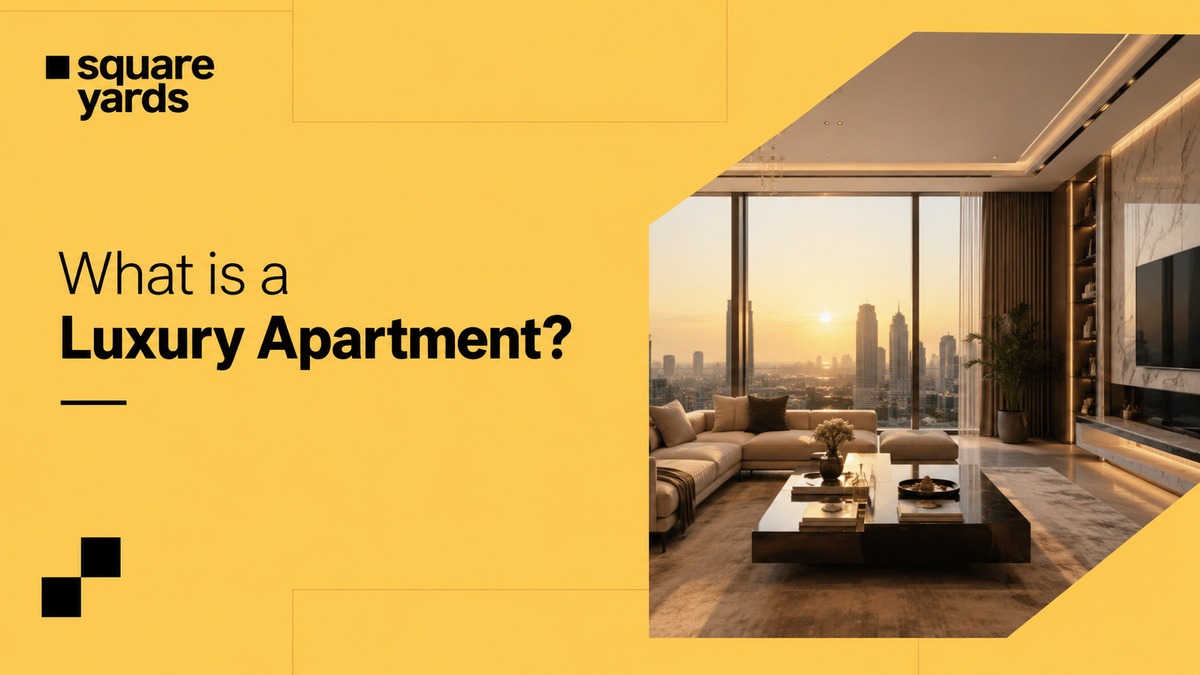
- What is a luxury apartment: the three-part definition that actually works
- Luxury apartments in Bangalore: micro-markets, developers and what Rs 2 crore actually gets
- Luxury apartments in Gurgaon: DLF 5, Golf Course Road and the ultra-luxury corridor
- Luxury apartments in Mumbai: where the price is highest and the definition is strictest
- The buyer who chose Indiranagar over Whitefield for three reasons
- Price brackets and what each gets you in 2026
- Five things to verify before buying a luxury apartment in India
What is a luxury apartment: the three-part definition that actually works
Most definitions of a luxury apartment focus on the obvious: marble floors, concierge service, a rooftop pool. These are features. They are not the definition. A studio apartment in Worli with sea views and a private elevator could command Rs 8 crore. A 3 BHK in a gated community in Pune with Italian marble and a gym might be Rs 1.2 crore. Both have premium finishes. Only one is a luxury apartment.
The genuine definition has three components that must all be present simultaneously.
- Location rarity. Luxury property sits in a micro-market where land is genuinely scarce and demand is reliably high from high-net-worth buyers. In Mumbai, this means South Mumbai, Worli, and Bandra West. In Delhi, it means Lutyens bungalow zone, Golf Links, and Defence Colony. In Bengaluru, it means Koramangala, Indiranagar, and the Prestige or Embassy micro-markets near Devanahalli. In Gurgaon, it means DLF 5, Golf Course Road, and the Camellias-Aralias corridor. The location must carry intrinsic scarcity: not just expensive today, but defensibly scarce over a 10-year horizon.
- Specification benchmarked against international standards. Imported marble or European stone (not just Indian granite). Branded sanitary fittings: Kohler, Grohe, or Duravit. German-engineered modular kitchen. Home automation integrating lighting, climate, security, and entertainment. Double-glazed windows with acoustic insulation. Certified energy performance. Floor-to-ceiling heights of at least 10 feet, often 11 to 12 feet. These are not decoration choices; they are specifications that determine resale value and differentiate the unit from a premium apartment.
- Amenity ecosystem that functions as household infrastructure. This is what the Rs 2 to 5 crore premium actually buys: the buyer does not have to maintain a gym, does not need a car wash service, does not hire security personnel separately, does not manage waste disposal or backup power independently. The project absorbs those functions into the monthly maintenance charge. Concierge, valet parking, a temperature-controlled pool, a business lounge, a spa, a children’s play zone with dedicated staff. The amenity package converts what would be separate monthly expenses into a single maintenance fee.
The maintenance charge is not a cost. It is the product. A luxury apartment with a Rs 15,000 monthly maintenance charge that includes 24/7 concierge, valet, gym, and pool management is often more cost-efficient than a similarly priced premium apartment where the buyer separately pays for gym membership, security deposit, housekeeping, and car maintenance.
Luxury apartments in Bangalore: micro-markets, developers and what Rs 2 crore actually gets
Bengaluru’s luxury residential market in 2026 is concentrated in three distinct corridors, each serving a different buyer profile.
Old Airport Road, Indiranagar and Koramangala (South-East corridor). The established luxury micro-market for Bengaluru’s senior tech executives and entrepreneurs. Prestige, Sobha, and Brigade are the dominant developers. A 3 BHK luxury apartment of 2,200 to 2,800 sq ft carpet area in this corridor is priced between Rs 2.5 and Rs 5 crore. The defining feature here is low-rise density: most luxury projects are 15 to 24 floors, not super-tall towers, giving residents a more exclusive community feel.
Whitefield and Sarjapur (East corridor). The largest-volume luxury market in Bengaluru, driven by tech-campus proximity. Rs 2 to Rs 4 crore for a luxury 3 BHK. Developers: Prestige, Mahindra Lifespaces, and Embassy, among others. The appeal here is integrated townships: a luxury apartment within a self-contained development with schools, retail, and healthcare access within 1 kilometre.
Devanahalli (North, near KIAL). The emerging luxury market, driven by Bengaluru’s expanding aerospace and defence ecosystem and the planned Business Park near the airport. Entry point: Rs 1.8 to Rs 2.5 crore for a luxury 3 BHK. Buyers here tend to be investor-oriented, with 5 to 7 year horizons, betting on the appreciation driven by airport proximity and infrastructure investment.
Luxury apartments in Gurgaon: DLF 5, Golf Course Road and the ultra-luxury corridor
Gurgaon hosts some of India’s most expensive residential real estate, concentrated in the Golf Course Road and DLF 5 corridor that runs from Sector 42 to Sector 57 and includes the Camellias, Aralias, and Magnolias by DLF.
Entry luxury in Gurgaon (Rs 2 to Rs 5 crore) is found in Golf Course Extension Road and Dwarka Expressway. Projects here offer the standard luxury package: concierge, branded fittings, large carpet areas of 2,000 to 3,000 sq ft.
Mid-luxury (Rs 5 to Rs 15 crore) is concentrated on Golf Course Road itself. Developers include M3M, Smartworld, and Emaar. The defining feature for Gurgaon mid-luxury is view: units with a direct golf course view command a 20 to 35 percent premium over identical units without it.
Ultra-luxury (above Rs 15 crore) is dominated by DLF’s Camellias and Aralias, which sell for Rs 25 to Rs 80 crore and above. These are products without genuine domestic comparators: private pools, double-height living rooms, dedicated staff quarters, and concierge infrastructure that rivals five-star hotels. The Camellias waitlist has historically been longer than the supply.
One flag specific to Gurgaon luxury buyers: the stamp duty on a Rs 10 crore transaction in Haryana is approximately Rs 70 lakh for a male buyer (7 percent), before registration. At this price point, the transaction cost planning is as important as the property selection.
Luxury apartments in Mumbai: where the price is highest and the definition is strictest
Mumbai is where the luxury apartment definition is most strictly applied and where the gap between premium and genuine luxury is largest. The city’s constrained geography means that the only genuine luxury locations are those where land cannot be created.
South Mumbai (Worli, Lower Parel, Malabar Hill, Cuffe Parade). The established ultra-luxury belt. Typical prices: Rs 5 to Rs 50 crore for a sea-facing apartment. Developers: Lodha, Oberoi, and Raheja. The defining amenity here is the sea view: a direct Arabian Sea view adds 40 to 60 percent to the price of an identical unit without it.
Bandra West. Mumbai’s celebrity and creative-class micro-market. Prices: Rs 4 to Rs 20 crore. Mid-rise projects (8 to 15 floors) with boutique floor-plate layouts. Developers: Rustomjee, Kalpataru, and others. The defining feature is proximity to Bandra’s social infrastructure: restaurants, schools, and the sea face.
Eastern suburbs: Vikhroli, Mulund (Thane border). The entry point for Mumbai’s luxury market. Rs 2 to Rs 4 crore for a 2 or 3 BHK with luxury specifications. Developer: Godrej Properties is particularly strong here. The trade-off is commute: this belt is 45 to 60 minutes from South Mumbai but offers meaningfully more carpet area per rupee.
The buyer who chose Indiranagar over Whitefield for three reasons
This is the conversation that separates genuine luxury buyers from premium buyers.
She was 44, a co-founder of a Bengaluru SaaS company that had completed a Series C, looking at a 3 BHK luxury apartment with a budget of Rs 4 crore. She had shortlisted two projects: a luxury project in Whitefield at Rs 3.8 crore with a larger carpet area (2,600 sq ft) and a full amenity package, and a project in Indiranagar at Rs 4.1 crore with a smaller carpet area (2,200 sq ft) but a boutique low-rise structure with 24 units across 8 floors.
The Whitefield project had more amenities on paper. The Indiranagar project had three things the Whitefield project did not: a freehold, unencumbered land title with no ongoing litigation; a micro-market where registered transaction prices had appreciated at 11 to 14 percent annually for the prior 4 years; and a project where every unit had a dedicated visitor parking slot, not a shared-pool system. Those three factors, not the amenity checklist, drove the decision.
“The Whitefield apartment had a larger gym and a better pool. The Indiranagar apartment had 24 units in the building, a clean land title, and 11 percent appreciation on the registered transactions in the same street over four years. I am not buying a gym. I am buying an asset. The Square Yards advisor showed me the registered transaction data and I stopped looking at the amenity brochures.”
A small note on this story. The buyer’s real name and a few identifying details have been changed to protect the privacy of our customers. The story and the outcome are real, shared with the buyer’s written consent.
Price brackets and what each gets you in 2026
| Segment | Price range | Typical carpet area | What defines it |
|---|---|---|---|
| Entry luxury | Rs 2 to Rs 5 crore | 1,800 to 2,800 sq ft | Branded fittings, concierge, pool, gym. Grade-A developer. Prestige micro-market. |
| Mid-luxury | Rs 5 to Rs 15 crore | 2,500 to 5,000 sq ft | Home automation, private elevator lobbies, spa, business lounge. Golf course or sea view. Boutique project density. |
| Ultra-luxury | Rs 15 to Rs 50 crore | 4,000 to 8,000 sq ft | Private pool, double-height living rooms, service staff quarters. Limited supply in iconic developments. |
| Trophy / super-luxury | Above Rs 50 crore | Penthouses, sky villas | Bespoke finishes, hotel-standard concierge, address scarcity. Often waitlisted. DLF Camellias, Lodha World One. |
Five things to verify before buying a luxury apartment in India
- RERA registration and complaint history. Check the state RERA portal before any money changes hands. A luxury project with five or more active complaints from buyers is a developer-accountability risk that no amenity package compensates for. Our RERA verification guide covers the full check.
- Land title and encumbrance status. Luxury transactions are high enough in value that a title dispute can result in loss of the entire investment. Obtain an Encumbrance Certificate for a minimum 30-year period before signing any agreement.
- Developer delivery record. Past projects delivered on time and to specification. Check possession dates on the RERA portal for the developer’s previous projects. Delivery record is the only objective measure of a developer’s commitment.
- Maintenance charge structure and corpus. What is the monthly maintenance? Is there a corpus fund? Who manages the property after possession? A luxury apartment in a project with poor post-possession management deteriorates significantly in resale value within 5 to 7 years.
- Transaction costs at this price point. On a Rs 5 crore flat in Maharashtra, stamp duty is Rs 25 lakh. On a Rs 10 crore flat in Haryana, stamp duty is Rs 70 lakh. Factor 7 to 9 percent of the purchase price as transaction costs before arriving at your effective all-in budget.
For further reading, our What is a Duplex Apartment guide covers another premium format, and our What is 3 BHK guide explains the configuration that dominates the luxury segment. For the legal due diligence chain, see our legal checklist before buying property.
What is a Luxury Apartment: Features, Price and City FAQs
1. What is a luxury apartment in India?
A luxury apartment in India is a premium residential unit characterised by a scarce prestige location, internationally benchmarked specifications (imported marble, branded sanitary fittings, home automation), and an amenity ecosystem replacing standalone services (concierge, valet, pool, spa). Entry price in metro cities is typically Rs 2 crore and above.
2. What are luxury apartments in Bangalore in 2026?
Luxury apartments in Bengaluru are in three corridors: Indiranagar and Koramangala (Rs 2.5 to Rs 5 crore), Whitefield and Sarjapur (Rs 2 to Rs 4 crore), and Devanahalli near the airport (Rs 1.8 to Rs 2.5 crore). Developers include Prestige, Sobha, Brigade, Mahindra Lifespaces, and Embassy.
3. What are luxury apartments in Gurgaon in 2026?
Luxury apartments in Gurgaon are on Golf Course Road and DLF 5. Entry luxury (Rs 2 to Rs 5 crore) is on Golf Course Extension and Dwarka Expressway. Ultra-luxury above Rs 15 crore is dominated by DLF Camellias and Aralias, starting at Rs 25 crore.
4. What are luxury apartments in Mumbai in 2026?
Luxury apartments in Mumbai are in South Mumbai (Worli, Lower Parel), Bandra West, and eastern suburbs (Vikhroli, Mulund). South Mumbai ultra-luxury starts at Rs 5 crore. Bandra West mid-luxury at Rs 4 crore. Eastern suburb entry-luxury at Rs 2 crore.
5. What features define a luxury apartment?
Six defining features: imported marble or European stone; branded sanitary fittings (Kohler, Grohe, or Duravit); home automation; floor-to-ceiling height of at least 10 feet; concierge and valet parking; and a minimum amenity set of pool, gym, spa, clubhouse, and 24/7 security.
6. What is the price of a luxury apartment in India in 2026?
Entry luxury starts at Rs 2 crore. Mid-luxury is Rs 5 to Rs 15 crore. Ultra-luxury is Rs 15 to Rs 50 crore. Trophy properties are above Rs 50 crore. Mumbai is the most expensive market; Bengaluru and Hyderabad offer more carpet area per crore at comparable specification levels.
7. Is a luxury apartment a good investment in India?
Luxury apartments in genuine scarcity micro-markets have historically appreciated at 8 to 14 percent per annum in cities like Bengaluru, Hyderabad, and Pune. The investment thesis rests on location scarcity, developer brand maintaining resale premium, and rental yield from corporate or diplomat tenants (typically 2 to 3.5 percent gross).
8. What is the difference between a luxury and a premium apartment?
A premium apartment has above-average specifications but not scarcity location or a full amenity ecosystem. The price difference between premium and entry-luxury in the same city is typically 40 to 100 percent, and resale liquidity for luxury apartments in prestige locations is materially higher.