
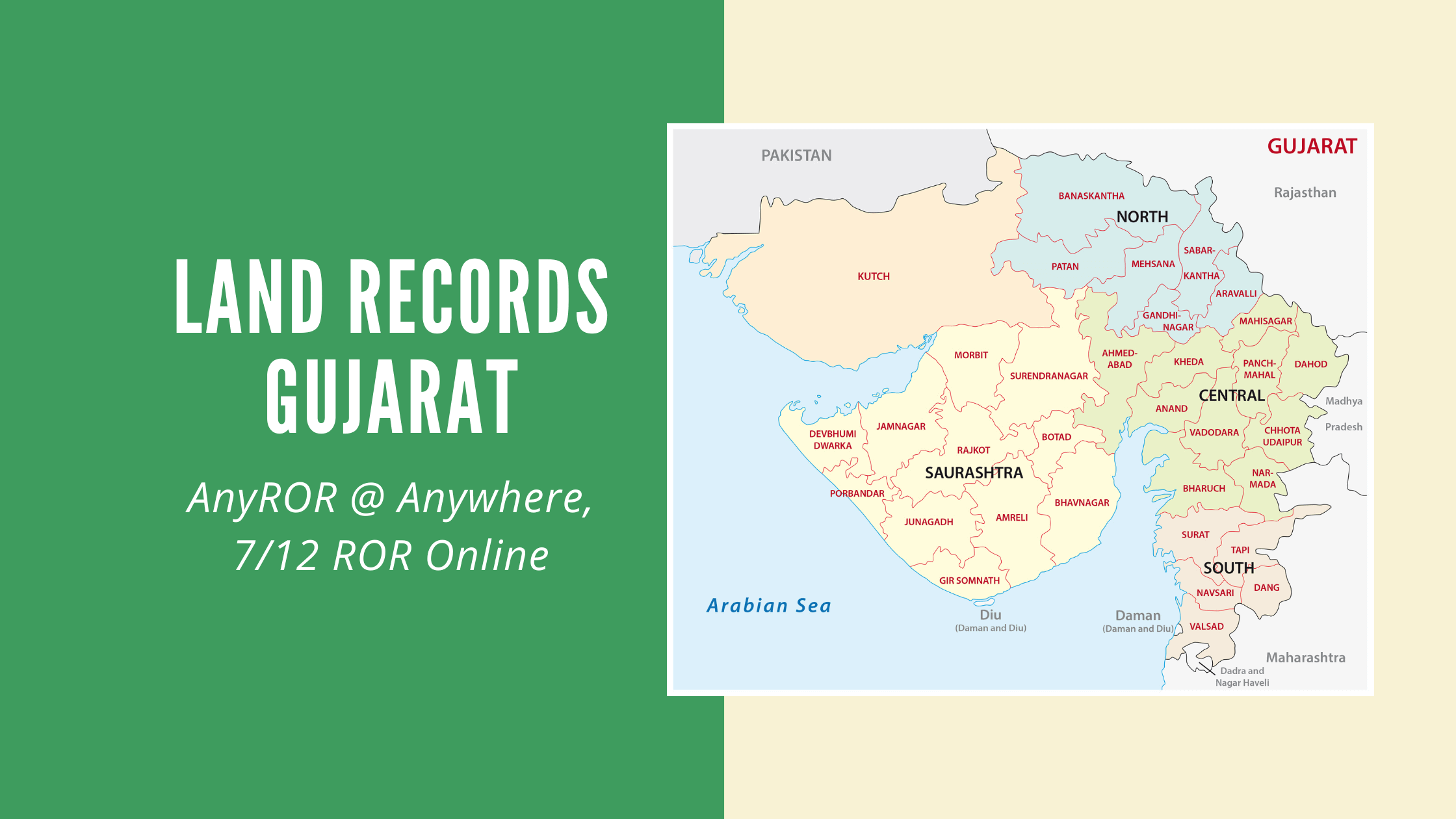
If you own agricultural land in Gujarat, or you are planning to buy a plot, a farmhouse, or a flat anywhere in the state, at some point you will need to look at the official land record. In Gujarat, that record lives on one portal: AnyRoR, short for Any Record of Rights Anywhere. It is run by the Gujarat Revenue Department, and it is the single place where you can pull up a 7/12 extract, check who owns a survey number, see the history of a mutation, or download a property card for a flat in Ahmedabad or Surat.
This guide walks through everything a first time user needs, from what AnyRoR actually is, to how the 7/12 online system works, to reading VF6, VF7, and VF8A records, to checking urban property cards, downloading a digitally signed RoR, and avoiding the fake websites that copy the AnyRoR name. Whatever your reason for landing here, whether it is a bank loan, a property purchase, an inheritance dispute, or simple curiosity about a family field, the process is the same and it takes only a few minutes once you know where to click.
- AnyRoR Gujarat at a Glance
- What Is AnyRoR Gujarat
- Why Land Records in Gujarat Matters
- Rural vs Urban Land Records: Know the Difference First
- Understanding 7/12 Utara (Satbara) in Gujarat
- Village Forms Explained: VF6, VF7, VF8A and Others
- How to Check AnyRoR Gujarat 7/12 Online: Step by Step
- How to Search AnyRoR Land Records by Owner Name
- How to View AnyRoR Village Map with Survey Number
- How to Get a Digitally Signed RoR (Legally Valid Copy)
- Checking Urban Land Records and Property Cards
- Common Reasons People Check Land Records in Gujarat
- Fees, Access, and Practical Tips
- AnyRoR vs e-Dhara vs iORA: Which One Do You Need?
- Checking Revenue Case Details and 135-D Notices Online
- Land Record vs Sale Deed: What Each One Actually Proves
- Documents and Details to Keep Ready Before Searching Land Record
- Land Record Terms Gujarat People Should Know
- Wrapping Up
AnyRoR Gujarat at a Glance
Short on time? Here is everything you need to know about the portal in one place.
|
Detail |
Information |
|---|---|
|
Full name |
Any Record of Rights Anywhere (AnyRoR @ Anywhere) |
|
Also searched as |
Bhulekh Gujarat, Gujarat land record, AnyRoR 7/12 |
|
Official website |
anyror.gujarat.gov.in |
|
Run by |
Revenue Department, Government of Gujarat |
|
Rural records |
7/12 Utara (VF7), 8A (VF8A), VF6 entries, 135-D notices, revenue cases |
|
Urban records |
Property Card and Unit Property Card |
|
Maps |
Village map with survey numbers (Bhu Naksha) |
|
Search by |
Survey or block number, khata number, or owner’s name |
|
Fee to view |
Free |
|
Legally valid copy |
Digitally signed RoR or digitally sealed property card, for a small fee |
What Is AnyRoR Gujarat
AnyRoR stands for Any Record of Rights Anywhere. It is the online land records portal maintained by the Revenue Department of the Government of Gujarat, accessible at anyror.gujarat.gov.in. Before this portal existed, anyone who wanted to check a land record had to visit the local Talati (village accountant) or the Mamlatdar office and wait for a physical copy of the register. AnyRoR digitised those registers so that a person in Mumbai, Dubai, or anywhere else can pull up the same record from a phone or laptop.
The name captures the idea well. Record of Rights, or RoR, refers to the official document that establishes who holds rights over a piece of land, whether as owner, tenant, or through some other recorded interest. “Anywhere” means the record can be accessed from any location, not just at the village office where the physical register is kept.
The portal covers land records for every district and taluka in Gujarat, spanning both rural agricultural land and urban plots and buildings. Rural records are organised around village level registers called Village Forms, and urban records are organised around property cards issued by the City Survey office. Anyone with an internet connection can search these records free of charge, though a digitally signed, legally valid copy involves a small fee.
You may also see the portal called “Bhulekh Gujarat”. That is simply a common name people use for Gujarat’s online land records, and the official site behind it is AnyRoR.
Why Land Records in Gujarat Matters
A land record is not paperwork you check once and forget. It plays a role at nearly every stage of owning, buying, or borrowing against property in Gujarat.
Proving ownership. The 7/12 extract or the urban property card is the closest thing to a live ownership snapshot for a piece of land. It shows the current recorded owner, the extent of land, and any pending changes.
Buying and selling. Before paying an advance on any plot or farmland, a buyer should check the seller’s name against the current record, confirm the survey number matches the physical land being shown, and look for any pending mutation, loan charge, or litigation noted against it. Skipping this step is one of the most common reasons property disputes happen in Gujarat.
Bank loans. Banks and NBFCs ask for a recent land record extract before sanctioning a crop loan, a Kisan Credit Card, or a loan against property. A digitally signed RoR is often the version they will accept, since it carries a verifiable digital signature rather than a plain printout.
Government schemes. Farmers applying for subsidy schemes, crop insurance under PM Fasal Bima Yojana, or electricity connections for agricultural pump sets are frequently asked to submit their 7/12 or 8A extract as proof of land holding.
Dispute resolution and inheritance. When land passes through inheritance or a family partition, the mutation entry (VF6) is the document that formally updates ownership in government records. Checking this history helps confirm that a transfer has actually been finalised rather than just agreed upon informally.
Rural vs Urban Land Records: Know the Difference First
One point that trips up a lot of first time users is not realising that Gujarat maintains two separate record systems depending on where the land sits.
Rural land records apply to agricultural and village land. These are tracked through Village Forms, most importantly VF6, VF7, VF8A, and VF12, and the 7/12 extract is built from a combination of these forms.
Urban land records apply to land and buildings that fall within a City Survey area, meaning most developed parts of cities like Ahmedabad, Surat, Vadodara, Rajkot, and Gandhinagar. Here, the equivalent of the 7/12 is the Property Card or Unit Property Card, issued by the City Survey / Superintendent of Land Records office rather than the Talati.
If you search for a rural survey number under the urban section, or the reverse, you will get no results. Knowing which category your land falls under before you start searching will save a lot of confusion.
Understanding 7/12 Utara (Satbara) in Gujarat
The term 7/12, sometimes written as Satbara Utara, comes up constantly in any conversation about Gujarat land records, and it is worth understanding exactly what it is rather than just how to fetch it. In Gujarati, it is called the 7/12 નો ઉતારો.
The name comes from two separate Village Forms that are combined into a single extract:
- Village Form 7 (VF7) records who holds rights over a survey number: the owner’s name, the type of tenure, and any rights, mortgages, or encumbrances noted against the land.
- Village Form 12 (VF12) records the agricultural side of the same land parcel: crops sown, irrigation source, and cultivation details over recent seasons.
When these two are read together, they answer the two questions a buyer, lender, or government office usually needs answered at the same time: who owns this land, and what is being done with it. That combined extract is what people mean when they ask for the “7/12” or “Satbara Utara.”
A genuine 7/12 extract typically shows the district, taluka, and village name, the survey or block number, the total area of the parcel, the recorded owner’s name and share, the type of tenure (such as old tenure or new tenure land, which affects whether the land can be freely sold), any loan or mortgage charge noted on the land, and the crop and cultivation details for recent years.
It is worth being precise here, because several older articles blur the line between 7/12 and 8A. The 7/12 is organised by survey number and tells you about one specific parcel. The 8A extract, covered next, is organised by person and tells you everything that person owns across a village. They answer different questions and a buyer usually needs to check both.
Village Forms Explained: VF6, VF7, VF8A and Others
The Gujarat rural land record system runs on a set of Village Forms maintained originally by the Talati at the village level. Understanding what each one covers makes the rest of the AnyRoR process much easier to follow.
VF6: The Mutation Register
VF6, also called the register of mutation entries or Hakk Patrak, is the running log of every change made to land rights in a village. Whenever land changes hands through sale, inheritance, gift, court decree, or government acquisition, a fresh entry is recorded in VF6 before the main 7/12 record is updated to reflect it. In Gujarati, it is written as હક્ક પત્રક, which is why many people search for it as the “6 number hak patrak”.
This makes VF6 the most important document to check before finalising any land transaction. A 7/12 extract only shows the current position. VF6 shows the history and, critically, whether a recent mutation has actually been finalised or is still open for objections under Section 135-D, which allows a 30 day window for anyone to raise a claim against a proposed change. A mutation that is still inside this objection window is not yet settled, and a buyer should wait for it to be confirmed before proceeding.
VF7: Ownership and Survey Details
VF7 is the register of ownership at the survey number level. It lists the landowner’s name, the extent of land held, the survey or block number, and any rights or charges against the parcel. This is the “7” half of the 7/12 extract described earlier, and on AnyRoR it usually appears as an option called “VF7 Survey No. Details.”
VF8A: Khata (Account) Details
VF8A groups all the land held by a single owner within one village under one khata, or account, number. Where the 7/12 is organised by land parcel, the 8A is organised by person. If a seller claims to own only one plot, the 8A extract will show whether they actually hold other survey numbers in the same village under the same account, which is useful for spotting land a seller may have left out of the conversation. VF8A is also the form most commonly asked for when applying for agricultural subsidies or verifying total landholding for tax and eligibility purposes. In Gujarati, this extract is usually called the 8-અ નો ઉતારો.
VF12: Cultivation Record
VF12 captures season wise cultivation details for a survey number, including the crop grown and the irrigation method used. Combined with VF7, it forms the full 7/12 extract.
Other Records on AnyRoR
Beyond these four, the rural section of AnyRoR also gives access to old scanned VF6 and VF7/12 records for historical reference, entry lists by month and year, integrated survey number details for land that has been resurveyed, and revenue case details for disputes pending before revenue authorities. Most everyday users will only need VF7, VF8A, and VF6, but knowing the other options exist helps when a bank or advocate specifically asks for one of them.
Apart from land records, the AnyRoR homepage also lists a few other services. For instance, there is e-CHAVDI (ઈ-ચાવડી) for village-level revenue services, and the Farmer Registry, where farmers can register to get a Unique Farmer ID linked to Aadhaar and their 7/12 record.
Explore Land Records in Other States
| Karnataka | Bhoomi Online RTC |
| Chhattisgarh | CG Bhuiya |
| Uttarakhand | Bhulekh UK |
| Punjab | PLRS |
| Madhya Pradesh | Bhulekh MP |
| West Bengal | Banglarbhumi |
| Odisha | Bhulekh Odisha |
| Bihar | Land Record Bihar |
| Jharkhand | Jharbhoomi |
| Tamilnadu | Patta Chitta |
| Maharashtra | Mahabhulekh |
| Telangana | Dharani |
How to Check AnyRoR Gujarat 7/12 Online: Step by Step
Checking a rural land record on AnyRoR takes only a few minutes once you have the basic details of the land ready: the district, taluka, and village, along with either the survey number, the owner’s name, or the khata number.
Step 1: Go to the official AnyRoR website. Open a browser and visit anyror.gujarat.gov.in. Always type the address directly or use a bookmarked link rather than clicking through search ads, since a number of lookalike sites use similar names.
Step 2: Select “View Land Record – Rural.” The homepage presents separate options for rural land, urban land, and property search. Choose the rural option for any agricultural or village land.
Step 3: Choose the record type you need. A dropdown menu will present options including VF7 Survey No. Details, VF8A Khata Details, VF6 Entry Details, Old Scanned VF6 and VF7/12 Details, Revenue Case Details, 135-D Notice for Mutation, and a few others. For a standard 7/12 lookup, select the VF7 Survey No. Details option.
Step 4: Select District, Taluka, and Village. These dropdowns are in both Gujarati and English, so users unfamiliar with the script can still navigate them without difficulty.
Step 5: Enter the survey number or owner’s name. Depending on the record type chosen, you can search by survey number, block number, or owner’s name.
Step 6: Enter the captcha and submit. Fill in the verification code shown on screen and click “Get Record Detail.”
Step 7: View or download the record. The land record appears directly on screen. Most browsers let you print the page or save it as a PDF. This standard copy is useful for personal reference and preliminary checks, but it does not carry a digital signature, which matters for the next step.
How to Search AnyRoR Land Records by Owner Name
Don’t have the survey number? That’s quite common, especially with inherited land. Luckily, you can still find the record. On the AnyRoR homepage, look for the Property Search option, listed as મિલ્કત વિગત જોવા માટે.
- Open anyror.gujarat.gov.in and select Property Search.
- Choose the district, taluka and village.
- Search by the owner’s name instead of the survey number.
- Enter the captcha and open the result.
- Note down the survey or khata number shown, and then pull the full 7/12 or 8A using the steps above.
One small thing to watch: names are often spelt differently in Gujarati records. So, if your first search shows nothing, try the Gujarati spelling, or search with just the surname.
How to View AnyRoR Village Map with Survey Number
A 7/12 tells you who owns a survey number, but it doesn’t show you where that land actually sits. For that, you need the village map, often called Bhu Naksha. AnyRoR gives you access to Gujarat’s digital village maps, so you can match the record with the plot you’re being shown on the ground.
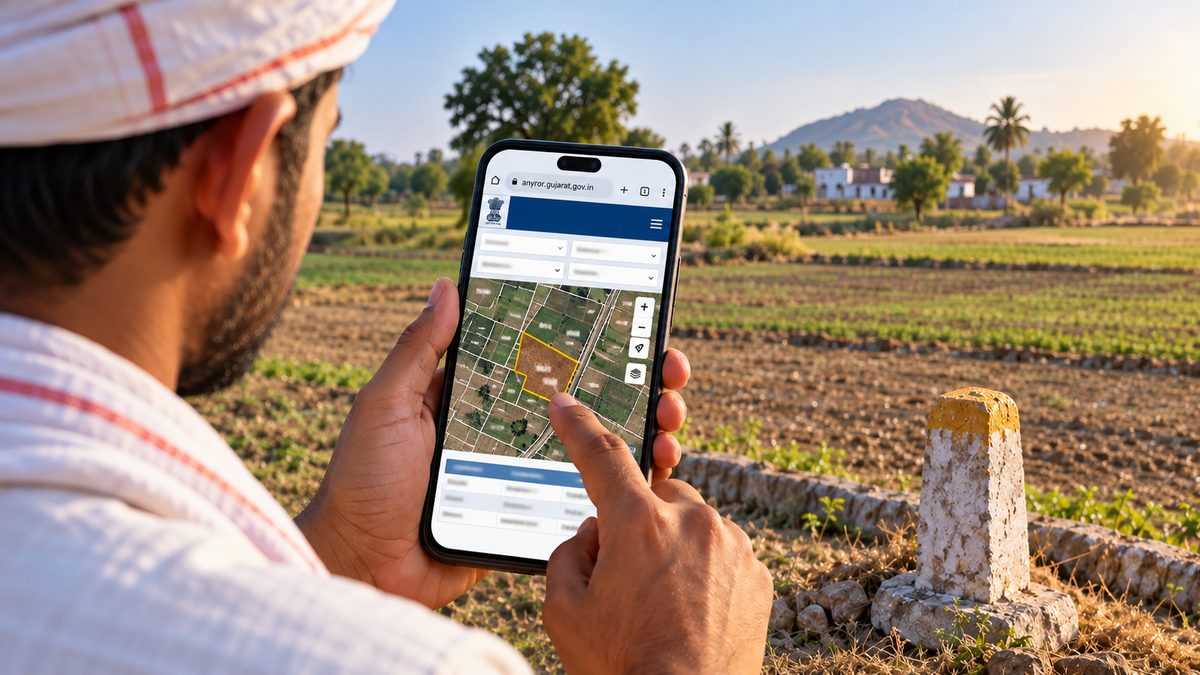
- Go to anyror.gujarat.gov.in and open the Village Map or Bhu Naksha option.
- Select the district, taluka and village.
- Find your survey or block number on the map, or search for it.
- Click the number to see the plot’s shape along with its neighbouring survey numbers.
- Download or print the map for your reference.
Here’s a tip that saves a lot of confusion. After land consolidation, many villages moved from survey numbers to block numbers. So, if an old sale deed mentions a survey number you can’t find, check the block number in the current 7/12 first.
Keep in mind that the online map is for reference only. If you need a certified map copy, for example for a court case or a boundary dispute, apply at the Taluka or District Inspector of Land Records (DILR) office.
How to Get a Digitally Signed RoR (Legally Valid Copy)
A record you view or print directly from the search result is meant for informational use. If you need a copy that a bank, court, or government office will formally accept, you need the digitally signed version.
To obtain it: visit the AnyRoR homepage and select the option for Digitally Signed RoR. Register or log in using your mobile number, since an OTP based login is required for this service. Select the location details of the land, including district, taluka, village, and survey or khata number. Make the applicable payment online, since this service involves a small fee unlike the free search option. Once processed, download the digitally signed certificate, which includes a verifiable digital signature and can be validated independently.
This digitally signed copy is the version accepted for loan applications, court submissions, and other official purposes where a plain printout will not be sufficient. Keep this distinction in mind: browsing the record for free is one workflow, and obtaining a document with legal standing is a separate, paid workflow on the same portal.
Checking Urban Land Records and Property Cards
If the property you are checking sits in a City Survey area rather than a village, the process shifts to the urban section of AnyRoR, and the terminology changes along with it.
Step 1: Visit anyror.gujarat.gov.in and select “View Land Record – Urban.”
Step 2: Select ‘Property Card’ for an independent plot or building, or ‘Unit Property Card’ for a flat, shop or unit in a larger complex.
Step 3: Choose the District, City Survey Office (generally by ward) and fill in the Survey Number, Sheet Number or search by owner’s name, depending on the information you have.
Step 4: Type the CAPTCHA and click “Get Record Detail.”
Step 5: The urban land record will appear on the screen along with the ownership details, area in square meters and boundary information of the property.
The property card is Gujarat’s version of 7/12 and the buyer has to get this checked before paying any advance amount for a flat or commercial unit in any city of Gujarat. It confirms the seller’s registered ownership and the physical size of the unit. This helps to pick up on discrepancies between what is being sold and what is officially registered.
Need the property card for a bank or a legal purpose? In that case, use the Digitally Sealed Property Card option on the AnyRoR homepage. It works much like the digitally signed RoR for rural land: the copy carries a verifiable seal, so it is accepted where a plain printout is not.
Common Reasons People Check Land Records in Gujarat
The reasons users turn to AnyRoR vary widely, but a few patterns come up repeatedly.
Farmers also need the 7/12 and 8A extracts to apply for crop loans, Kisan Credit Card facilities and PM Fasal Bima Yojana insurance claims as lenders and insurers require documented proof of land holding before processing these.
Buyers checking farmland or a residential plot use the record to confirm the seller actually holds clear title, verify there is no undisclosed mortgage or dispute noted against the land, and cross check that the survey number matches the physical boundaries being shown on site.
NRIs and out of state owners who have inherited land in Gujarat but cannot travel there regularly use the portal to keep track of their property’s status, confirm mutation entries after a family transfer, and download documents needed for power of attorney or sale transactions handled remotely.
Homebuyers in cities check the property card before finalising a flat purchase, particularly for resale properties, to confirm the seller’s name on the card matches the name on the sale agreement.
Advocates and revenue consultants pull VF6 mutation history as part of standard title verification before drafting sale deeds or handling litigation connected to land.
Fees, Access, and Practical Tips
Searching and viewing rural or urban land records on AnyRoR is free of charge. The only cost involved is for the digitally signed RoR, which carries a nominal fee reflecting its legal standing.
The portal is accessible around the clock from any location with an internet connection, which is the entire point of the “anywhere” in its name. There is no need to visit a village office or wait for office hours simply to check a record, though the local Talati or Mamlatdar remains the right point of contact for corrections, disputes, or formally lodging a mutation request.
Because district, taluka, and village names appear in both Gujarati and English, the portal is usable even for people who cannot read the Gujarati script, which is particularly helpful for NRIs and property buyers from outside the state.
Given how many lookalike websites exist using variations of the AnyRoR name, always confirm you are on anyror.gujarat.gov.in before entering any personal information, making a payment, or trusting the steps shown. The government will never ask for bank account details through this portal, and any website or app that does should be treated as fraudulent.
AnyRoR vs e-Dhara vs iORA: Which One Do You Need?
People often mix up these three Gujarat revenue services, mainly because they all deal with land. Here is the simple difference:
|
Service |
What it is for |
|---|---|
|
AnyRoR |
Viewing and downloading land records, maps and property cards online |
|
e-Dhara |
The taluka-level system and centres where land records are kept and mutation entries are processed |
|
iORA |
Online applications for revenue permissions, such as land use conversion |
Put simply, AnyRoR is where you check a record. However, if you need to change a record, for example after buying land, the mutation goes through the e-Dhara system at the taluka level. And if you want permission to use farmland for something else, that application usually starts on iORA.
Checking Revenue Case Details and 135-D Notices Online
Beyond ownership and cultivation records, AnyRoR also gives access to pending revenue case details, which is useful when a mutation is in progress or a dispute has been raised at the taluka level. To check this, select “View Land Record – Rural,” then choose “Revenue Case Details” from the dropdown, select the district, taluka, village, and survey or block number, enter the captcha, and click “Get Record Detail.” The result shows the current status of any revenue case tied to that survey number, including cases connected to boundary disputes, tenancy questions, or objections filed under land conversion rules.
Closely related is the 135-D Notice for Mutation. Under Section 135-D of the Gujarat Land Revenue Code, whenever a mutation entry is proposed in VF6, the Talati issues a public notice inviting objections within a fixed period, typically 30 days. This step exists precisely to prevent fraudulent or mistaken transfers from being finalised without anyone having a chance to object. Checking this notice on AnyRoR before relying on a recent ownership change tells you whether the transfer is still open to challenge or has already been confirmed and closed. Skipping this check is one of the more common reasons buyers later discover a title issue that could have been caught in advance.
Land Record vs Sale Deed: What Each One Actually Proves
A point that confuses many first time buyers is the relationship between the land record on AnyRoR and the sale deed registered with the Sub-Registrar. These are two different documents that serve different purposes, and relying on only one of them is a common mistake.
The sale deed is the legal instrument that transfers ownership from seller to buyer and is registered at the office of the Sub-Registrar under the Registration Act. It is proof that a transaction took place and on what terms.
The land record, whether a 7/12 extract or an urban property card, is the government’s own running record of who currently holds rights over that land, updated through the mutation process after a sale deed is registered. A sale deed alone does not automatically update the AnyRoR record. The buyer or their representative typically needs to apply for mutation at the Talati or City Survey office after registration, after which the change appears in VF6 and eventually reflects in the 7/12 or property card.
This means a seller can, in principle, have a registered sale deed for a transaction from years ago that was never followed through with a mutation application, leaving the land record still showing the earlier owner’s name. Checking the current 7/12 or property card, rather than relying solely on a sale deed shown by the seller, is the only way to confirm whose name the land is actually recorded under today. If there is a mismatch between the sale deed and the current land record, it is worth asking directly why the mutation was never completed before proceeding further.
Buying land or a flat in Gujarat? Then treat the land record as your first check, not your last. Before you pay an advance, you can also run a Square Yards Title Search and a Litigation Search to spot ownership gaps or pending court cases on the property.
Documents and Details to Keep Ready Before Searching Land Record
Since AnyRoR search fields require specific location and identification details rather than a free text search, it helps to have the following ready before starting:
For rural land: the district, taluka, and village name, along with the survey number or block number if searching by parcel, or the owner’s name if searching by holder.
For urban property: the district, the relevant City Survey Office or ward, and the survey number, sheet number, or property card number.
For a digitally signed RoR: a registered mobile number for OTP verification, and payment details for the applicable fee.
For revenue case or mutation checks: the survey number and the approximate date range if you are trying to trace a specific transaction or dispute.
Having these details on hand before opening the portal avoids repeated back and forth between dropdown menus and speeds up what is otherwise a two to three minute process.
Land Record Terms Gujarat People Should Know
A short glossary helps when reading extracts or talking to a revenue official or lender.
Record of Rights (RoR): The general term for the official document establishing who holds rights over land, of which the 7/12 extract is the rural version.
Survey Number: The unique number assigned to a specific parcel of agricultural land within a village, used to identify it in every record.
Khata Number: The account number under which all land held by one owner in a village is grouped, as used in the VF8A extract.
Mutation Entry: A recorded change in ownership or rights over land, logged in VF6 before it is reflected in the main 7/12 record.
Jantri: The government determined market valuation of land and property in a given area, used to calculate stamp duty during registration. Jantri rates are distinct from the land record itself but are often checked alongside it during a purchase.
Property Card: The urban equivalent of the 7/12 extract, issued for land and buildings within City Survey areas.
Old Tenure and New Tenure: Classifications that affect whether land can be freely transferred or requires government permission and premium payment before sale.
Block Number: The number given to a land parcel after land consolidation. In many villages, it has replaced the older survey number on the 7/12.
Bhu Naksha: The digital village map that shows each survey or block number as a plot on the ground.
Wrapping Up
AnyRoR has genuinely changed how land records work in Gujarat. What once meant a trip to the Talati’s office and a wait for a physical register can now be done from a phone in a few minutes, whether you are checking a 7/12 extract for a family field, verifying a seller’s ownership before a purchase, or pulling a property card for a flat in the city. The key is knowing which record answers which question: VF7 for ownership at the survey number level, VF8A for everything a person holds across a village, VF6 for the mutation history, and the property card for anything in a City Survey area.
Treat the free search as your first checkpoint and the digitally signed RoR as the version you actually need for a bank, a court, or any formal transaction. Always confirm you are on anyror.gujarat.gov.in before entering any details, since the AnyRoR name has been copied by enough lookalike sites and apps that this single habit will save you from most of the trouble people run into. Beyond that, the process is straightforward, free to use, and available anywhere, which is exactly what it was built for.
Frequently Asked Questions:
1. What is AnyRoR Gujarat?
AnyRoR, meaning Any Record of Rights Anywhere, is the official online land records portal run by the Gujarat Revenue Department at anyror.gujarat.gov.in. It lets anyone view rural and urban land records, including the 7/12 extract, VF6, VF7, VF8A, and urban property cards, from any location.
2. How can I check AnyRoR Gujarat 7/12 online?
Visit anyror.gujarat.gov.in, select “View Land Record – Rural,” choose “VF7 Survey No. Details,” select your district, taluka, and village, enter the survey number, fill in the captcha, and click “Get Record Detail.” The 7/12 extract will appear on screen and can be printed or saved.
3. What is the difference between VF7 and VF8A?
VF7 is organised by survey number and shows ownership and rights for one specific land parcel. VF8A is organised by person and lists every survey number a single owner holds within a village under one khata number. Checking both gives a fuller picture during a land purchase.
4. Is the copy downloaded from AnyRoR legally valid?
A regular printout from the free search is meant for reference purposes only. For legal or official use, such as bank loans or court submissions, you need the Digitally Signed RoR, available through a separate paid service on the same portal.
5. How do I check urban land records or a property card in Gujarat?
On the AnyRoR homepage, select “View Land Record – Urban,” choose “Property Card” or “Unit Property Card,” select the district and City Survey Office, enter the survey or sheet number, complete the captcha, and click “Get Record Detail.”
6. What does 7/12 mean with respect to Gujarat land records?
The 7/12, also called Satbara Utara, combines Village Form 7, which records ownership and rights, with Village Form 12, which records cultivation and land use. Together they form the primary rural land record used to confirm ownership, extent, and agricultural details of a survey number.
7. Is there an official AnyRoR mobile app?
No. The Gujarat Revenue Department has not released an official AnyRoR mobile application. Several third party apps use similar branding, but none are affiliated with the government, and users should avoid entering payment or personal details on them.
8. Can I check land records in Gujarat without visiting a government office?
Yes. AnyRoR was built specifically so that rural and urban land records can be checked entirely online, from any location, without visiting the Talati, Mamlatdar, or City Survey office in person. Physical visits are only needed for corrections, disputes, or formally registering new mutations.
9. What is VF6 and why does it matter before buying land?
VF6 is the mutation register that logs every change in land ownership, including sales, inheritance, and court orders. Checking VF6 before a purchase reveals the full ownership history of a parcel and shows whether any recent mutation is still open for objections rather than finalised.
10. How can I check my land record map online in Gujarat?
AnyRoR allows users to view land maps, known as Naksha, alongside the standard record search. This helps confirm the physical layout and boundaries of a survey number in addition to its ownership details.
11. What is the official website of AnyRoR @ Anywhere?
The official website is anyror.gujarat.gov.in, run by the Revenue Department, Government of Gujarat. Since many lookalike sites use the AnyRoR name, check the address in your browser before you enter any details.
12. How can I download a 7/12 Utara PDF from AnyRoR?
For a free reference copy, open your 7/12 on AnyRoR and use the browser’s print option to save it as a PDF. If you need a PDF that a bank or court will accept, use the Digitally Signed RoR option instead. It needs an OTP login and a small fee.
13. What is the 6 number hak patrak in Gujarat?
It’s another name for VF6, the register of mutation entries. It shows each change in ownership, such as a sale, an inheritance or a court order. On AnyRoR, you’ll find it under VF6 Entry Details.
14. Can I check 7/12 by owner name in Gujarat?
Yes, you can. Use the Property Search option on AnyRoR, pick the district, taluka and village, and search with the owner’s name. Once you get the survey number from the result, you can open the full 7/12.
15. Is AnyRoR the same as Bhulekh Gujarat?
For most people, yes. “Bhulekh Gujarat” is a popular name for Gujarat’s online land records, while AnyRoR is the official portal that actually holds them.