
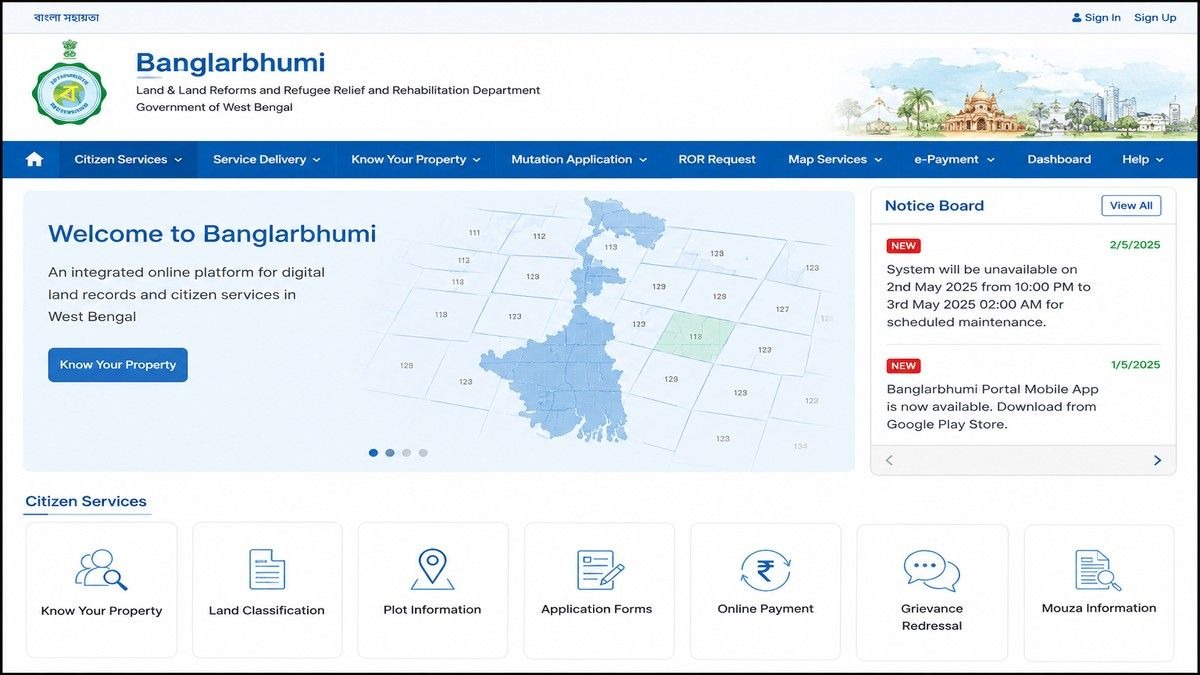
Anyone who’s dealt with West Bengal land records the old way knows exactly what it involved – showing up at a government office with no guarantee you’d leave with what you came for, running the same errand three times because some form was missing, or quietly paying someone who “knew people” just to get a document that was rightfully yours. Banglarbhumi, which went live in 2010, put most of that to rest. Property ownership details, land records, mutation applications, certified documents – you handle all of it from home now. This guide walks through everything: banglarbhumi registration, banglarbhumi login, pulling up records on the portal, and downloading the banglarbhumi app if you’d rather work from your phone.
What is Banglarbhumi Portal?
Banglarbhumi is the official land records portal run by West Bengal’s Department of Land & Land Reforms and Refugee Relief and Rehabilitation. It operates under the Digital India Land Records Modernization Program and has changed the practical reality of land administration in the state in ways that are hard to overstate.
Understanding the WB Banglarbhumi System
What the portal gives you, in plain terms, is access to everything tied to a piece of land – owner names, plot numbers, area measurements, property values, ownership history, and full land maps for West Bengal. Before any of this existed online, getting that information meant physical visits to revenue offices, paperwork that multiplied on its own, and delays that nobody could explain or fix. Middlemen did well in that environment because they understood the system and most people didn’t.
The portal replaced all of that with a searchable, centralized database. And it’s not just useful for landowners – if you’re scouting a location for a business in West Bengal, block-level infrastructure data and plot specifics are right there once you punch in your district and block.
Key Features of Banglarbhumi Gov In
|
Feature |
What It Does |
|
Round-the-Clock Access |
Available 24/7 from anywhere – no office hours, no queues |
|
Centralized Land Data |
RoR, Khatian, plot maps, mutation cases, land classification – one place |
|
Live Map Updates |
Ownership maps updated in real time |
|
Transparent Transactions |
Full property history reduces fraud between buyers and sellers |
|
Online Mutation Services |
Submit mutation requests online with auto fee calculation and status tracking |
|
Certified Document Access |
Request digitally signed copies of RoR, plot maps, and other official records |
|
Encumbrance Certificates |
Check mortgages and unpaid dues before buying or applying for a loan |
|
Secure Authentication |
Dual-authentication including biometric verification |
|
Entrepreneur-Friendly Tools |
Infrastructure data, plot availability, and land details for site planning |
Who Can Use the Portal?
The portal is open to everyone. What you can actually do depends on whether you’ve set up an account:
|
User Type |
Available Services |
|
Unregistered |
View land records, plot info, general property search, Know Your Property |
|
Registered (logged in) |
Everything above, plus mutation applications, certified ROR requests, application tracking |
Registration is free and takes about five minutes. The homepage at banglarbhumi.gov.in organizes everything under clearly labeled tabs – Citizen Services, Service Delivery, Know Your Property, Mutation Application, ROR Request, and Map Services – so you’re not hunting around for what you need.
Benefits of Using Banglarbhumi for Land Records
Access to Digital Land Records
It doesn’t matter if you’re an NRI sitting in another country or a farmer in a district with one government office that closes at 3 pm – your land records are reachable whenever you actually need them. The portal works in Bengali, English, and Hindi, so language doesn’t become an obstacle when you’re trying to read your own Khatian or make sense of plot information.
Keeping physical copies of documents is no longer a necessity, though you can download and print whenever you want. And the 2026 update brought in biometric-based access for officials and location-linked verification, which makes tampering with records harder than it’s ever been.
Transparency in Property Transactions
The portal has largely put the informal broker class out of business – the people who used to charge real money to pull up records that are now freely accessible to anyone with a phone. Every land inquiry is logged and traceable, from checking a plot map to paying land tax.
Before buying, you can verify RS-LR ownership yourself, directly on the portal. You can also check whether land is caught up in litigation, so you don’t walk into a purchase that’s actually someone else’s court battle. That kind of clarity upfront has cut down on the disputes over boundaries, inheritance, and competing ownership claims that used to drag on for years.
Time and Cost Savings
What used to mean multiple trips, queues, and follow-up calls now takes a few minutes from wherever you happen to be. The portal runs around the clock – you can check a land record on a Sunday night if that’s when you need it.
For rural landowners who live an hour or more from the nearest district office, the difference is tangible – no travel, no lost workday, no separate errand for each query. Banks have noticed too: faster property document verification moves loan approvals along for buyers and sellers alike.
Prevention of Land Fraud
Digitization makes it genuinely difficult to manipulate ownership records or produce fake land documents. Every change to a record requires authenticated access, enforced by the biometric system. That protects your property rights against false claims in ways the old paper-based system simply couldn’t.
Transaction history being publicly accessible also helps you catch inflated property prices before you agree to anything. You can look up comparable land values in an area and cross-check them yourself, rather than taking a seller’s figures at face value.
How to Register on Banglarbhumi
If you want access to mutation applications and certified document downloads, you’ll need an account. The banglarbhumi registration process is short – five minutes if your details are in front of you.
Step 1: Visit www Banglarbhumi Gov In West Bengal
Open https://banglarbhumi.gov.in/BanglarBhumi/Home.action in your browser. Chrome, Firefox, and Internet Explorer all work without issues. Find the Sign Up button at the top-right corner of the homepage – it sits right next to Sign In. Click it and you’ll land on the public registration form.
Step 2: Complete the Banglarbhumi Registration Process
Go through the form carefully. You’ll need to provide:
- Full name (first, middle, last)
- Guardian’s name as it appears on your ID documents
- Complete address, Police Station name, district, and pin code
- An active email address and mobile number – both receive OTPs
- A password, confirmed by re-entering it
- The captcha code (hit refresh if it’s unreadable)
The 2026 version uses dual OTP verification – one sent to your mobile, one to your email – before you can submit the form. Go over everything once before clicking Submit.
Step 3: Verify Your Account
After submitting, an OTP arrives on your mobile and an activation link hits your inbox. Enter the mobile OTP when prompted, then click the email link to fully activate the account. After that, your banglarbhumi login credentials work – e-Porcha, mutation applications, certified document requests, all of it becomes available.
How to Check West Bengal Land Records Online
Using Banglarbhumi Login to Access Records
For basic land details, plot info, RS-LR data, maps, and the Know Your Property feature, you don’t need to be signed in at all. Mutation applications and certified documents are where you’ll need to log in.
To sign in, click Sign In on the homepage. A popup appears – select Citizen as your user type, or Departmental User if you’re a government official. Enter your registered mobile number and password, fill in the captcha, and click Login to reach your dashboard.
Searching Land Records by Plot Number
Know Your Property is the quickest way to find ownership and plot details. Click it from the left-side tab – it takes you to the WB Land Records section at banglarbhumi.gov.in:8080/LRWEB. From there:
- Select your district, block, and mouza from the dropdown menus
- Choose Plot as your search type
- Enter your plot number, complete the captcha, and click Submit
- The Record of Rights appears – click View to see the full details
The result gives you plot number, land classification, owner name, and share area in acres on a single screen.
Searching Land Records by Owner Name
If you have a Khatian number, select Khatian as your search option after choosing your location. Enter the number, complete the captcha, and click View to see all records connected to it.
There’s also a Query Search option for when you’re referencing prior official correspondence about a land matter. Log in, select Query Search from the menu, enter your Query Number, Query Year, and captcha, then click Show.
Downloading and Printing Records
Once records are on screen, a download and print option is right there alongside the data. You can save Khatian and plot information directly to your device. For digitally signed copies that carry legal weight for bank and government use, register, pay online, and the system generates documents with official digital signatures.
Using the Banglarbhumi App
Banglarbhumi App Download Process
The official banglarbhumi app is called JOMIR TOTHYA, published by the Land & Land Reforms and RR&R Department, Government of West Bengal. It’s available on both Android via the Google Play Store and iOS via the Apple App Store.
Worth flagging: third-party apps like BhuTools and others like it show up in search results and claim to offer the same service. None of them are government-recognized, the data they display can be stale or just wrong, and there’s no support channel if something doesn’t work. Use JOMIR TOTHYA – it connects to government servers directly and is backed by official authentication.
Features of the Mobile Application
- Search land records by Khatiyan and Dag number for any West Bengal property
- View and save ownership details to your phone as an image
- Share records with family members, lawyers, or buyers through any sharing app
- Available in Bengali, English, and Hindi
- File land-related complaints directly through the app
- Access saved records offline – no internet connection required once downloaded
Checking Records Through the App
|
Step |
Action |
|
1 |
Select your district from the dropdown |
|
2 |
Choose the block where your property sits |
|
3 |
Select the Mouza (revenue village) |
|
4 |
Pick your search type: Plot or Khatian |
|
5 |
Enter the relevant number |
|
6 |
Fill in the captcha and tap View |
|
7 |
Save the record using the icon at the top-right |
Records you save stay in your phone storage without needing an internet connection – useful when you’re at a site visit or in a meeting somewhere the signal is unreliable.
How to Apply for Land Mutation and Track Status
Understanding Land Mutation Process
Land mutation – called Dakhil Kharij or Namantaran in West Bengal – is the process of updating revenue records when a property changes hands. Sale, inheritance, gift, partition – any transfer needs mutation to get your name into the Record of Rights. Three things depend on it being done:
- Property tax notices reach you by name
- You can use the property as loan collateral
- Future sales go through without complications
West Bengal maintains two separate records: the registered deed at the Sub-Registrar’s office, and the Khatian at the Block Land and Land Reforms Office. Both need updating for your ownership to be complete in any legal sense.
Submitting Mutation Application Online
Log into banglarbhumi.gov.in and navigate to Online Application then Mutation Application. The form asks for:
- Location details: district, block, mouza
- Applicant details: type, full address, registry office, deed date
- Buyer information: caste, gender, religion, email, mobile number (OTP verified)
- Documents to upload: registered deed copy, chain deeds connecting current Porcha owner to seller, current Khatian, latest land revenue receipt
Submit and hold onto your application number. For payment, go to Online Application thehn Fee Payment, enter your request type and application number, complete the captcha, and pay through the GRIPS gateway via net banking or debit card. Your mutation case number gets assigned right away. If you’re paying at a counter, verify through the Application-GRN Search section.
Tracking Your Application Status
Log in and go to Citizen Services , Online Service Status and then Mutation Status. Search by case number and year or by deed number and year. The portal shows whether your file is Pending, Under Review, or Approved. When delays happen, they’re usually tied to document verification, a required field inquiry or an objection connected to the land.
Mutation Processing Fees in 2026
|
Land Type |
Rural Area |
Municipal Area (Outside KMDA) |
Within KMDA |
|
Agricultural Land |
Rs. 40/decimal |
Rs. 60/decimal |
Rs. 80/decimal |
|
Non-Agricultural Land |
Rs. 100/decimal |
Rs. 150/decimal |
Rs. 200/decimal |
|
Commercial/Industrial (up to 10 decimals) |
Rs. 500/decimal |
Rs. 500/decimal |
Rs. 500/decimal |
|
Commercial/Industrial (above 10 decimals) |
Rs. 1,000/decimal |
– |
– |
Conclusion
Banglarbhumi has made land record management something ordinary people can actually handle on their own. Verifying ownership before a purchase, applying for mutation after a transfer, checking your own plot details – none of it requires an office visit anymore.
Registration takes under five minutes. The JOMIR TOTHYA app lets you verify records on the spot, wherever you are. Live updates and biometric authentication keep records accurate and harder to manipulate than they’ve ever been. If you haven’t set up an account yet, it’s worth a few minutes today – not because it’s impressive technology, but because it just works, and that’s more than the old system could honestly claim.
Frequently Asked Questions:
1. What is Banglarbhumi and who can access it?
Banglarbhumi is the Government of West Bengal’s official land records and property information portal. Anyone can use it – no account needed for basic searches such as viewing land records and plot details. Registered users may apply for mutations, request certified documents and track status.
2. How do I register on the Banglarbhumi portal?
Visit banglarbhumi.gov.in and click Sign Up on the top-right. Enter your name, guardian name, address, district, pin code, email and mobile number. You will receive OTPs on both your email id and mobile. Enter them, set a password, submit the form and click on the activation link in your email. The account is active immediately after.
3. Can I check land records without logging into Banglarbhumi?
Yes. Basic land details, plot information and Know Your Property are all available without an account. Select Know Your Property, choose your district, block and mouza, and search by plot number or Khatian number. You need to log in for certified documents and mutation applications.
4. What is land mutation and how do I apply for it online?
Land mutation (Dakhil Kharij) updates revenue records when ownership of property changes – through sale, inheritance, or gift. Login to Banglarbhumi, go to Online Application: Mutation Application, fill the form, upload your registered deed and current Khatian and complete payment. You will receive an application number, so you can follow up on the progress.
5. What are the mutation fees for different types of land in 2026?
Agricultural land Rs. 40/decimal in rural, Rs. 60/decimal in municipal and Rs. 80/decimal in KMDA areas. The price for non-agricultural land in the same zones is Rs. 100, Rs. 150 and Rs. 200/decimal. Commercial and industrial land Rs. 500/decimal for plots up to 10 decimal and Rs. 1,000/decimal thereafter in rural areas.