
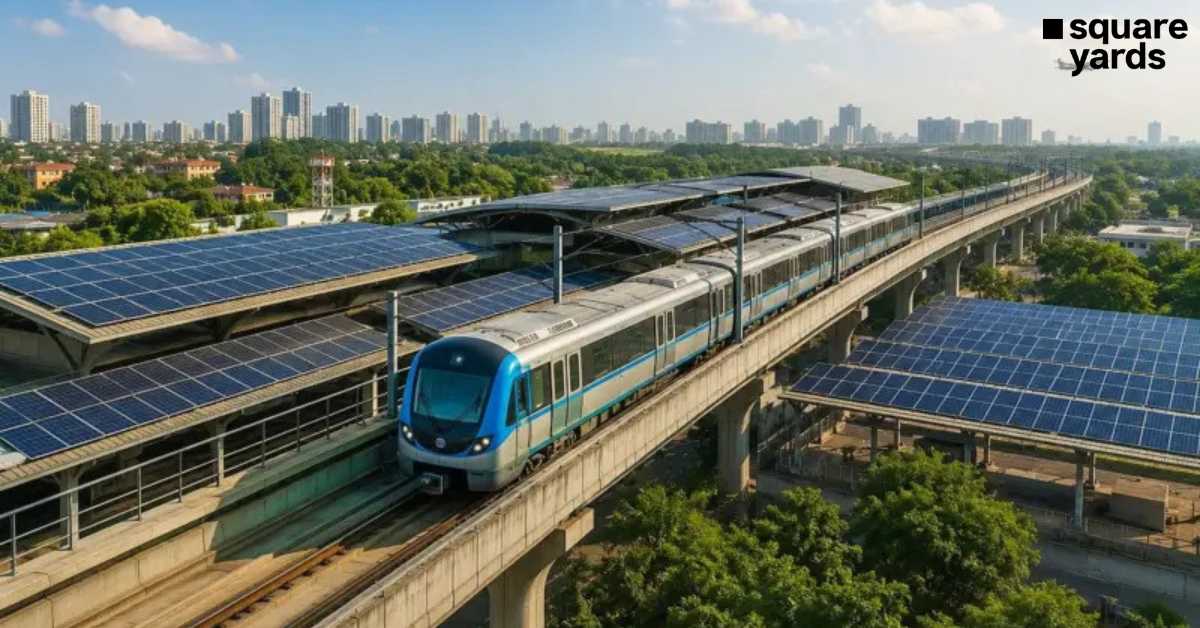
Bengaluru: Infrastructure projects often reshape real estate markets once operational. Bengaluru’s Airport Metro corridor, however, appears to be influencing housing prices years before the first train begins service.
The 39-km Phase 2B Airport Line of Namma Metro’s Blue Line, connecting Hebbal to the Kempegowda International Airport (KIA), is currently under construction and is expected to open around mid-2027. Yet, residential markets along the line are already showing signs of value appreciation.
The timing makes the trend particularly significant. Karnataka approved the revised airport metro alignment in January 2019; the center sanctioned the combined Phase 2A and 2B Blue Line project in April 2021, with construction starting in early 2022. Media reports indicate that civil works on the Hebbal-Airport stretch are approximately 75% complete, with operations now targeted for next year.
Select localities outperform city averages
Data available from Square Yards show that the strongest gains are concentrated around established future metro nodes rather than being uniformly distributed across the entire corridor. Between June 2025 and March 2026, Bengaluru’s average residential prices increased by approximately 13.6%. Several airport-metro-linked micro-markets significantly outperformed that benchmark.
Hebbal, which is expected to become one of the most important interchange and gateway stations on the airport route, recorded an 18.3% rise in average asking prices during the period. A tighter catchment within the area, Hebbal Kempapura, registered an even stronger 28.6% increase.
Jakkur, located within the catchment of the future Jakkur Cross station, emerged as one of the strongest performers, with prices rising by nearly 44%. Yelahanka New Town, another key metro-linked node, recorded growth of 17.5%, comfortably above the citywide average.
Navarathna Agrahara, situated near the airport development zone and often considered a proxy for the Airport City influence area, witnessed a remarkable 44.6% increase in residential prices during the same period.
These figures indicate that the market is increasingly assigning value to future metro accessibility, particularly in locations where connectivity benefits are easiest for buyers to understand and quantify.
Airport City and Metro are creating a dual-growth catalyst
Industry observers note that the Airport Metro story cannot be viewed in isolation. North Bengaluru is simultaneously benefiting from multiple infrastructure investments, including Airport City developments, logistics parks, commercial hubs, aerospace clusters, and road upgrades around the KIA region.
The upcoming metro line is expected to strengthen these growth drivers by reducing travel uncertainty between the airport region and Bengaluru’s established employment centers.
The airport stretch will include key stations such as Hebbal, Kodigehalli, Jakkur Cross, Yelahanka, Bagalur Cross, Doddajala, Airport City, and Airport Terminal. Once operational, the corridor will provide a direct mass-transit link between Bengaluru’s eastern and southern employment hubs and the airport region through the broader Blue Line network.
This enhanced connectivity is already influencing homebuyer preferences, particularly among investors seeking long-term appreciation opportunities.
Snapshot of North Bengaluru’s emerging metro hubs
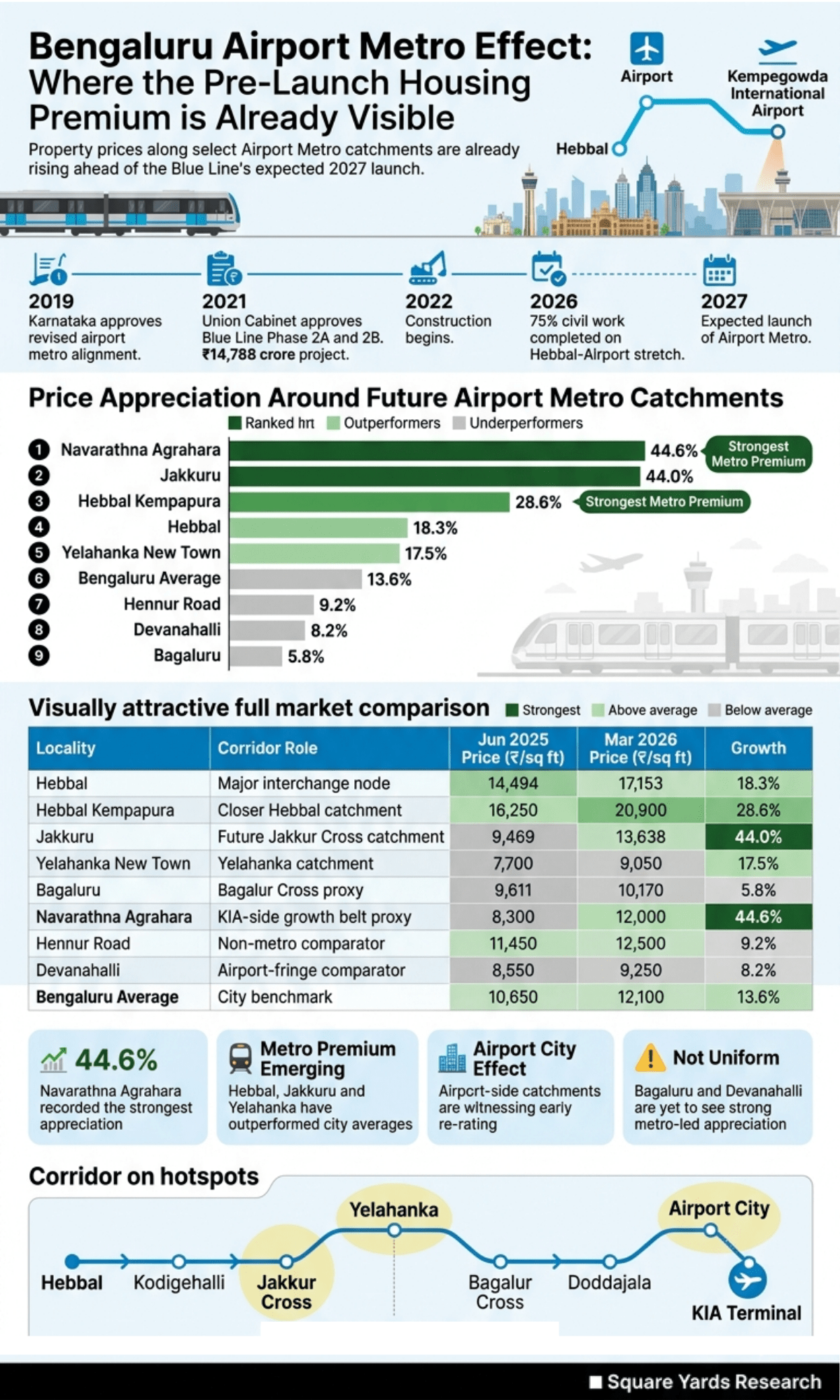
The data also highlight an important nuance: the metro premium is real but uneven. While Hebbal, Jakkur, and airport-adjacent catchments have recorded strong appreciation, some outer-corridor locations remain at an earlier stage of repricing.
Bagaluru, a proxy for the future Bagalur Cross station area, recorded a comparatively modest 5.8% increase during the June 2025-March 2026 period. This was below Bengaluru’s citywide average and below gains recorded in several other metro-linked localities.
Similarly, Devanahalli, despite its proximity to the airport region, recorded growth of around 8.2%, indicating that not all northern micro-markets have yet experienced the same level of investor enthusiasm. This divergence suggests that buyers are selectively rewarding locations with stronger existing infrastructure, higher visibility, and clearer connectivity benefits, rather than assigning a blanket premium across the entire corridor.
Early signs of a station-led pricing effect
One of the more interesting patterns emerging from the data is the difference between broader neighborhoods and tighter catchments closer to future metro nodes.
Hebbal Kempapura’s 28.6% growth significantly exceeded the 18.3% increase recorded across the wider Hebbal market. While not a direct station-distance analysis, the trend suggests that locations perceived to be closer to future metro access points may already be experiencing stronger demand.
A more rigorous assessment would require project-level geospatial mapping comparing homes within 1 kilometer of future stations with those farther away. Nevertheless, current pricing trends offer early evidence that a station-led premium may already be forming.
Buyers paying for tomorrow’s connectivity today
For Bengaluru’s residential market, the Airport Metro represents a rare case where infrastructure-led value creation is becoming visible before project completion.
With operations still at least a year away, the strongest-performing micro-markets along the corridor have already begun separating themselves from both city averages and comparable non-metro locations.
As construction progresses toward the 2027 launch target, analysts expect investor attention to remain concentrated around established nodes such as Hebbal, Jakkur, Yelahanka, and the Airport City belt.
The broader takeaway is clear: Bengaluru’s Airport Metro is no longer just an infrastructure project. It is already becoming a real estate story, with select North Bengaluru catchments commanding a measurable pre-launch premium as buyers position themselves for the city’s next major transit corridor.