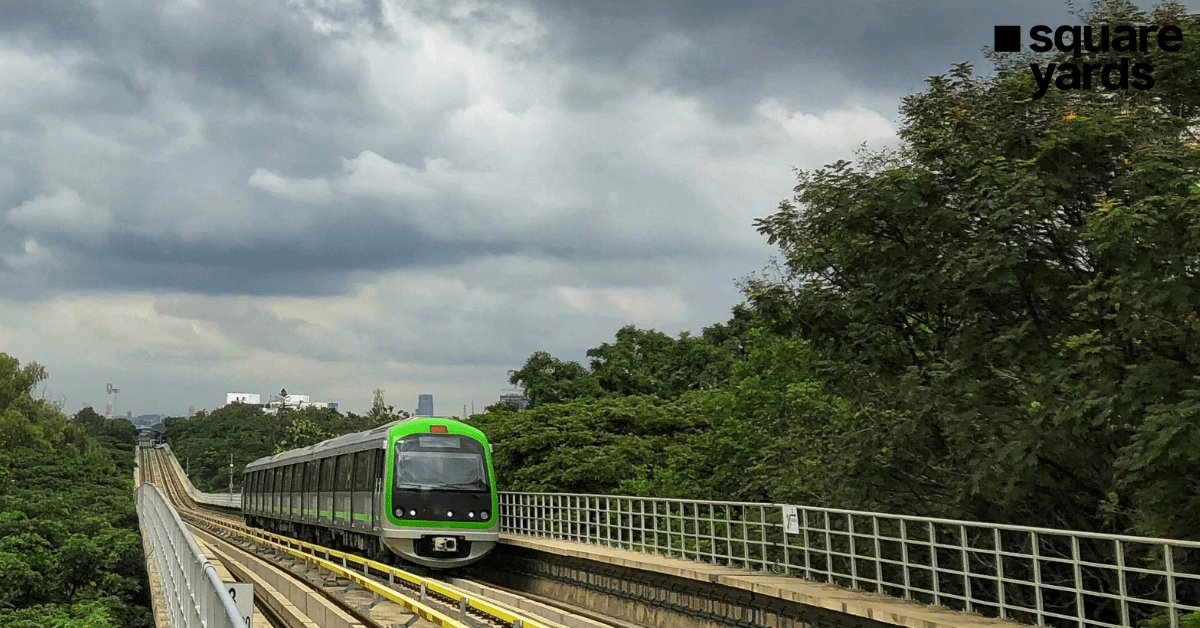
Karnataka has outlined an ambitious roadmap to expand the Namma Metro network to nearly 500 km, scaling up Bengaluru’s mass transit infrastructure over the coming years. The plan builds on the completion of ongoing projects such as the Pink Line and Blue Line, alongside the implementation of the already approved Phase-3. It will also lay the groundwork for future corridors that will extend metro connectivity across more parts of the city.
The expansion comes as Bengaluru continues to grapple with rising traffic congestion and rapid urban growth. The increasing demand for better connectivity between residential areas, IT corridors, and Kempegowda International Airport has made an alternate mode of commute necessary.
As part of the approved pipeline, Phase-3 will add 44.65 km across two corridors with 31 stations, while the Pink and Blue Lines are expected to improve north-south, east-west, and airport connectivity. The broader vision also proposes integrating metro development with major road projects, tunnels, and flyovers to create a more comprehensive urban transport network.
According to Sunil Pareek, executive director, Assetz, a fully functional, extensive metro network will bridge the accessibility gap between emerging residential corridors and core economic hubs, catalyzing price surges, driving high-quality developments across peripheral micro-markets, and supporting the recalibration of commute-driven rental yields across the city. “For developers, this evolution opens opportunities for large-scale suburban townships in all directions of the city, transit-oriented mixed-use developments and high-density vertical projects along high-capacity transit corridors,” Pareek adds.
Pink Line: Connecting residential neighborhoods with employment hubs
The Pink Line is one of the most awaited sections of Namma Metro because it creates Bengaluru’s second north-south metro corridor. Stretching approximately 21.25 km from Kalena Agrahara to Nagawara, the line includes a mix of elevated and underground sections and will connect major destinations such as IIM Bengaluru, Jayadeva Hospital, Dairy Circle, Langford Town, Shivajinagar, Cantonment and Nagawara. It also creates important interchange opportunities with the Green, Yellow and Blue Lines, making cross-city travel easier. The project is expected to be commissioned in stages, with the elevated section opening ahead of the underground stretch.
Real estate impact of the Pink Line
The Pink Line is expected to benefit some of Bengaluru’s most supply-constrained residential markets. Localities including Kalena Agrahara, Hulimavu, Bannerghatta Road, and JP Nagar are likely to see stronger demand from end-users who currently depend heavily on road transport. These areas already have established residential communities, but improved metro access could increase their attractiveness for professionals working across Central Bengaluru.
Further north, neighborhoods such as Tavarekere, Dairy Circle, Wilson Garden, Langford Town, and Richmond Town could see renewed interest in premium residential redevelopment as metro connectivity improves access to CBD employment centers without requiring private vehicles.
The northern stretch covering Shivajinagar, Pottery Town, Cantonment, Nagawara, and nearby Thanisandra is particularly significant. Nagawara will become an interchange with the Blue Line, creating one of the city’s key multimodal nodes. Residential projects in Thanisandra, Manyata Tech Park’s surrounding micro-market, HBR Layout, and Hebbal are therefore expected to benefit from improved commuting options for IT employees.
Price insights
|
Locality |
Average price (per sq ft) |
|
Kalena Agrahara |
Rs 9,000 – 14,300 |
|
Hulimavu |
Rs 8,000 – 12,800 |
|
Bannerghatta Road |
Rs 6,000 – 12,800 |
|
JP Nagar |
Rs 6,000 – 28,000 |
|
Wilson Garden |
Rs 10,600 – 33,000 |
|
Richmond Town |
Rs 10,000 – 29,400 |
|
Nagavara |
Rs 8,300 – 20,000 |
|
Thanisandra |
Rs 10,800 – 20,000 |
Source: Square Yards Research
Blue Line: Airport connectivity becomes a reality
The Blue Line forms part of Phase 2A and Phase 2B and is designed to connect Central Silk Board with Kempegowda International Airport via KR Puram, Hebbal and Nagawara. The corridor will provide Bengaluru with its first direct metro connection to the airport while also linking several of the city’s largest IT and commercial hubs. Interchanges with the Yellow, Purple and Pink Lines will make it one of the network’s busiest corridors.
Real estate impact of the Blue Line
In South Bengaluru, Central Silk Board, HSR Layout, Bellandur, and nearby employment districts could witness stronger rental demand as commuting improves for technology professionals. The eastern section around KR Puram, Mahadevapura, Bennigana Halli, and Whitefield strengthens links between major IT corridors and the airport. These areas already attract significant housing demand, and faster airport access may further enhance their appeal among professionals and business travelers.
North Bengaluru is likely to be among the biggest beneficiaries. Hebbal, Nagawara, Jakkur, Yelahanka, Bagalur, Kannur, and Devanahalli have already emerged as important residential growth corridors due to the airport and large infrastructure investments. Metro connectivity could boost new residential projects, increase demand for existing homes, and encourage mixed-use developments around stations.
Price insights
|
Locality |
Average price (per sq ft) |
|
Bellandur |
Rs 11,000 – 19,000 |
|
KR Puram |
Rs 8,500 – 18,000 |
|
Mahadevapura |
Rs 6,500 – 18,000 |
|
Bennigana Halli |
Rs 6,500 – 15,000 |
|
Whitefield |
Rs 9,500 – 18,000 |
|
Hebbal |
Rs 9,000 – 21,000 |
|
Nagavara |
Rs 8,300 – 20,000 |
|
Jakkur |
Rs 7,900 – 20,000 |
|
Bagalur |
Rs 9,500 – 12,000 |
|
Kannur |
Rs 7,900 – 13,000 |
|
Devanahalli |
Rs 8,000 – 12,000 |
Source: Square Yards Research
Phase 3: Western Bengaluru moves into the spotlight
Phase 3 represents the next approved stage of Namma Metro expansion and covers 44.65 km across two corridors with 31 stations. The project includes the JP Nagar 4th Phase-Hebbal corridor and the Hosahalli-Kadabagere corridor. A notable feature is India’s longest planned double-decker metro section, where elevated metro tracks will be constructed above road flyovers to maximize limited urban space. The project focuses on improving mobility across western Bengaluru, where road congestion has intensified alongside rapid residential growth.
Real estate impact of Phase 3
Phase 3 opens up several western micro-markets that have historically depended almost entirely on road transport. The JP Nagar, Mysore Road, and Magadi Road corridors are expected to gain from reduced travel times to employment centers. Established neighborhoods could see more redevelopment as metro connectivity makes them more attractive to homebuyers. Further west, localities such as Hosahalli, Kengeri Satellite Town, Kadabagere, Herohalli, and surrounding suburban areas may attract greater interest from developers seeking relatively affordable land parcels for future residential projects.
The northern end around Hebbal further strengthens its role as one of Bengaluru’s most important transportation hubs by connecting multiple metro corridors. This is expected to improve accessibility for nearby residential areas including RT Nagar, Sahakara Nagar, Kodigehalli, and Jakkur, while also supporting commercial office development.
Price insights
|
Locality |
Average price (per sq ft) |
|
JP Nagar |
Rs 6,000 – 28,000 |
|
Mysore Road |
Rs 6,000 – 13,000 |
|
Magadi Road |
Rs 8,000 – 15,000 |
|
Hosahalli |
Rs 9,000 – 14,000 |
|
Kengeri Satellite Town |
Rs 7,500 – 10,000 |
|
RT Nagar |
Rs 7,300 – 11,000 |
|
Sahakara Nagar |
Rs 6,200 – 12,000 |
|
Jakkur |
Rs 7,900 – 20,000 |
Source: Square Yards Research
The proposed 500 km Namma Metro expansion is the next phase of Bengaluru’s metro development. The Pink Line, Blue Line and Phase 3 form the core of this larger expansion. As these corridors are completed and additional routes are taken up for implementation, metro connectivity will extend to more residential, commercial and industrial areas across the city. The expansion will improve connectivity across the city and link more residential, commercial and industrial areas to the metro network. It also marks an important step in Bengaluru’s long-term transport infrastructure plans.