
For decades, India’s luxury real estate market revolved around a handful of prestigious addresses. South Mumbai, South Delhi, and Bengaluru’s central business districts were the undisputed destinations for affluent homebuyers, offering exclusivity, convenience, and status.
That equation is now changing.
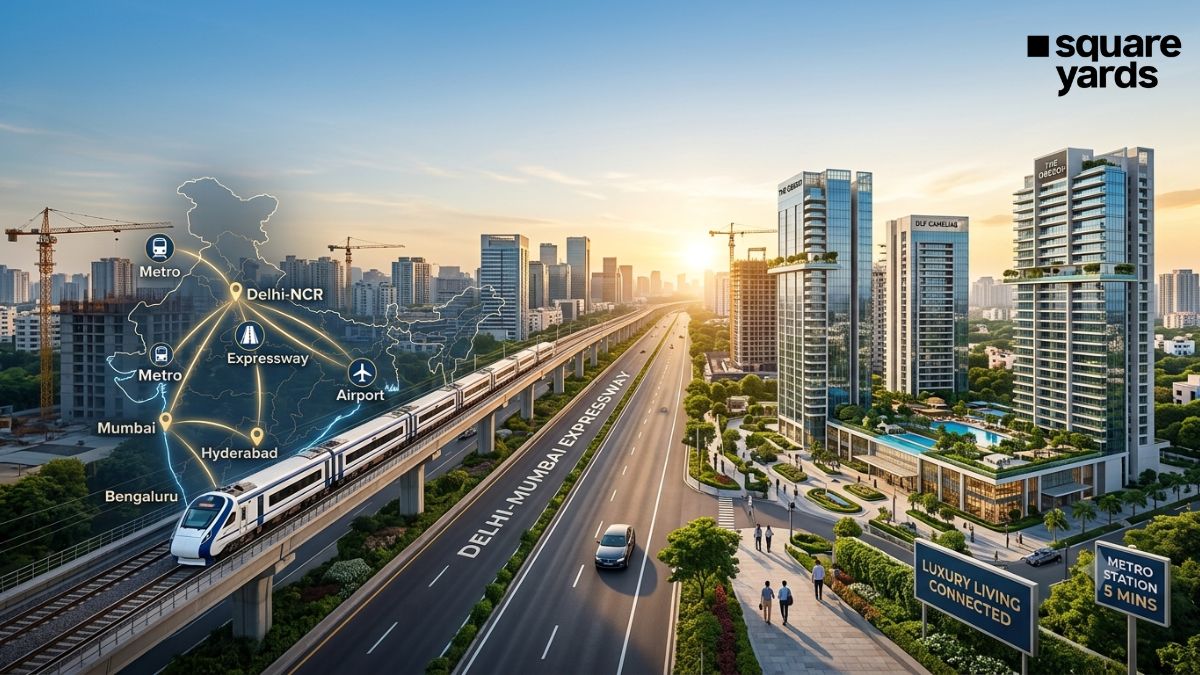
A new generation of luxury destinations is emerging, not because they have replaced these iconic neighborhoods, but because massive infrastructure investments are changing how cities grow. Airports, expressways, metro corridors and ring roads are making previously peripheral locations more accessible, allowing them to compete with traditional luxury markets.
According to Square Yards Data Intelligence, infrastructure is no longer simply supporting urban expansion. It is actively reshaping where luxury homebuyers choose to live and where developers are investing.
Connectivity is becoming the new luxury driver
Luxury buyers have traditionally prioritized central locations because they offered shorter commutes, established social infrastructure, and premium lifestyles. But as cities expand, these advantages are no longer exclusive to legacy neighborhoods.
Improved connectivity has significantly reduced travel times, making emerging micro-markets far more attractive. As accessibility improves, developers are launching integrated townships, branded residences, and premium communities in these locations, giving buyers access to larger homes, modern amenities, and stronger long-term appreciation potential.
Rather than replacing traditional luxury districts, infrastructure is creating a second generation of premium residential hubs in India’s luxury real estate market.
Delhi-NCR: New corridors challenge established luxury markets
Projects such as the Dwarka Expressway, Southern Peripheral Road (SPR), and the upcoming Noida International Airport at Jewar have dramatically changed buyer preferences across the region. Gurgaon’s SPR corridor now commands average prices of around Rs 15,600 per square foot (psf), recording an 18.4% year-on-year increase, driven by improving metro connectivity and road infrastructure.
The Dwarka Expressway is also steadily narrowing the pricing gap with Gurgaon’s established Golf Course Road, while the Yamuna Expressway corridor has emerged as one of India’s fastest-growing luxury destinations. Supported by the upcoming international airport, apartment prices along the Yamuna Expressway have increased by nearly 90% between FY21 and FY25, outperforming several mature markets across NCR.
Mumbai: Prestige stays, growth moves outward
South Mumbai continues to command unmatched prestige, with asking prices exceeding Rs 41,000 psf, while the city’s median luxury housing rate remains close to Rs 38,000 psf. Yet future luxury growth is increasingly shifting beyond the island city.
Infrastructure projects such as the Navi Mumbai International Airport and the Mumbai Coastal Road are driving premium demand toward Navi Mumbai and Panvel. Square Yards data shows apartment prices around the airport corridor rising by approximately 74% between FY21 and FY25. While South Mumbai is unlikely to lose its status as India’s luxury real estate address, much of the next phase of high-end residential development is taking shape in these emerging corridors.
Bengaluru: Airport-led growth redefines the luxury map
Historically, premium housing was concentrated in South Bengaluru. However, infrastructure expansion around Kempegowda International Airport has shifted luxury demand decisively toward the north.
Between FY21 and FY25, apartment prices in North Bengaluru appreciated by approximately 69%, while plotted developments surged by nearly 118%, significantly outperforming most other parts of the city.
Improved road networks, expanding IT corridors, and airport connectivity have enabled North Bengaluru to achieve price levels comparable to long-established premium neighborhoods, encouraging developers to launch large luxury townships and high-end residential projects.
Hyderabad: Airport connectivity creates a new luxury belt
Development around Rajiv Gandhi International Airport and the Outer Ring Road has transformed the city’s southern corridor into an emerging luxury destination.
Apartment prices in airport-linked micro-markets rose by approximately 74% between FY21 and FY25, compared with around 48% across the rest of Hyderabad. Plotted developments delivered even stronger appreciation.
Improved connectivity, combined with expanding commercial activity, has turned locations once considered peripheral into attractive destinations for premium residential investment.
Infrastructure is also influencing market activity
The impact of infrastructure on India’s luxury real estate market is not limited to pricing. It is increasingly shaping where transactions happen and where developers choose to launch projects.
Square Yards data shows Mumbai recorded nearly 67,000 high-value residential registrations, worth over Rs 108,500 crore, during the twelve months ending July 2026. Cities including Pune, Hyderabad, Bengaluru, and Noida also witnessed strong luxury housing activity despite rising ticket sizes.
Developers are responding by concentrating premium launches in infrastructure-led growth corridors, reflecting growing confidence that future demand will increasingly favor well-connected locations over traditional central business districts.
The pricing gap is narrowing
Although legacy luxury markets continue to command the highest prices, the difference is steadily shrinking. Gurgaon Golf Course Road averages nearly Rs 22,000 psf, and Noida Expressway is approaching Rs 12,750 psf, while Bengaluru’s central market exceeds Rs 13,800 psf.
More importantly, airport-linked and infrastructure-driven corridors are recording faster appreciation than many established luxury districts. This suggests that infrastructure is influencing not only where luxury homes are being built, but also where long-term capital appreciation is likely to be strongest.
India’s luxury real estate geography is emerging
Today’s premium destinations are increasingly being shaped by infrastructure. Airports, expressways, metro systems, and major road networks are improving accessibility, attracting commercial investment, encouraging residential development, and creating a self-reinforcing cycle of value creation.
Traditional luxury districts will continue to retain their prestige and exclusivity. However, the country’s next generation of premium residential markets is emerging along infrastructure-led growth corridors.
For developers, these locations offer room to build larger, integrated luxury communities. For affluent homebuyers and investors, they present an opportunity to enter premium markets that combine modern infrastructure with stronger long-term growth potential.