
Metro corridors are becoming an important factor in determining where housing demand is shifting across India’s major cities. While they are designed to improve urban mobility, their influence increasingly extends to where developers launch projects, how new micro-markets emerge, and which neighborhoods attract sustained buyer interest. The relationship, however, is not the same across every city.
An analysis of five metro corridors, supported by Square Yards market data, shows that transit infrastructure alone does not reshape housing markets. Employment hubs, industrial activity, planning policies, and existing urban infrastructure continue to influence how residential demand develops around each corridor.
Why metro corridors are influencing housing growth
Metro corridors rarely transform housing markets on their own. Their impact becomes more visible when improved connectivity is combined with employment centers, commercial activity, planned infrastructure, and available residential supply. Together, these factors influence where developers invest and where homebuyers look beyond established city centers.
The five corridors covered in this article illustrate this pattern in different ways. Some are strengthening mature housing markets, while others are accelerating demand in locations that were previously on the edge of urban expansion.
How five metro corridors are shaping real estate market trends
Although every metro corridor improves connectivity, the housing market does not respond in the same way everywhere. Some corridors are driven by industrial expansion, others by established IT hubs or planning policies. Looking at each example individually helps explain how different factors shape local housing demand.
Taken together, these examples show that metro infrastructure works as an enabler rather than the sole driver of housing growth. The strength of each market ultimately depends on the economic activity and urban development surrounding the corridor.
Southern Peripheral Road metro corridor, Gurgaon
The Southern Peripheral Road (SPR) Metro corridor is strengthening one of Gurgaon’s fastest-growing housing belts. Connecting key sectors with NH-48, Golf Course Extension Road, and major employment hubs, the corridor is expanding access across New Gurgaon.
The average asking price across Gurgaon stands at Rs. 14,850 per sq. ft., while Manesar offers a lower entry point at Rs. 11,850 (psf). The SPR corridor has also recorded 160% price appreciation over the last five years and 18.4% year-on-year growth, placing it among the city’s strongest-performing markets.
The corridor demonstrates how metro expansion can amplify demand when it coincides with manufacturing growth, established road infrastructure, and sustained private investment.
Property market at a glance
- Average asking price (Gurgaon): Rs. 14,850 (psf)
- Average asking price (Manesar): Rs. 11,850 (psf)
- SPR appreciation (5 years): 160%
- Year-on-year appreciation: 18.4%
Bengaluru Blue Line metro corridor
HSR Layout and BTM Layout sit along the same metro corridor but occupy different positions in Bengaluru’s housing market. Market data places HSR Layout at an average asking price of Rs. 15,450 (psf), compared with Rs. 11,500 (psf) in BTM Layout, reflecting the premium attached to a more established neighborhood.
The comparison suggests that metro connectivity supports demand, but existing neighborhood maturity continues to influence pricing across the corridor.
Mumbai Metro Line 5
Metro Line 5 is linking Thane, Bhiwandi, and Kalyan, drawing greater attention to housing markets along the corridor.
|
Local market |
Data |
|
Thane |
Average asking price: Rs. 15,350 (psf) |
|
Bhiwandi |
Median asking price: Rs. 16,900 (psf) |
|
Rental market |
Rs. 25,100/month (1 BHK) to Rs. 60,100/month (3 BHK) |
Unlike the Gurgaon or Bengaluru corridors, the Mumbai corridor highlights the importance of rental demand alongside capital values. This suggests that metro-led markets do not always follow the same growth pattern and can attract different buyer and tenant segments.
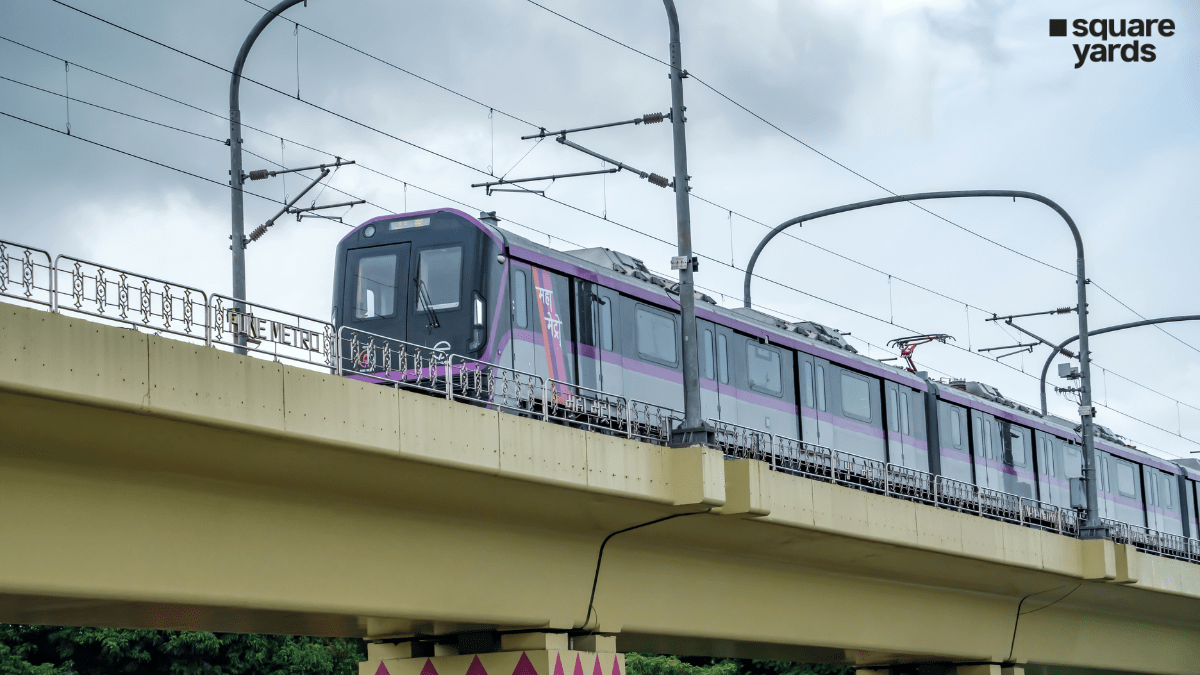
Pune Metro Line 3
Pune Metro Line 3 connects Hinjawadi, Baner, and other key employment hubs, improving access across one of the city’s busiest IT corridors.
Hinjawadi
- Average asking price: Rs. 11,400 (psf)
- Rental yield: 4.21%
Baner
- Average asking price: Rs. 15,700 (psf)
- Rental yield: 3.36%
The corridor illustrates how employment clusters continue to shape housing demand even after metro connectivity improves. While Hinjawadi attracts professionals working in Pune’s IT sector, Baner reflects the pricing strength of an established residential market.
Delhi TOD and metro influence zone
Delhi’s Transit-Oriented Development (TOD) policy is guiding growth around metro corridors rather than road networks alone. The average asking price in Dwarka is Rs. 15,300 (psf), with an average rental yield of 2.12%. Sector 17 has also posted 27.86% year-on-year appreciation.
Delhi differs from the other corridors because planning policy plays a more direct role in guiding development, demonstrating that metro expansion alone does not determine market performance.
What the five metro corridors reveal
The five corridors reveal that metro infrastructure influences housing markets in different ways depending on the local economic and planning context. Rather than creating identical outcomes, each corridor reflects a distinct combination of employment, infrastructure, and policy. The strongest residential markets continue to emerge where transit expansion is supported by employment, infrastructure, and long-term urban planning.
- Employment hubs remain the strongest driver of demand. The Gurugram-Manesar belt and Pune’s Hinjawadi corridor demonstrate how industrial and IT activity continue to attract housing demand alongside metro expansion.
- Established neighborhoods continue to command premium prices. HSR Layout, Baner, and Dwarka report higher average asking prices than several emerging locations connected through the same transit network.
- Emerging corridors are widening housing choices. Locations such as Manesar and Bhiwandi illustrate how metro connectivity is expanding buyer interest beyond traditional residential hotspots.
- Planning policies influence market performance. Delhi’s Transit-Oriented Development (TOD) approach highlights how policy can shape housing growth alongside public transport investment.
The next phase of metro-led residential growth
The five metro corridors show that housing growth is shaped by more than transport infrastructure alone. Metro expansion creates the framework, but employment, planning, and existing urban development determine how individual markets respond. As more corridors become operational across India, understanding these local differences will be as important as tracking the projects themselves.