
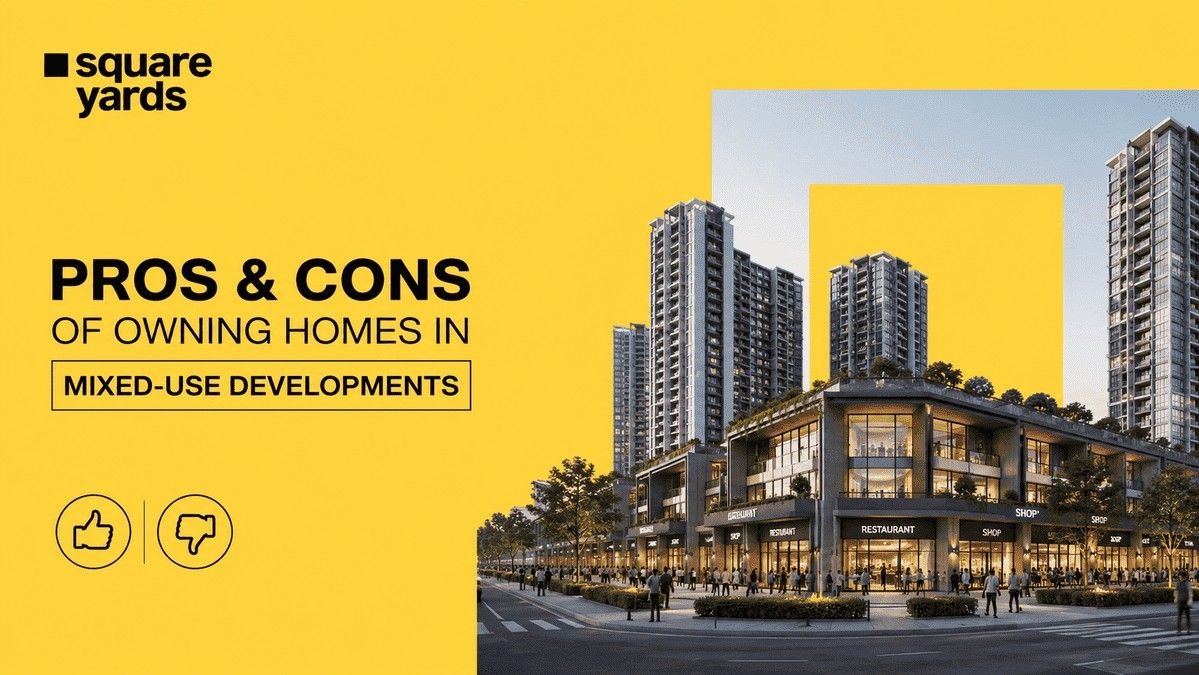
Radhika Chatterjee, a 48-year-old academic researcher from Kolkata, recalls the moment clearly. Buying her first home in a commercial-residential complex was supposed to be exciting. Instead, for most of the journey, it just felt overwhelming – and nobody was giving her straight answers about the daily realities of living above retail spaces.
She’s not alone. In India’s rapidly urbanising cities, mixed-use developments are being marketed aggressively as the future of convenient urban living. But the conversation rarely covers what owning a home in one of these projects actually looks and feels like on a Tuesday morning when the ground-floor café opens at 7am.
This guide covers the pros and cons of owning homes in mixed-use developments in practical terms: what you need to know, where most people go wrong, and how to make property decisions that hold up over time.
Mixed-Use Developments: What You Need to Know First
What is a mixed-use development? It’s a property that brings residential and commercial spaces together under one roof – apartments sitting above retail shops, offices, restaurants, or service providers – all within a single building or complex. In Indian cities, these projects are showing up more and more across high-density urban corridors and metro-adjacent growth zones, often packaged as the smarter, more connected way to live.
When it comes to actually weighing the pros and cons of owning homes in mixed-use developments, the gap between knowing the theory and applying it correctly is where most people lose ground. The fundamentals matter – but so does the order in which you work through them.
The Core Principle Behind Mixed-Use Ownership
The single most important shift any buyer needs to make is moving from reactive to proactive. Most people only start evaluating integrated residential and commercial properties when they’re already under pressure – a deadline, a developer’s pitch, or a transaction that’s halfway done. The buyers who consistently walk away with better outcomes are those who build their understanding of these property ecosystems well before the decision window opens.
Why Evaluating the Property Format Matters
Every property decision has a compounding effect. Getting the realities of living in a mixed-use development wrong at the point of purchase can take years to correct – and in the meantime, you’re dealing with daily friction you didn’t sign up for: noise, footfall, parking fights, or commercial activity bleeding into residential hours. Getting it right early, on the other hand, creates a foundation that genuinely delivers on convenience and makes every financial decision that follows easier to defend.
For a clearer picture of how market values are moving in your target location, reviewing a current online property valuation can help you benchmark your decisions against real data rather than developer claims.
Key Factors to Evaluate
Breaking this down into steps removes the overwhelm. The goal isn’t to analyse everything at once – it’s to work through each dimension in sequence, letting each answer shape the next question.
Step 1: Establish Your Baseline
Before you start comparing options, be clear about what you’re comparing against. That means setting your constraints in writing: budget ceiling, timeline, non-negotiables, and the risk range you’re genuinely comfortable with – not the one that sounds reasonable in a sales meeting. For a home in a mixed-use development specifically, your non-negotiables need to address noise tolerance, privacy expectations, and how much the quality of a lobby or building entrance actually matters to your daily experience.
Step 2: Map the Market Context
National trends make for interesting reading, but they rarely tell you what’s happening in the 2km radius that actually matters to your decision. What’s going on at the micro-market level determines whether the timing works in your favour, how much room you have to negotiate, and what a realistic hold period looks like. In 2025-26, Indian cities with active metro expansion and infrastructure investment are showing appreciation that outpaces the national average – particularly in micro-markets sitting adjacent to metro corridors.
Step 3: Validate Before Committing
The most reliable validation isn’t more time reading – it’s triangulating your research against independent data sources. The goal isn’t to eliminate uncertainty; it’s to cut out the avoidable errors. A structured 48-hour research pause before any decision point tends to produce more clarity than weeks of passive information-gathering.
Pros and Cons of Owning Homes in Mixed-Use Developments
Quick answer: Mixed-use developments offer multi-income potential, urban convenience, and strong appreciation in growth corridors – but they also bring noise concerns, higher maintenance costs, financing complexity, and resale liquidity challenges that pure residential properties simply don’t carry.
|
Factor |
Pro |
Con |
|
Income potential |
Rental yield from residential + commercial exposure |
Commercial vacancy can affect overall property income |
|
Convenience |
Retail, dining, and services within the building |
Footfall and commercial activity can disrupt residential peace |
|
Appreciation |
Strong in urban growth corridors and metro zones |
Slower resale in markets with limited mixed-use buyer demand |
|
Maintenance costs |
Shared infrastructure can reduce per-unit cost |
Higher society charges due to commercial upkeep obligations |
|
Financing |
Available through home loans in many cases |
Some lenders apply commercial rates to mixed-use floors |
|
Community |
Vibrant, active environment with built-in amenities |
Privacy can feel compromised in high-footfall buildings |
|
Property tax |
Depends on state and floor use declaration |
Commercial floors may attract higher property tax rates |
|
Management |
Professional building management often included |
Complex management structure can slow grievance resolution |
Pros of Owning Homes in Mixed-Use Developments
Multiple income streams and appreciation potential One of the clearest advantages of mixed-use developments is the income diversification that’s structurally built in. When residential and commercial tenants both occupy the same building, a dip in one segment is often cushioned by stability in the other. In high-demand urban locations – near metro stations, business districts, or expressway corridors – mixed-use properties have shown strong capital appreciation over time, largely because the land use intensity is higher than in single-purpose residential blocks.
Unmatched urban convenience For anyone actually living in the unit, having grocery stores, pharmacies, cafes, and service providers on the ground floor is a quality-of-life upgrade that’s hard to put a number on. In Indian metros where commutes are long and daily errands eat into evenings, that built-in convenience carries a real and measurable premium – both in how the property feels to live in and in how it’s valued by tenants.
Stronger rental demand in the right locations Homes in mixed-use developments tend to attract a specific type of tenant – professionals, young couples, and urban residents who actively seek out walkability and built-in amenities, and who’ll pay above market to get it. In well-located projects, this translates to above-average rental yields compared to equivalent residential-only buildings in the same zone.
Energy efficiency and sustainable design trends In 2025-26, mixed-use developments are increasingly being built with green building principles at their core – shared infrastructure, optimised common areas, and energy-efficient systems that reduce per-unit operating costs over time. For Indian buyers who are increasingly factoring sustainability into their decisions, this is becoming less of a bonus and more of a baseline expectation.
Cons of Owning Homes in Mixed-Use Developments
Noise, footfall, and lifestyle friction This is the part that rarely makes it into the brochure. Lower residential floors in mixed-use buildings regularly deal with noise from retail activity, delivery vehicles, and customer footfall through commercial hours. If the building has restaurants or entertainment businesses, that impact can run well past dinner. For buyers with young children, elderly family members, or anyone whose work happens at home, this isn’t a minor inconvenience – it’s a daily reality that needs to be assessed before the purchase, not discovered after.
Higher maintenance charges and property tax complexity Mixed-use buildings typically cost more to maintain than pure residential complexes because the common infrastructure is serving two different types of occupiers. Society maintenance charges reflect that. Property tax adds another layer of complexity – some states apply differentiated rates based on the declared use of each floor, which catches a meaningful number of buyers off guard when the first annual bill arrives.
Financing complexity Home loan eligibility for units in mixed-use developments isn’t always as straightforward as buyers expect. Some lenders look closely at the commercial-to-residential ratio of the project before approving standard home loan rates, and the terms or approval timelines can differ from what you’d get on a purely residential purchase. Confirming your loan eligibility early in the process – before you’re emotionally committed to a specific unit – is genuinely important here.
Resale liquidity challenges The buyer pool for homes in mixed-use developments is smaller than for standard residential properties. Some buyers specifically filter these projects out. That doesn’t make resale impossible – in well-located projects with strong commercial occupancy, it can be quite straightforward – but it does mean your exit timeline may stretch longer, and a quick sale may require pricing at a steeper discount than a comparable pure residential unit would need.
Common Pitfalls and How to Avoid Them
These mistakes show up repeatedly – across different markets, different property types, and different buyer profiles – because they all trace back to the same root cause: prioritising what’s familiar or well-marketed over what’s actually accurate.
- Over-relying on asking price as a proxy for real market value
- Ignoring carrying costs – maintenance charges, property tax, vacancy periods – when calculating net returns
- Anchoring on a single data point rather than a pattern across comparable transactions
- Treating liquidity as an afterthought rather than a planning input
- Letting documentation decisions slide until they become urgent
- Not physically visiting the building at different times of day to see what noise and footfall actually look like in practice
Every one of these is fixable – but fixing them before a transaction costs far less than fixing them after.
A Practical Framework for Decision-Making
A practical framework for evaluating the pros and cons of owning homes in mixed-use developments doesn’t need to be complicated. What matters is consistency, not sophistication. A repeatable process you apply to every decision will produce better outcomes over time than a brilliant approach you only use occasionally.
Applying the Framework to Your Situation
The framework works best when it’s shaped around your specific profile. A three-year investor needs to weight variables differently than someone planning a ten-year hold. An NRI managing a property from abroad has different risk priorities than a resident buyer in the same city. Work out which variables actually apply to your situation, weight them against your timeline and risk tolerance, and apply them consistently. The end result should be a ranked set of options and a clear decision trigger – not an open-ended comparison that quietly extends itself indefinitely.
What the Data Actually Shows
Across Indian mixed-use real estate markets in 2025-26, a few consistent patterns are emerging. Cities where infrastructure investment is active – metro expansion, expressway projects, commercial zone development – are showing appreciation that outpaces the national average. Micro-markets sitting adjacent to metro corridors are repricing faster than city-level averages imply.
Rental yield data shows a divided market between premium and mid-segment properties in mixed-use developments. Mid-segment units have lower headline yields, but more stable occupancy. This variation in stability is more important for investors seeking predictable income over a long period of time than the yield gap suggests
Mixed-Use Property: Key Checklist
|
Item |
Action / Consideration |
|
Define your objective |
Investment return, owner-occupation, or a combination of both |
|
Establish your budget and financing baseline |
Include stamp duty, registration, society deposits, and incidental costs |
|
Research the micro-market, not just the city |
Focus on 2km radius data – not metro-level averages |
|
Visit the building at different times of day |
Assess commercial noise, footfall, and parking situation firsthand |
|
Validate all documentation independently |
Do not rely solely on the developer or seller’s copies |
|
Confirm home loan eligibility upfront |
Check lender position on mixed-use project financing before committing |
|
Calculate total cost of ownership |
Include maintenance charges, property tax, and expected vacancy periods |
|
Confirm compliance requirements for your profile |
Investor, NRI, and first-time buyer rules differ significantly |
|
Run a downside scenario before deciding |
What happens if appreciation is 0% for 3 years? |
|
Engage a verified advisor before signing |
One conversation before commitment costs less than one error after |
How Square Yards Supports You
Meena Pillai, a 39-year-old product manager from Pune, was exploring the lifestyle and infrastructure aspects of mixed-use properties when she was working with a Square Yards advisor. Armed with verified market data, structured timelines and transaction support, Meena could make evidence-based decisions – not guesswork.
From the first search to long-term ownership, Square Yards covers the entire property lifecycle with offerings that include mortgage assistance, rental management and interiors.
Take the Next Step
Good information means the difference between a good property decision and an expensive one. Visit Square Yards for market data, verified listings and advisory support that puts you in charge of your next move.
Frequently Asked Questions:
1. What is a mixed-use development in real estate?
At its core, a mixed-use development is a single building or complex where residential units and commercial spaces, retail shops, offices, restaurants; coexist under one roof. For owners, that combination translates to lifestyle convenience and income potential that a standalone residential property simply can’t replicate.
2. What are the main pros of owning homes in mixed-use developments?
The advantages that actually move the needle are multiple income streams, strong appreciation in growth corridors, and the kind of urban convenience that working professionals in Indian metros are genuinely willing to pay a premium for. Add higher rental demand from tenants who prioritise walkability and built-in amenities, and the investment case becomes harder to dismiss.
3. What are the cons of owning homes in mixed-use developments?
The drawbacks most buyers discover too late: noise and footfall from commercial activity bleeding into residential hours, higher maintenance charges, property tax complexity that varies by floor and state, financing complications that standard home loan assumptions don’t prepare you for, and a narrower resale buyer pool than you’d have with a pure residential property.
4. Are home loans available for units in mixed-use developments?
Yes, but not always on the terms buyers expect. Eligibility depends heavily on the lender and the project’s commercial-to-residential ratio, and some banks apply different financing terms to mixed-use projects entirely. Verifying loan eligibility before you’re emotionally committed to a unit is one of those steps that costs nothing upfront and can save you considerably later.
5. Are homes in mixed-use developments a good investment in India in 2026?
They can be and in the right micro-markets, quite a strong one. But “right micro-market” is doing a lot of work in that sentence. Strong metro connectivity and active commercial activity are the two signals worth tracking. Beyond location, buyers need to honestly account for total ownership costs, liquidity timelines, and whether the lifestyle trade-offs actually fit before calling it a sound decision.