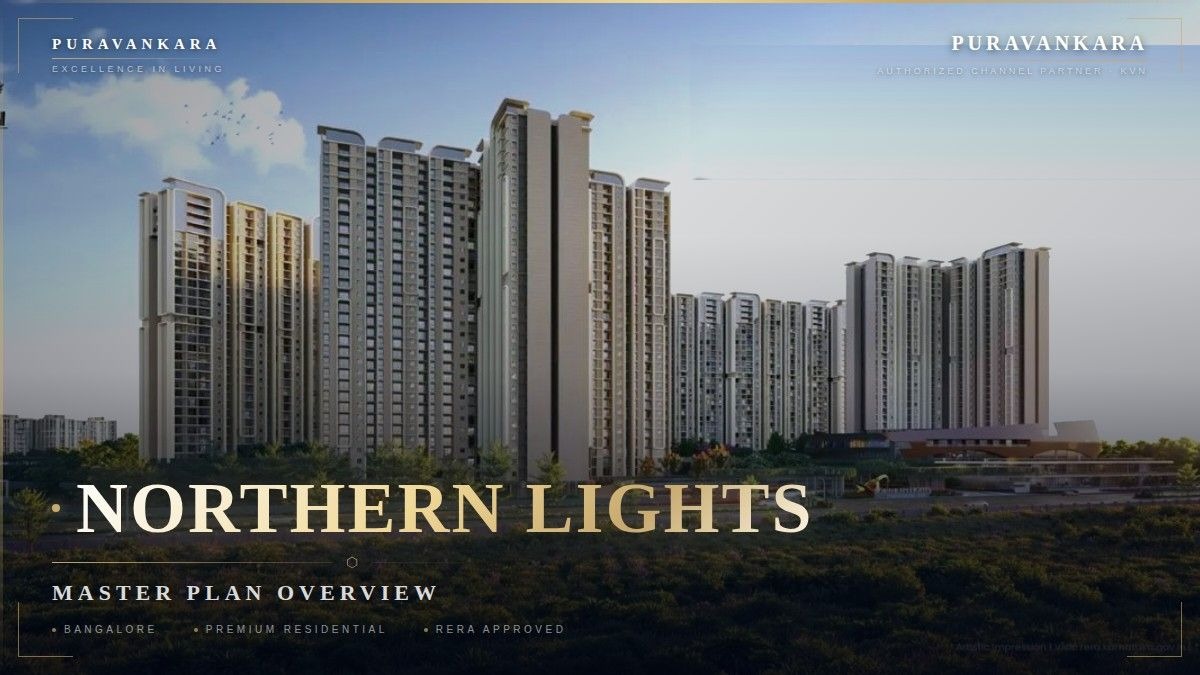
A township’s master plan is its DNA. It determines how much of the total land is built upon versus left open, how towers are placed relative to each other, where common areas are positioned, and ultimately how pleasant it is to live in the community on a daily basis. The Purva Northern Lights at Bagalur has been designed with a stated 77 percent open space ratio across 24.59 acres. This blog explains what that means architecturally, how the 7.89-acre central greens anchors the design, and why the master plan of this project is genuinely distinct from most urban apartment developments.
Table of contents
- Understanding the 24.59-Acre Site
- What Does 77% Open Space Mean?
- The 7.89-Acre Central Greens: The Heart of the Township
- Tower Placement and Density Analysis
- The Multi-Phase Design Structure
- Sustainability Features in the Master Plan
- Why the Master Plan Matters for Resale Value
- FREQUENTLY ASKED QUESTIONS
Understanding the 24.59-Acre Site
To put 24.59 acres in context: this is roughly equivalent to 18 to 19 full-size football fields. For a residential project to use this much land to house just under 3,000 apartments means the average density is significantly lower than typical urban apartment complexes, where 2,000 to 3,000 units might be packed into 5 to 8 acres through high-rise construction. The Purva Northern Lights master plan leverages this scale to create a more livable environment.
The large land area at Northern Lights translates directly into more breathing room between towers, wider internal roads, generous landscaping, and a sense of openness that high-density urban projects cannot replicate.
What Does 77% Open Space Mean?
The 77 percent open space figure means that of the total 24.59 acres, approximately 18.93 acres is not occupied by buildings, parking structures, or other covered construction. The Purva Northern Lights dedicates this open area to:
- Central green lawns and garden landscape
- Internal roads, pathways, and cycling tracks
- Outdoor amenity zones including sports courts, jogging tracks, and play areas
- Natural landscaping, tree cover, and water features
- Open areas between towers that ensure natural light, ventilation, and privacy for individual units
By comparison, the RERA-mandated minimum open space requirement in Bangalore varies between 10 to 30 percent depending on the FSI zone. The Puravankara Northern Lights master plan at 77 percent is well above the minimum, reflecting a genuine design philosophy rather than a regulatory compliance exercise.
The 7.89-Acre Central Greens: The Heart of the Township
The signature landscape feature of Purva Northern Lights is its 7.89 acres of central greens, a continuous green space positioned at the core of the township. The Purva Northern Lights master plan integrates this as a central design element rather than a peripheral feature. At 7.89 acres, it is a genuine park, comparable in size to some public parks in Bangalore.
The central greens are designed to serve multiple functions:
- A visual and sensory green core that residents can see from their balconies and common areas
- A gathering and recreation zone where the jogging track, yoga pavilion, and informal seating areas are likely to be positioned
- A microclimate moderator, large green areas reduce the urban heat island effect, keeping temperatures in the township lower than the surrounding built environment
- An acoustic buffer between towers, reducing the noise that travels between units in closely spaced high-rise developments
Tower Placement and Density Analysis
With 2,973 total homes across 24.59 acres, the average density at Northern Lights is approximately 121 units per acre. The Purva Northern Lights ensures this lower density compared to typical urban developments, where projects might have 200 to 350 units per acre. This means:
Greater distance between towers, improving privacy and reducing overlooking
Better natural light penetration to lower floors
Improved cross-ventilation for individual units
Less crowding around shared amenities like the clubhouse and pool
The Multi-Phase Design Structure
The project is structured as a multi-phased development with three RERA-registered phases (KVN, KVN Phase 2, and KVN Phase 3). The Purva Northern Lights master plan follows a phased execution approach, where construction proceeds section by section. Early-phase buyers may experience some construction activity in adjacent phases during their initial years of occupation, which is standard in township developments.
Sustainability Features in the Master Plan
The Purva Northern Lights master plan incorporates several sustainability-oriented design choices:
- Rainwater harvesting systems designed to capture and reuse roof and surface runoff
- Sewage treatment plant (STP) for treating wastewater on-site before disposal or reuse in landscaping
- Large green area and tree planting as part of the 77% open space mandate, contributing to local biodiversity and air quality
- Treated water supply, ensuring water quality for domestic use across the entire township
Why the Master Plan Matters for Resale Value
A well-planned township with generous open spaces consistently commands a resale premium over dense urban complexes. The Purva Northern Lights master plan plays a key role in long-term value appreciation. Buyers and tenants in the Rs. 30,000 to Rs. 80,000 monthly rent bracket, which Puravankara Northern Lights will target, actively seek out green, low-density communities. The master plan is therefore not just a quality-of-life asset; it is a long-term value protection strategy for homeowners.
FREQUENTLY ASKED QUESTIONS
How does a high open space ratio benefit residents in daily living?
A higher open space ratio ensures better air circulation, reduced congestion, more greenery, and a healthier living environment, making day-to-day life more comfortable compared to dense developments.
What is the importance of central greens in a township layout?
Central greens act as the focal point of the community, providing recreational space, improving aesthetics, and enhancing overall well-being by offering residents a large, accessible green zone.
How does lower density impact the quality of living in this project?
Lower density means fewer units per acre, which results in less crowding, quieter surroundings, shorter wait times for amenities, and improved privacy for residents.
Will residents face construction disturbance due to phased development?
In multi-phase projects, early residents may experience some construction activity nearby, but phased execution ensures better planning and gradual infrastructure readiness across the township.
How do sustainability features in the master plan add long-term value?
Features like rainwater harvesting, sewage treatment, and large green cover help reduce maintenance costs, improve environmental efficiency, and enhance the long-term livability of the project.