
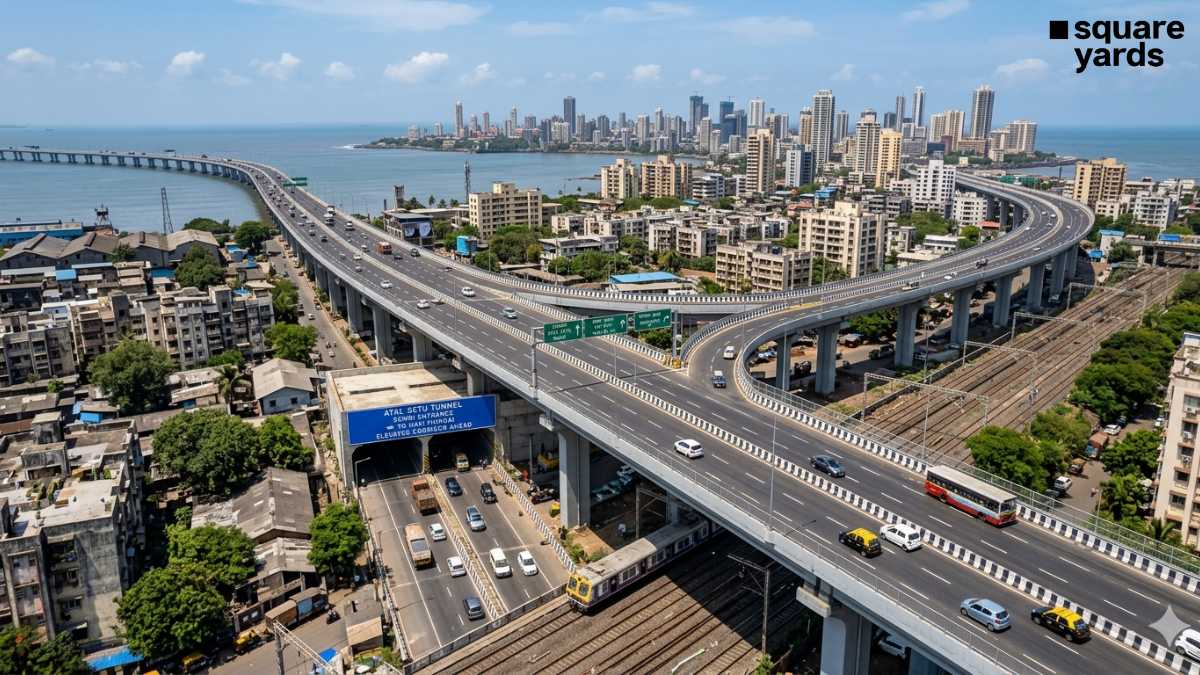
Mumbai’s next real estate growth story may not be driven solely by new launches or luxury towers. Instead, it could be shaped by a new mobility spine connecting the city’s eastern and western edges. At the center of this transformation is the Sewri-Worli Elevated Corridor (SWEC), a critical infrastructure project that will connect the Mumbai Trans Harbor Link (Atal Setu) with the Bandra-Worli Sea Link and the Coastal Road. This will create a seamless east-west transit chain across the city.
The project’s significance extends well beyond transportation. By compressing travel times between eastern harbor-side locations and Mumbai’s premium western districts, the corridor is expected to alter buyer preferences, investment flows, and residential demand patterns across multiple micro-markets.
Mumbai’s missing infrastructure link
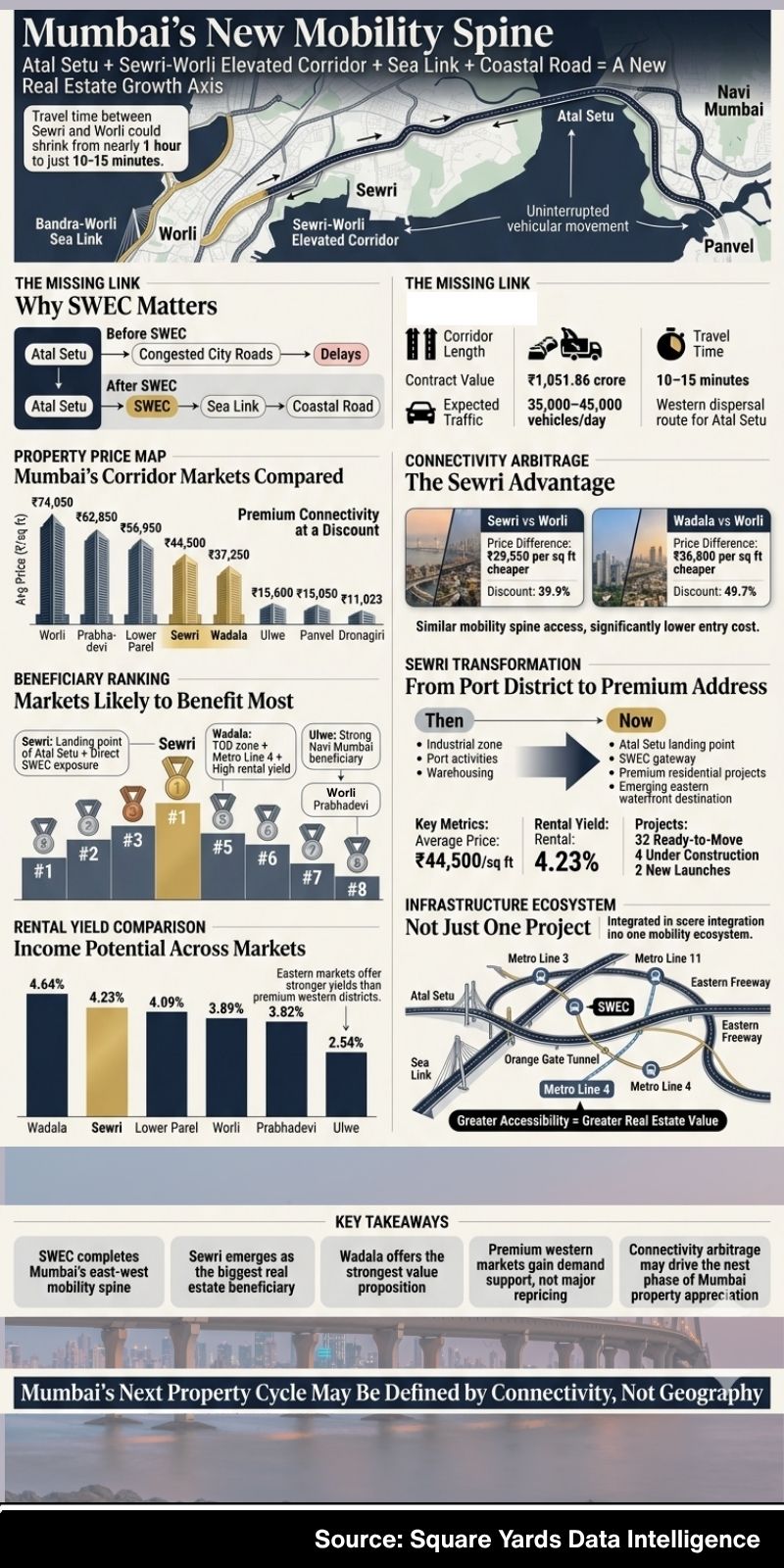
The Rs 1,052-crore SWEC is a four-lane elevated corridor forming part of the Mumbai Trans Harbor Link dispersal system. The project spans approximately 4.5 km, includes nearly 2.9 km of ramps.
Atal Setu has already connected Mumbai with Navi Mumbai through a 21.8-km sea bridge. On the western side, the Bandra-Worli Sea Link and Coastal Road have significantly improved north-south connectivity. SWEC is intended to stitch these assets together into a single high-speed corridor, assuming major infrastructural significance.
Expected to be completed by 2026-end the upcoming project will cut the travel time between Sewri and Worli to approximately 10-15 minutes from nearly an hour during peak congestion.
Sewri-Worli elevated corridor: How will it impact property prices?
Historically, Mumbai’s seafront neighborhoods commanded substantial price premiums due to superior connectivity, access to business and lifestyle advantages. However, infrastructure upgrades are beginning to challenge that equation.
According to Square Yards Data Intelligence (March 2026), Worli remains the city’s most expensive market among the corridor-linked locations, with average residential values at Rs 74,050 per square foot (psf). Prabhadevi follows at Rs 62,850 psf, while Lower Parel stands at Rs 56,950 psf. In comparison, Sewri is priced at Rs 44,500 psf and Wadala at Rs 37,250 psf.
The pricing gap creates what analysts call “connectivity arbitrage”. Buyers can access the emerging infrastructure spine at significantly lower entry points while benefiting from increasingly comparable mobility advantages. Compared with Worli, Sewri offers nearly a 40% discount in average pricing, while Wadala trades at almost 50% lower rates.
Sewri: From port district to premium residential hub
Among all corridor-linked markets, Sewri appears best positioned to benefit from the infrastructure-led transformation. Traditionally known for its port, industrial and warehousing activities, Sewri has undergone a remarkable repositioning over the past decade. Today, it occupies one of the most strategic locations in Mumbai’s transport network.
The locality serves as the Mumbai landing point of Atal Setu and the eastern anchor of the Sewri-Worli Elevated Corridor. It is also supported by the Eastern Freeway and is expected to benefit from future eastern waterfront redevelopment initiatives.
Despite comparatively affordable prices, the rental stock in Sewari offers annual yield of 4.23%, stronger than several premium western markets. This suggests Sewri is gradually evolving into a premium residential destination in its own right.
Wadala gets a connectivity shot
Neighboring Wadala is also emerging as a strong beneficiary of the corridor. The locality benefits from proximity to Sewri, direct access to the Eastern Freeway, and planned connectivity enhancements through Metro Line-4 and Transit-Oriented Development (TOD) initiatives. Value-wise, Wadala offers one of the most attractive price-to-connectivity propositions among Mumbai’s established residential districts.
Its rental yield of 4.64% is the highest among the core corridor markets analysed, indicating strong occupier demand alongside investment potential.
Premium markets gain through demand expansion
While Sewri and Wadala may experience the strongest re-rating potential, established premium districts are unlikely to be left behind. Worli, Prabhadevi and Lower Parel already form part of Mumbai’s luxury housing ecosystem, with several projects commanding prices above Rs 1 lakh psf.
Improved access from Navi Mumbai and eastern suburbs could expand the buyer catchment for these high-value markets. Rather than creating new luxury demand, SWEC is expected to deepen and broaden existing demand pools.
Lower Parel remains the most active market among the corridor-linked locations, recording over 1,300 annual registered transactions and gross sales exceeding Rs 3,000 crore. Worli and Prabhadevi continue to attract high-ticket residential investments and ultra-luxury buyers. For these markets, the corridor acts as a value enhancer rather than a value creator.
Navi Mumbai also stands to gain
The corridor’s influence extends beyond the island city of Mumbai.
On the Navi Mumbai side, Ulwe and Panvel are expected to gain from stronger integration with Mumbai’s employment and business districts. Ulwe currently records average residential values of Rs 15,600 psf and has emerged as one of the clearest beneficiaries of Atal Setu-led connectivity improvements. Panvel, meanwhile, dominates in transaction volumes and supply pipeline, supported by infrastructure developments including the upcoming Navi Mumbai International Airport.
However, the full economic impact of Atal Setu may only be realized once SWEC becomes operational and western dispersal bottlenecks are removed.