

Bihar does something almost no other state does: it prices stamp duty on the gender of both people in a property deal, not just the buyer. Sell from a man to a woman and the total works out to 7.6%. Flip the direction, woman to man, and it climbs to 8.4%. Every other combination, including joint ownership, sits at a flat 8%. Add in Bihar’s own valuation system, the MVR, and a 1% discount for registering online, and there’s a fair bit to unpack before you sign anything.
This guide walks through the current stamp duty in Bihar for every deed type, how the registration charges in Bihar are worked out, what documents you’ll need, and where buyers typically go wrong when budgeting for a purchase.
- What Is Stamp Duty in Bihar?
- Stamp Duty and Registration Charges in Bihar 2026: Current Rates
- Factors That Determine Your Stamp Duty in Bihar
- Why Bihar’s Rates Depend on Both Parties’ Gender
- Property Registration Charges in Bihar
- How to Calculate Stamp Duty and Registration Charges in Bihar
- Register Property through an Online Portal in Bihar:
- MVR (Minimum Value Register) / Circle Rate in Bihar
- The 1% Online Registration Discount in Bihar
- Stamp Duty and Registration Charges for Different Deeds in Bihar
- Gift Deed Stamp Duty in Bihar
- Rent Agreement / Lease Deed Stamp Duty in Bihar
- Agricultural Land Stamp Duty in Bihar
- Land Registration Charges in Bihar
- Common Mistakes Buyers Make While Calculating Bihar Registry Charges
- Documents Required for Property Registration in Bihar
- How to Register Property and Pay Stamp Duty in Bihar (Bhumijankari): Step-by-Step
- How to Get a Refund on Stamp Duty in Bihar
- Tax Benefit on Stamp Duty in Bihar
- Conclusion
What Is Stamp Duty in Bihar?
Stamp duty is a tax the state government charges on the document that transfers property, usually a sale deed but also gift deeds, lease agreements, and a handful of other instruments. It’s levied under the Bihar Stamp Act, drawn from the central Indian Stamp Act, 1899, and paying it is what makes your deed legally admissible; without it, the document won’t hold up as evidence in court if a dispute ever comes up.
Registration is a separate requirement under the Registration Act, 1908. Once stamp duty is paid, the deed still has to be formally recorded at the Sub-Registrar Office covering the property’s location. A third step, mutation, then updates the ownership entry in Bihar’s land records (the Jamabandi). Skip any one of these and your ownership isn’t really settled. That becomes obvious the moment you try to sell, take a loan against the property, or need to prove title in a dispute.
Put simply: stamp duty makes the transaction document valid, registration puts it on public record, and mutation reflects it in the government’s own land register. In Bihar, both stamp duty and registration are calculated on whichever is higher: your declared sale value or the government’s Minimum Value Register (MVR), and the applicable rate itself depends on the gender of the parties involved in the transfer.
Stamp Duty and Registration Charges in Bihar 2026: Current Rates
Here’s where the numbers currently stand for a standard sale deed. Both stamp duty and the registration charge in Bihar shift depending on whether the seller and buyer are male or female.
|
Transfer Type |
Stamp Duty |
Registration Fee |
Total |
|
Male to Female |
5.7% |
1.9% |
7.6% |
|
Female to Male |
6.3% |
2.1% |
8.4% |
|
Other (male-to-male, female-to-female, joint ownership) |
6% |
2% |
8% |
A man selling to a woman gets the lowest combined rate on the table. A woman selling to a man pays the most. Everything else, man to man, woman to woman, or a joint purchase, falls in between at a flat 8%. All three scenarios are calculated on whichever is higher: your agreed sale price or the property’s MVR. Whichever slab applies, the bihar stamp duty and land registration charges together stay in the 7.6% to 8.4% band, one of the narrower ranges among neighbouring states.
You’ll sometimes see this simplified online as “6.3% for a male buyer, 5.7% for a female buyer.” That’s not quite accurate. The rate depends on the gender of both the seller and the buyer, not just one side of the deal.
Factors That Determine Your Stamp Duty in Bihar
The final stamp duty and registration fees in Bihar on any transaction depend on more than just the property’s price. Before you calculate anything, it helps to know what actually moves the number:
- Gender of both parties: Bihar is one of the few states that bases the rate on the direction property moves between a man and a woman, not just who’s buying.
- Property location: MVR rates differ sharply between urban centres like Patna and rural blocks, so the same-sized plot can attract very different duty depending on where it sits.
- Property type: residential, commercial, agricultural, and industrial land are each valued differently under the MVR schedule, and industrial land carries its own exemption.
- Nature of the transaction: a straightforward sale, a gift to a relative, a lease, or a mortgage each attract different rates under the Indian Stamp Act as applied in Bihar.
- Declared value vs MVR: duty is charged on whichever figure is higher, so undervaluing a property doesn’t reduce your liability.
- Mode of registration: completing the process online through the Bhumijankari portal earns a flat 1% discount that isn’t available for offline registration.
- Relationship between parties: for gift deeds, whether the transfer is between close relatives or unrelated parties affects how the rate is applied.
Why Bihar’s Rates Depend on Both Parties’ Gender
This is the detail that sets Bihar apart from nearly every other state. Most states simply offer women a lower rate as buyers. Bihar instead looks at the direction property is moving between a man and a woman. A transfer into a woman’s name (male to female) is the cheapest option at 7.6% all-in. A transfer out of a woman’s name to a man is the costliest at 8.4%. Anything that doesn’t involve a change in gender ownership, man to man, woman to woman, or a joint purchase, lands in the middle at 8%.
The intent behind this structure is fairly transparent: it nudges families toward registering property in a woman’s name and keeping it there. For anyone planning how to structure a purchase or an internal family transfer, that’s a genuine financial consideration. On a high-value property, the difference between the cheapest and priciest slab can run into lakhs, and it’s worth working out before the sale deed is drafted rather than after.
Property Registration Charges in Bihar
Registration fees in Bihar follow the same gender-based structure as stamp duty rather than sitting at a flat rate:
- Male-to-female transfer: 1.9% registration fee
- Female-to-male transfer: 2.1% registration fee
- All other combinations, including joint ownership: 2% registration fee
- No upper cap: the full percentage applies regardless of how high the property value goes
- A small additional scanning/document-handling fee applies, though it’s minor compared to the main charge
On a ₹60 lakh property registered as a standard sale, that works out to roughly ₹1,20,000 in registration fees alone, separate from stamp duty. This fee is what actually places your name in the Sub-Registrar’s public record, which becomes the basis for mutation, resale, and any future loan against the property.
How to Calculate Stamp Duty and Registration Charges in Bihar
Working out your total liability comes down to a simple formula, repeated for each component:
- Step 1: Determine the property’s chargeable value: the higher of your agreed sale price or the government’s MVR for that locality and property type.
- Step 2: Identify the correct rate slab based on the gender of the seller and buyer (5.7%, 6.3%, or 6% for stamp duty; 1.9%, 2.1%, or 2% for registration).
- Step 3: Multiply the chargeable value by the stamp duty rate to get the stamp duty payable.
- Step 4: Multiply the chargeable value by the registration rate to get the registration fee payable.
- Step 5: Add the two figures together for your total statutory cost.
- Step 6: If registering online through Bhumijankari, subtract the 1% discount from the applicable charges.
This is the same basic approach used across most calculators, though the gender-based slab in Bihar makes it slightly more involved than states with a single flat rate.
Worked Examples: Rs 50 Lakh Property
Male-to-Female Transfer
|
Item |
Calculation |
Amount |
|
Chargeable value |
Assume ₹50,00,000 |
₹50,00,000 |
|
Stamp duty at 5.7% |
5.7% of ₹50,00,000 |
₹2,85,000 |
|
Registration fee at 1.9% |
1.9% of ₹50,00,000 |
₹95,000 |
|
Total statutory cost |
7.6% |
₹3,80,000 |
Female-to-Male Transfer
|
Item |
Calculation |
Amount |
|
Stamp duty at 6.3% |
6.3% of ₹50,00,000 |
₹3,15,000 |
|
Registration fee at 2.1% |
2.1% of ₹50,00,000 |
₹1,05,000 |
|
Total statutory cost |
8.4% |
₹4,20,000 |
Other (Male-to-Male or Joint Ownership)
|
Item |
Calculation |
Amount |
|
Stamp duty at 6% |
6% of ₹50,00,000 |
₹3,00,000 |
|
Registration fee at 2% |
2% of ₹50,00,000 |
₹1,00,000 |
|
Total statutory cost |
8% |
₹4,00,000 |
Most home loans don’t cover stamp duty and registration, so it’s worth setting aside roughly 8% of the property value from your own funds, separate from the loan amount. Registering online shaves off another 1%, which is a straightforward saving worth acting on.
Stamp Duty and Registration Charges in Other States
| State | Stamp Duty Charges |
|---|---|
| Maharashtra | Stamp Duty in Maharashtra |
| Gujarat | Stamp Duty in Gujarat |
| Uttar Pradesh | Stamp Duty in Uttar Pradesh |
| West Bengal | Stamp Duty in West Bengal |
| Delhi | Stamp Duty in Delhi |
| Madhya Pradesh | Stamp Duty in Madhya Pradesh |
| Rajasthan | Stamp Duty in Rajasthan |
| Karnataka | Stamp Duty in Karnataka |
| Telangana | Stamp Duty in Telangana |
| Goa | Stamp Duty in Goa |
| Andhra Pradesh | Stamp Duty in Andhra Pradesh |
| Kerala | Stamp Duty in Kerala |
| Uttarakhand | Stamp Duty in Uttarakhand |
| Jharkhand | Stamp Duty in Jharkhand |
| Assam | Stamp Duty in Assam |
| Punjab | Stamp Duty in Punjab |
| Odisha | Stamp Duty in Odisha |
| Himachal Pradesh | Stamp Duty in Himachal Pradesh |
| Chhattisgarh | Stamp Duty in Chhattisgarh |
| Tamil Nadu | Stamp Duty in Tamil Nadu |
| Jammu and Kashmir | Stamp Duty in Jammu and Kashmir |
| Haryana | Stamp Duty in Haryana |
Register Property through an Online Portal in Bihar:
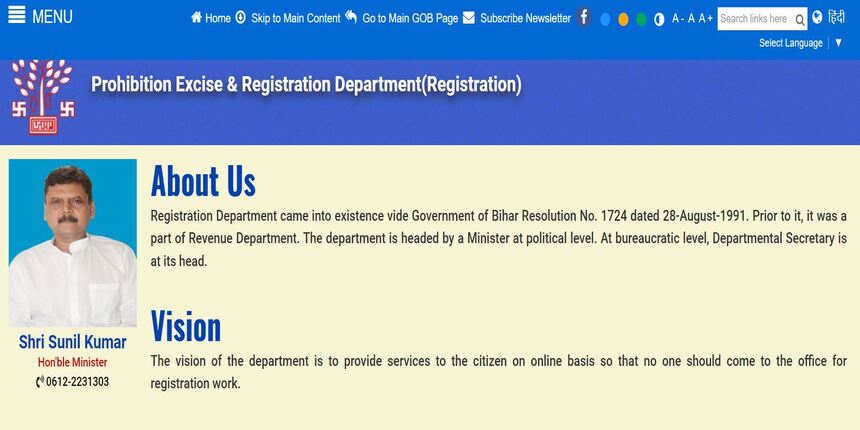
- Go to the Department of Registration’s official website at www.biharregd.gov.in. Select the ‘E-services for Registration’ tab on the resulting page.
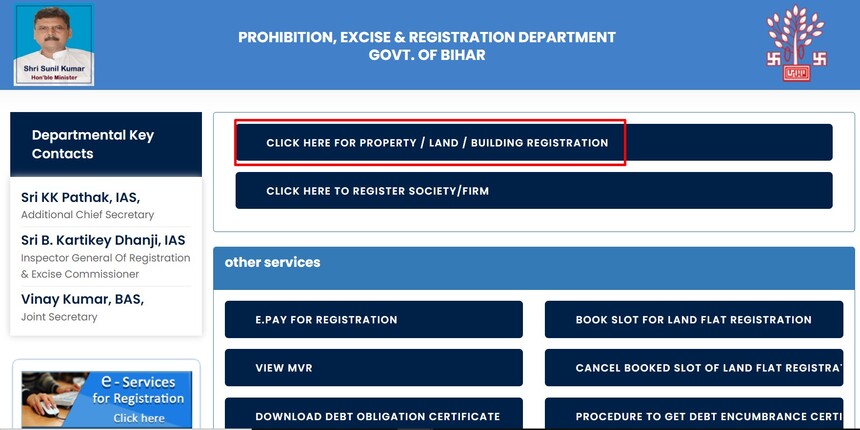
- Choose from the numerous options that show on the next page. Click the ‘Land/property registration’ option for buyers who wish to register their flats or apartments.
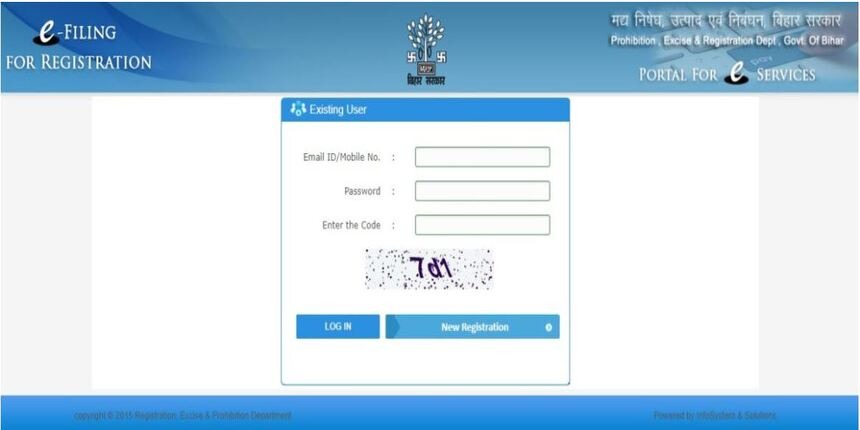
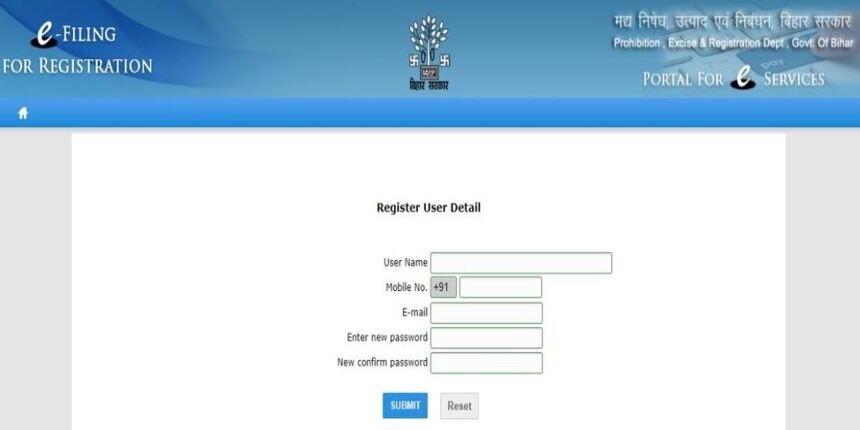
- While registered users may enter their email address/mobile number, password, and captcha on the next screen and click “Log In,” new users must select the “New Registration” button.
- After the user fills out all of the required information, they will receive an OTP on their phone or email address, which must be entered to activate the account.
- To continue, a registered user must enter the property data and submit all property-related documentations. After you’ve uploaded all of your documentation, click on the ‘Save’ button.
- After you’ve saved the scanned copies of your documentation, you’ll be sent to a screen where you may choose to “Pay Now.” Choose the payment mode and click on the ‘online payment’ button to continue with the process.
- The user will receive the eStamp when the payment has been processed successfully. An acknowledgement slip and a registration number will be produced.
- All parties concerned must appear at the sub-registrar’s office at the scheduled time, bringing all property-related paperwork as well as evidence of residence and identification. All of the paperwork will be examined by the official in charge, after which the signatures, photos, and fingerprints of the transferor, transferee, and witnesses will be gathered. The property registration procedure will be completed at this point.
MVR (Minimum Value Register) / Circle Rate in Bihar
MVR is Bihar’s version of what most other states call the circle rate, the minimum value the government has fixed for property in a given area, published and periodically revised by the Registration Department. Stamp duty is charged on whichever is higher: your declared sale value or the applicable MVR for that locality and property category. If you buy below the MVR, duty is still calculated on the MVR figure, which is precisely the point: it exists to prevent undervaluation of transactions. MVR rates run considerably higher in cities like Patna compared to rural blocks, and they vary further by property type (residential, commercial, agricultural). You can check the current MVR for any location through the “View Land MVR” option on the Bhumijankari portal by entering the location, land type, and area. This same portal doubles as a bihar land registry fee calculator and a bihar registry charges calculator, letting you work out the exact stamp duty and registration amount before you commit to a price. It’s worth doing this before finalising a price with the seller, since a mismatch between your agreed price and the MVR can mean a bigger bill at registration than expected, or in some cases attract scrutiny for undervaluation.
The 1% Online Registration Discount in Bihar
Bihar offers a genuine incentive that many buyers simply aren’t aware of: completing the registration process through the Bhumijankari portal, rather than doing it entirely offline, earns a flat 1% discount on the applicable stamp duty and registration charges. On a ₹50 lakh property, that 1% works out to ₹50,000, not a trivial amount. Given that Bihar’s combined charges already run between 7.6% and 8.4%, this is one of the only levers available to bring the total bill down without changing anything about the transaction itself. It’s worth confirming with your deed writer or the Sub-Registrar’s office exactly how the discount is applied on the chargeable value at the time of registration, since the mechanics can vary slightly depending on the payment mode used.
Stamp Duty and Registration Charges for Different Deeds in Bihar
Different legal instruments attract different rates under the Indian Stamp Act as it applies in Bihar. Here’s a consolidated view across the deed types buyers, sellers, and families most commonly deal with:
|
Deed Type |
Stamp Duty |
Registration Fee |
|
Sale/Conveyance deed |
5.7% (M→F) / 6.3% (F→M) / 6% (other) |
1.9% / 2.1% / 2% |
|
Gift deed (close relative) |
Same gender-based rates as sale |
Same gender-based rates as sale |
|
Lease deed (up to 11 months) |
1% of annual rent, or ₹500, whichever is less |
₹1,000 flat |
|
Lease deed (11 months to 5 years) |
6% of average annual rent |
₹1,000 flat |
|
Lease deed (over 5 years) |
8% of average annual rent |
₹1,000 flat |
|
Mortgage deed |
Varies with loan amount and mortgage type (simple/registered) |
As applicable per instrument value |
|
Power of Attorney |
Nominal fixed duty for family POAs; higher for POAs involving consideration |
Nominal registration fee |
|
Partition deed |
Duty applied on the share being separated, not total property value |
As applicable per share value |
|
Will/Settlement deed |
Wills are generally exempt from stamp duty; settlement deeds follow gender-based or nominal rates depending on relationship |
Nominal, if registered voluntarily |
|
Exchange deed |
Duty applied on the higher-valued property being exchanged |
As applicable per instrument value |
|
Industrial-purpose land |
Exempted |
Exempted |
Rates for instruments like mortgage, partition, and power of attorney depend on the specifics of the transaction, so it’s worth confirming the exact figure through the Bhumijankari portal’s charge calculator or with a deed writer before executing any of these documents. This table is also the fastest way to see the full range of stamp duty charges in Bihar in one place, rather than checking each deed type separately.
Gift Deed Stamp Duty in Bihar
A gift deed transfers property without any money changing hands, but Bihar doesn’t offer a separate flat concession for gifts the way many states do. A gift to a close relative simply follows the same gender-based structure as a regular sale.
|
Gift Between Close Relatives |
Stamp Duty |
Registration Fee |
|
Male donor to female recipient |
5.7% |
1.9% |
|
Female donor to male recipient |
6.3% |
2.1% |
|
Other (male-to-male, female-to-female) |
6% |
2% |
“Close relatives” here covers spouses, parents, children, siblings, and grandparents/grandchildren. Because the applicable rate tracks the gender of the donor and recipient rather than the relationship itself, a father gifting to a daughter or a husband gifting to a wife falls under male-to-female and gets the lowest rate of 5.7%. A mother gifting to a son lands at 6.3% instead. In effect, the gift deed registration charges in Bihar are identical to what a sale would attract between the same two people.
On the tax side, a gift deed registration charge in Bihar doesn’t come with the flat nominal fee some states offer for family transfers. The percentage-based rates apply in full. That said, gifts received from a specified relative remain exempt from income tax under Section 56(2)(x), which softens the overall cost even if the stamp duty itself isn’t discounted.
Rent Agreement / Lease Deed Stamp Duty in Bihar
The rent agreement stamp duty in Bihar is charged differently from a sale or gift, based on the lease tenure rather than the property’s market value:
- Up to 11 months: stamp duty is 1% of the annual rent, or ₹500, whichever is lower, plus a flat ₹1,000 registration fee. Most residential rental agreements fall into this bracket, and many landlords keep tenure under 11 months specifically to avoid mandatory registration, though registering still offers stronger legal protection for both parties.
- 11 months to 5 years: stamp duty rises to 6% of the average annual rent over the lease term, with the same ₹1,000 registration fee.
- Over 5 years: stamp duty is 8% of the average annual rent, again with a ₹1,000 registration fee.
For long-term commercial leases in particular, this tenure-based structure means the stamp duty can add up meaningfully compared to a short residential tenancy, so it’s worth factoring into the total cost of leasing rather than treating it as an afterthought.
Agricultural Land Stamp Duty in Bihar
Agricultural land in Bihar follows the same gender-based stamp duty and registration structure as any other property type: 5.7% for male-to-female transfers, 6.3% for female-to-male, and 6% for other combinations, plus the corresponding registration fee. What differs is the base value: agricultural land’s MVR is typically fixed lower than residential or commercial land in the same area, which reduces the chargeable amount even before the rate is applied. Land bought or held for industrial purposes is fully exempted from both stamp duty and registration, as part of the state’s push to encourage industrial investment. As with any land purchase, mutation (dakhil kharij) on the Bihar Bhumi portal remains a separate, mandatory step after registration. It’s what actually updates the Jamabandi to reflect the new owner.
Land Registration Charges in Bihar
Land registration charges in Bihar mirror the standard structure: 1.9% for male-to-female transfers, 2.1% for female-to-male, and 2% for all other combinations, with no upper cap regardless of the plot’s value. A few points specific to land transactions are worth keeping in mind:
- Always confirm the MVR for the specific plot before agreeing on a price, since agricultural, residential, and commercial land within the same block can carry different MVR figures.
- After registration, mutation is a separate process on the Bihar Bhumi portal and isn’t automatic. Skipping it is one of the most common reasons land disputes arise later, since your name won’t appear in the revenue records until it’s done.
- When asking about jamin registry fee in Bihar or about the Bihar jamin registry rate the amount will always come from the MVR of that plot. Therefore checking the sellers Jamabandi entry and looking for any encumbrances before registration can prevent inheriting a dispute with the land.
- Buyers who compare land registry charges in Bihar or land registry cost in Bihar across districts should note that the registry charges in Bihar for land follow the MVR slab of that block, not a single statewide figure.
Common Mistakes Buyers Make While Calculating Bihar Registry Charges
A lot of the confusion that buyers face with Bihars registry charges comes from a handful of recurring errors:
Calculating charges on the deal value: forgetting that the duty is charged on whichever is higher the sale price or the MVR. This can lead to a bill than expected if the deal value is lower than the MVR.
Ignoring the transfer category: assuming a flat rate applies without checking whether the transaction is male‑to‑female, female‑to‑male or another combination, each of which carries a rate.
Not checking land records before finalising the deal: skipping a Jamabandi and encumbrance check can mean discovering a title issue after money has changed hands.
Paying an advance without document verification: handing over money before confirming that ownership documents, tax receipts and land maps match what is on record.
Relying only on broker estimates: taking a broker’s verbal figure for stamp duty and registration at face value instead of confirming the exact amount through the Bhumijankari portal’s own calculator.
Working through the MVR, the correct transfer category, and the document checklist upfront avoids most of these issues before they turn into a bigger problem at the Sub-Registrar’s office.
Documents Required for Property Registration in Bihar
Both parties and two witnesses need to be physically present at the Sub-Registrar Office with originals plus self-attested copies of each of the following.
Identity and Personal Documents
- Aadhaar card for identity verification of all parties
- PAN card, mandatory for both buyer and seller
- Recent passport-size photographs of buyer, seller, and witnesses
- Address/ID proof: voter ID, driving licence, or passport for all parties and witnesses
Core Property Documents
- Sale or gift deed, drafted for the correct chargeable value and executed on the appropriate e-stamp
- MVR reference for the property, checked in advance on the Bhumijankari portal
- Jamabandi/land record establishing the seller’s ownership
- Encumbrance certificate or prior deeds confirming clear title with no outstanding charges
- Latest property or land tax receipts showing no dues pending
- Land map and measurement details matching the official records
Turning up short even one document typically means registration doesn’t go through that day, so it’s worth confirming the full list against your specific transaction type before booking a Sub-Registrar appointment.
How to Register Property and Pay Stamp Duty in Bihar (Bhumijankari): Step-by-Step
- Step 1: Visit bhumijankari.bihar.gov.in and check the MVR for the property using the “View Land MVR” tool.
- Step 2: Calculate the applicable stamp duty and registration fee based on the gender combination and deed type involved.
- Step 3: Complete the payment online and generate the e-stamp certificate. This is the point at which the 1% online discount applies, and where the bihar bhumi registration fee for your transaction gets locked in.
- Step 4: Book an appointment at the relevant Sub-Registrar Office and prepare all required documents for both parties and witnesses.
- Step 5: Attend the appointment in person for document verification, along with photographs and biometric capture.
- Step 6: Download the registered deed and receipt once the process is complete.
- Step 7: Apply for mutation (dakhil kharij) separately on the Bihar Bhumi portal to update the Jamabandi and formally reflect the change of ownership in revenue records.
How to Get a Refund on Stamp Duty in Bihar
Refunds can be obtained in certain cases, such as when a transaction is cancelled after stamp paper or an e-stamp has already been bought, when duty has been paid in amounts exceeding that which was really due, or when a deed becomes spoiled or is otherwise made unusable before it is executed. In order to apply for a refund, it is usually necessary to submit an application to the Registration Department together with the original stamp paper or e-stamp certificate, proof of payment, and a written reason for the cancellation or for the overpayment, all within the time frame set out in the relevant rules. Refunds are usually made after a small administrative fee has been deducted, and the precise percentage of the amount that is kept as well as the time it will take to process the refund should be checked with the local Registration Office, as these particulars may be changed from time to time.
Tax Benefit on Stamp Duty in Bihar
Stamp duty and registration charges paid on a residential property can be claimed as a tax deduction, which offsets some of the upfront cost:
- Deduction of up to ₹1,50,000 under Section 80C, claimable in the financial year the payment is actually made
- Applies only to residential house property, not commercial space and not a bare, undeveloped plot
- Available only under the old tax regime; buyers who’ve opted for the new regime cannot claim this deduction
- Joint buyers can each claim their proportionate share of the expense, within the overall ₹1,50,000 cap per individual
- Separately, gifts received from a specified relative remain exempt from income tax under Section 56(2)(x), regardless of the stamp duty paid on the gift deed
Quick Reference: Stamp Duty and Registration in Bihar
|
Property Value |
Male to Female (7.6%) |
Female to Male (8.4%) |
Other (8%) |
|
₹30 lakh |
₹2,28,000 |
₹2,52,000 |
₹2,40,000 |
|
₹50 lakh |
₹3,80,000 |
₹4,20,000 |
₹4,00,000 |
|
₹75 lakh |
₹5,70,000 |
₹6,30,000 |
₹6,00,000 |
|
₹1 crore |
₹7,60,000 |
₹8,40,000 |
₹8,00,000 |
These figures combine stamp duty and registration for each gender combination, before applying the 1% online discount, and assume the sale value meets or exceeds the MVR. It’s worth confirming the current MVR and rate slab on the Bhumijankari portal before finalising a budget around these numbers.
Conclusion
Stamp duty and registration together in Bihar add up to somewhere between 7.6% and 8.4% on top of the property price, and where you land on that range depends on a factor most states don’t consider at all: the gender of both the seller and the buyer. Male-to-female transfers are cheapest at 7.6%, female-to-male the most expensive at 8.4%, and everything else sits at a flat 8%, all calculated on the higher of your declared value or the MVR.
Two things can genuinely bring the bill down: registering property in a woman’s name secures the lowest available rate, and completing registration online through Bhumijankari earns a flat 1% discount regardless of the gender combination. Beyond the core sale transaction, gift deeds follow the same gender-based rule rather than a flat family concession, lease deeds are priced by tenure rather than value, and mutation on Bihar Bhumi remains a separate, easy-to-overlook step that shouldn’t be skipped.
Check the MVR on Bhumijankari, confirm the correct rate slab for your transaction, pay online to capture the discount, book your Sub-Registrar appointment with the full document set ready, and close the loop with mutation afterward. Following that sequence keeps registration day straightforward.
Frequently Asked Questions:
1. How to calculate stamp duty and registration charges in Bihar?
To calculate the stamp duty and registration charges in Bihar first take the property’s MVR or the higher of the sale value. Then apply the rate that matches the gender combination.
2. What is the Bihar registry rate for 2026?
For 2026 the combined stamp duty and registration rate is 7.6 % for male‑to‑female transfers 8.4 % for female‑to‑male transfers and 8 % for all combinations calculated on the higher of the sale value or MVR.
3. What are the registration charges for property in Patna?
Registration charges in Patna follow the statewide gender‑based structure, 1.9 %, 2.1 % or 2 % depending on the transfer type but because Patna’s MVR is usually higher than rural areas the chargeable value and therefore the absolute fee tend to be larger for comparable‑sized properties.
4. What are the new rules for land registration in Bihar?
Current rules require registration through the portal for the e‑stamp and payment step with the 1 % online discount applied at that stage followed by in‑person verification at the Sub‑Registrar Office and a separate mutation application on the Bihar Bhumi portal to update land records.
5. How to check stamp duty?
Stamp duty for a property can be checked using the charge calculator on the Bhumijankari portal by entering the property’s location, type and declared value alongside the MVR for that area.
6. What is the difference between stamp duty and registration charges?
Stamp duty is a tax on the transaction document itself making it legally valid while the registration charge is a fee for recording that document at the Sub‑Registrar Office. Both stamp duty and registration are payable together in Bihar calculated as percentages of the chargeable value.
7. What is the Stamp Duty Act applicable in Bihar?
Stamp duty in Bihar is governed by the Indian Stamp Act, 1899 as applicable to the state while registration itself is governed separately by the Registration Act, 1908.
8. What is the price of 1 katha land in Bihar?
Land prices per katha vary widely by district and locality. Are best checked against the current MVR for that specific area on the Bhumijankari portal rather than relying on a statewide average because valuations in urban Patna differ substantially from rural blocks.
9. What is the stamp duty rate for gift deeds in Bihar?
Gift deeds to close relatives follow the gender‑based rates as a sale: 5.7 % for male‑to‑female 6.3 % for female‑to‑male and 6 % for other combinations plus the corresponding registration fee. Bihar does not offer a flat concession for family gifts.
10. What is the registry circle rate for Bihar?
Bihar’s equivalent of the circle rate is called the MVR (Minimum Value Register) the government‑notified the minimum value for property in a given locality checked via the “View Land MVR” tool on the portal.
11. Are there any concessions for women buyers in Bihar?
Women buyers benefit indirectly through the structure: a transfer into a woman’s name (male‑to‑female) attracts the lowest combined rate of 7.6 % compared to 8 % or 8.4 % for other transfer types.
12. What happens if the declared value is lower than the MVR?
Stamp duty is still calculated on the MVR figure than the lower declared value because stamp duty is always charged on whichever amount is higher.