
Bengaluru’s property market has spread well past the old city limits. Whitefield, Sarjapur Road, Electronic City, the Yelahanka belt, all of it has seen serious price growth over the last few years. Most buyers walking into these deals know the flat’s price down to the rupee. Far fewer know what the government adds on top, and that number tends to be bigger than people expect.
Take an Rs 80 lakh flat as an example. Stamp duty, cess, surcharge and registration together come to roughly Rs 6.08 lakh, about 7.6 percent of what you’re paying for the flat itself. This guide walks through the current 2026 rates, how the math actually works out, and what to carry to the Sub-Registrar’s office so registration day doesn’t turn into a second trip.
- What Is Stamp Duty in Karnataka?
- Stamp Duty and Registration Charges in Karnataka 2026 : Current Rates
- How to Calculate Stamp Duty and Registration Charges in Karnataka
- Stamp Duty and Registration Charges in Other States
- Stamp Duty and Registration Charges for Resale Flat in Karnataka
- Stamp Duty and Registration Charges for New Flat in Karnataka
- Stamp Duty on Gift Deed in Karnataka
- Karnataka vs Maharashtra vs Tamil Nadu vs Delhi: Stamp Duty Comparison
- Home Registration Charges in Karnataka : What Is Included
- Guidance Value in Karnataka: How It Affects Your Stamp Duty
- Documents Required for Property Registration in Karnataka
- What Happens on Registration Day at the Sub-Registrar’s Office
- Sub-Registrar Offices in Karnataka: Key Locations
- How to Use the Stamp Duty Calculator for Karnataka
- How to Pay Stamp Duty Online in Karnataka
- Stamp Duty on Different Property Types in Karnataka
- Tax Benefit on Stamp Duty in Karnataka
- Quick Reference: Stamp Duty and Registration in Karnataka
- Conclusion
What Is Stamp Duty in Karnataka?
Stamp duty is a tax you pay to the Karnataka state government whenever you buy or transfer immovable property. The Karnataka Stamp Act, 1957 governs it. Pay it, and your sale deed becomes legally valid, admissible in court if things ever go wrong. Skip it, and the transaction can’t be registered at all. You’d have no recognised ownership to speak of.
Maharashtra charges a flat percentage that shifts by city and by the buyer’s gender. Karnataka works differently. Here, the rate depends only on what the property is worth, 2, 3 or 5 percent, nothing else. Gender doesn’t move the number at all, anywhere in the state. A cess and a surcharge sit on top of that slab rate, and the surcharge runs a touch higher outside city corporation limits.
One more thing worth knowing before the numbers: Bengaluru’s civic setup changed in 2025. BBMP is gone, replaced by the Greater Bengaluru Authority on September 2, 2025, with five separate city corporations, North, South, East, West and Central Bengaluru, now running ward-level work. Old stamp duty schedules that mention ‘BBMP limits’ are really talking about these same GBA corporation areas. So if your Sub-Registrar paperwork still says BBMP, don’t worry, it’s the same jurisdiction, just renamed.
Stamp Duty and Registration Charges in Karnataka 2026 : Current Rates
|
Category |
Base Stamp Duty |
Cess |
Surcharge (Urban) |
Total (Urban) |
Registration Charge |
|
Up to Rs 20 lakh |
2% |
10% of duty |
2% |
~2.24% |
2% of property value |
|
Rs 21 lakh to Rs 45 lakh |
3% |
10% of duty |
2% |
~3.36% |
2% of property value |
|
Above Rs 45 lakh (GBA/urban) |
5% |
10% of duty |
2% |
~5.6% |
2% of property value |
|
Above Rs 45 lakh (rural/Gram Panchayat) |
5% |
10% of duty |
3% |
~5.65% |
2% of property value |
|
Gift deed (blood relatives) |
Rs 1,000 to Rs 5,000 flat |
Applicable on flat amount |
Applicable on flat amount |
Rs 1,000 to Rs 5,000 |
Rs 500 to Rs 1,000 (fixed) |
|
Gift deed (non-relatives) |
5% |
10% of duty |
2% to 3% |
~5.6% |
2% of property value |
|
Why Karnataka is structured differently from Maharashtra cities: Cities like Thane and Pune stack a Local Body Tax and Metro Cess on a base rate, and that rate moves depending on the buyer’s gender. Karnataka skips gender entirely and instead moves the rate by how much the property is worth, then adds its own cess and surcharge on top. One more difference: Karnataka’s registration charge, 2 percent of the property’s value, has no ceiling. Maharashtra caps its fee at Rs 30,000 once a property crosses roughly Rs 15 lakh, so Karnataka’s charge overtakes it fairly quickly. |
How to Calculate Stamp Duty and Registration Charges in Karnataka
Both stamp duty and registration get calculated on whichever is higher, your agreement value or the guidance value. Guidance value is Karnataka’s government-set minimum for a given property, the same idea as Maharashtra’s Ready Reckoner Rate, just under a different name. The Department of Stamps and Registration publishes it, and you can check it yourself on the Kaveri Online Services portal.
Say you’ve agreed to pay Rs 70 lakh for a flat, but the guidance value for that locality comes to Rs 75 lakh. Stamp duty gets charged on the Rs 75 lakh, not on what you actually paid. Flip it around, agree to pay more than the guidance value, and stamp duty follows your actual agreement price instead.
Worked Example : Rs 80 Lakh Flat, GBA (Bengaluru Corporation) Area
|
Item |
Calculation |
Amount |
|
Agreement or guidance value (whichever higher) |
Assume Rs 80,00,000 |
Rs 80,00,000 |
|
Stamp duty at 5% |
5% of Rs 80,00,000 |
Rs 4,00,000 |
|
Cess at 10% of stamp duty |
10% of Rs 4,00,000 |
Rs 40,000 |
|
Surcharge at 2% (urban) |
2% of Rs 4,00,000 |
Rs 8,000 |
|
Registration charge at 2% |
2% of Rs 80,00,000 |
Rs 1,60,000 |
|
Total statutory cost |
|
Rs 6,08,000 |
|
As percentage of property value |
|
~7.6% |
Worked Example : Same Rs 80 Lakh Property, Rural (Gram Panchayat) Area
|
Item |
Calculation |
Amount |
|
Stamp duty at 5% |
5% of Rs 80,00,000 |
Rs 4,00,000 |
|
Cess at 10% of stamp duty |
10% of Rs 4,00,000 |
Rs 40,000 |
|
Surcharge at 3% (rural) |
3% of Rs 4,00,000 |
Rs 12,000 |
|
Registration charge at 2% |
2% of Rs 80,00,000 |
Rs 1,60,000 |
|
Total statutory cost |
|
Rs 6,12,000 |
|
Difference vs urban area |
|
Rs 4,000 more |
|
No gender-based saving in Karnataka: In Thane, Pune or Mumbai, putting the property solely in a woman’s name knocks a percentage point off stamp duty. Not in Karnataka. Male buyer, female buyer, joint owners in any combination, everyone pays the same slab rate, cess and surcharge here. What actually moves your total is the property’s value tier and whether it falls inside a GBA/urban corporation or out in a rural Gram Panchayat area. |
Stamp Duty and Registration Charges in Other States
| Maharashtra | Stamp Duty in Maharashtra |
| Gujarat | Stamp Duty in Gujarat |
| Uttar Pradesh | Stamp Duty in Uttar Pradesh |
| West Bengal | Stamp Duty in West Bengal |
| Delhi | Stamp Duty in Delhi |
| Haryana | Stamp Duty in Haryana |
| Rajasthan | Stamp Duty in Rajasthan |
| Bangalore | Stamp Duty in Bangalore |
| Gurgaon | Stamp Duty in Gurgaon |
| Pune | Stamp Duty in Pune |
| Punjab | Stamp Duty in Punjab |
| Odisha | Stamp Duty in Odisha |
Stamp Duty and Registration Charges for Resale Flat in Karnataka
A lot of buyers assume resale flats attract a lower stamp duty rate. They don’t. Buy from a builder or from someone who purchased the flat five years back, the math stays exactly the same, driven entirely by which value slab the property falls into.
- No GST on resale flats, that cost is strictly an under-construction thing
- Stamp duty is calculated on whichever is higher, the agreed price or the current guidance value
- The housing society may collect its own transfer or share-transfer fee separately
- Make sure the previous owner actually registered the flat correctly before you go any further
What to Verify Before Buying a Resale Flat in Karnataka
- Pull the Encumbrance Certificate from the Kaveri portal and read it, it shows every registered transaction on that property
- Ask the seller for the last three years of property tax receipts and confirm nothing is overdue
- Check that the Khata is in the seller’s name, a Khata still showing a previous owner is a red flag
- Look up the project on the Karnataka RERA (K-RERA) portal if it was built after 2017
- Request a maintenance dues clearance letter from the housing society before signing anything
- Check the current guidance value for that locality so you know what stamp duty will actually cost
Stamp Duty and Registration Charges for New Flat in Karnataka
Buying a brand new flat straight from a builder? Stamp duty rates don’t change from resale. What does change is GST, and that’s the real extra cost on an under-construction purchase.
- Stamp duty: 2%, 3% or 5% depending on value slab (same as resale)
- Registration: 2% of property value (same as resale)
- GST on under-construction flat: 5% for properties above Rs 45 lakh (non-affordable)
- GST on affordable housing (below Rs 45 lakh, meeting size criteria): 1%
- Stamp duty is paid at the time of the sale agreement or sale deed, not at possession
- Check the builder’s RERA registration on the K-RERA portal before signing anything
|
Registration timeline: Karnataka expects you to register the sale deed soon after paying stamp duty and generating the e-stamp certificate, since that certificate only stays valid for a limited window from its issue date. Book your Sub-Registrar slot the moment you’ve paid and your document draft is finalised. Don’t push it to later. |
Stamp Duty on Gift Deed in Karnataka
Transferring property to a family member in Karnataka? The stamp duty on a gift deed drops well below what a regular sale would cost you.
|
Recipient |
Stamp Duty |
Registration |
|
Blood relatives (spouse, parents, children, siblings) |
Rs 5,000 in GBA/BMRDA/corporation limits, Rs 3,000 in town panchayats, Rs 1,000 elsewhere |
Rs 500 to Rs 1,000 (fixed) |
|
Non-relatives |
5% (same as regular sale) |
2% of property value |
Under the Karnataka Stamp Act, ‘blood relatives’ for gift deed purposes means spouse, parents, children, siblings and similarly close family. Step outside that list and you’re back to the full 5 percent sale rate, plus cess and surcharge. There’s a tax angle too: gifts to blood relatives are fully exempt from income tax under Section 56(2)(x) of the Income Tax Act.
Karnataka vs Maharashtra vs Tamil Nadu vs Delhi: Stamp Duty Comparison
|
State |
Rate Structure |
Registration Charge |
Gender Concession |
Why Different |
|
Karnataka |
2% / 3% / 5% slabs by value |
2% of property value |
None |
Cess + surcharge on slab rate, no LBT |
|
Maharashtra (Thane/Pune) |
7% flat (male), 6% (female) |
1%, capped at Rs 30,000 |
1% lower for women |
Metro cess + Local Body Tax on flat rate |
|
Maharashtra (Mumbai) |
6% flat (male), 5% (female) |
1%, capped at Rs 30,000 |
1% lower for women |
Metro cess only, no LBT |
|
Tamil Nadu |
7% flat |
1% (4% for some deed types) |
None statewide |
Flat rate regardless of value |
|
Delhi |
6% (male), 4% (female) |
1% of property value |
2% lower for women |
Flat rate, no cess or surcharge |
Because Karnataka runs on slabs, smaller properties – including affordable property in Bangalore. priced under Rs 20 lakh – actually end up with a lower headline rate than most other big states. Push past Rs 45 lakh, though, and the effective rate, once cess and surcharge are folded in, lands close to what Maharashtra’s flat-rate cities charge. Karnataka just gets there by a different route, and it charges everyone the same regardless of gender.
Home Registration Charges in Karnataka : What Is Included
When people search for ‘home registration charges in Karnataka,’ what they usually want is the full registration-day bill, stamp duty included. Here’s that breakdown, using an Rs 80 lakh flat in a GBA corporation area as the example.
|
Charge |
Who It Goes To |
Amount (Rs 80L flat) |
|
Stamp duty (5% slab) |
Karnataka state government |
Rs 4,00,000 |
|
Cess (10% of stamp duty) |
Karnataka state government |
Rs 40,000 |
|
Surcharge (2%, urban) |
GBA corporation / local body |
Rs 8,000 |
|
Registration charge (2%) |
Sub-Registrar’s office |
Rs 1,60,000 |
|
Total |
|
Rs 6,08,000 |
That’s just the government’s share. Add society transfer charges, brokerage if you used an agent, and whatever your lawyer charges to draft the sale deed, and the real number climbs higher still.
Guidance Value in Karnataka: How It Affects Your Stamp Duty
Guidance value is Karnataka’s floor price, the government’s assessed minimum for a property in a given locality, maintained by the Department of Stamps and Registration. Buy below it and stamp duty still gets charged on the guidance value, not on what you actually paid.
- Check the guidance value at kaverionline.karnataka.gov.in before finalising your agreement value
- Guidance values vary significantly across corridors, Whitefield rates differ from Jayanagar or Yelahanka
- A state-wide guidance value revision of roughly 10 to 15% has been proposed for 2026, though the exact notification date should be confirmed on the Kaveri portal, since timelines have shifted
- Agreeing to a sale price below the guidance value creates income tax risk, the difference can be taxable in your hands
Documents Required for Property Registration in Karnataka
Carry everything on this list in original, plus a self-attested photocopy. Both buyer and seller need to show up in person at the Sub-Registrar’s office, no exceptions.
Documents from Both Buyer and Seller
|
Document |
Details |
|
Aadhaar Card |
Original mandatory for biometric verification. Name must match exactly across all documents including the sale deed. |
|
PAN Card |
Mandatory for all transactions above Rs 5 lakh. Both buyer and seller must submit. |
|
Passport-size photographs |
Two recent colour photographs each, kept on file and affixed to the registered deed. |
|
Address proof |
Voter ID, driving licence or latest utility bill. Original plus self-attested photocopy. |
Core Property Documents
|
Document |
Who Provides |
Notes |
|
Sale deed / gift deed |
Buyer and seller |
Drafted and vetted by an advocate before the SRO visit |
|
Stamp duty e-stamp certificate |
Buyer |
Generated from the Kaveri portal after online payment, verifiable at shcilestamp.com |
|
Encumbrance Certificate |
Buyer verifies |
Pull a fresh EC from the Kaveri portal, covering at least 13 to 15 years |
|
Khata certificate and extract |
Seller |
Confirms the seller is the current titleholder in municipal records |
|
Previous sale deed |
Seller |
Original registered deed showing the seller’s acquisition of the property |
|
Property tax receipts |
Seller |
Last 3 years with no outstanding dues |
|
Society NOC |
Seller |
No Objection Certificate confirming no dues and approval to transfer |
|
RERA certificate |
Builder |
For new projects, verify the registration number on the K-RERA portal |
Additional Documents for Specific Situations
|
Situation |
Additional Documents Needed |
|
Resale flat |
Full chain of title deeds, society share certificate in seller’s name, maintenance dues clearance |
|
Under-construction new flat |
Builder-buyer agreement, allotment letter, GST payment receipts |
|
NRI buyer or seller |
Valid passport, OCI card if applicable, NRE/NRO account statement, registered Power of Attorney if not physically present |
|
Inherited property |
Death certificate of previous owner, succession certificate or probate of will, mutation records |
|
Agricultural land |
RTC (Pahani) extract, mutation records, conversion certificate if applicable |
|
Joint ownership |
All co-owners physically present with individual Aadhaar, PAN and photographs |
|
Name matching is critical: Your Aadhaar name must match exactly across your PAN card and the sale deed. A spelling variation between these documents causes delays at the Sub-Registrar’s office and may require rebooking your appointment slot. |
What Happens on Registration Day at the Sub-Registrar’s Office
- Arrive early and collect a token number before your slot time
- A scrutiny officer verifies your original documents against the details entered in the system
- When your token is called, buyer, seller and two witnesses proceed to the registering officer’s desk
- Biometric verification: thumb impressions and webcam photographs recorded for all parties
- You sign the summary sheets, check all property details and the consideration amount before signing
- The registered document is typically available for download within 24 to 48 hours
Sub-Registrar Offices in Karnataka: Key Locations
|
SRO Area |
Region Served |
|
SRO Jayanagar / Basavanagudi |
South Bengaluru, Jayanagar, JP Nagar, Banashankari |
|
SRO Malleswaram / Rajajinagar |
West Bengaluru, Malleswaram, Rajajinagar, Yeshwantpur |
|
SRO Yelahanka / Hebbal |
North Bengaluru, Yelahanka, Hebbal, Kodigehalli |
|
SRO Whitefield / K R Puram |
East Bengaluru, Whitefield, Mahadevapura, Kadugodi |
|
SRO Electronic City / Begur |
South-East Bengaluru, Electronic City, Bommanahalli |
|
SRO Anekal / Sarjapur |
Sarjapur Road, Anekal, outer south-east belt |
|
SRO Mysuru |
Mysuru city and surrounding taluks |
|
SRO Mangaluru |
Mangaluru city and Dakshina Kannada |
|
SRO Hubballi-Dharwad |
Hubballi and Dharwad twin cities |
Your SRO depends on where the property sits, not where you live. Double check yours on the Kaveri portal before you book a slot. And book early if you can, slots disappear fast toward month-end, when most registrations get scheduled.
How to Use the Stamp Duty Calculator for Karnataka
Below are the few steps that will help you in Calculating Stamp Duty in Karnataka:
Step 1: Go on the official website of “Kaveri Online Services”.
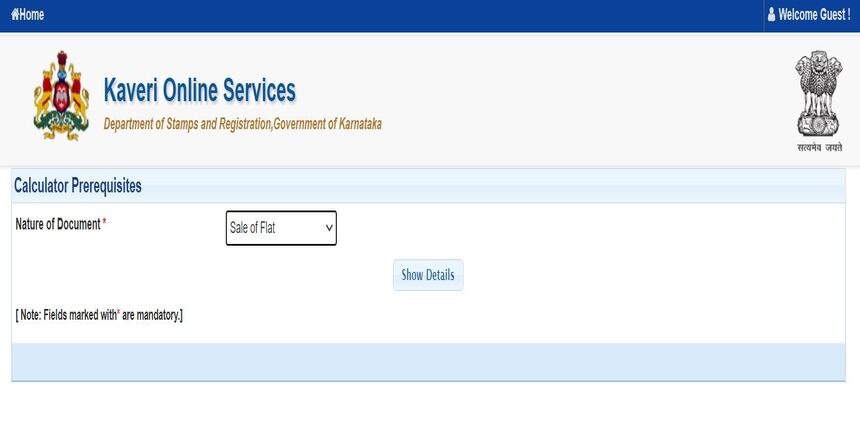
Step 2: Next, fill in the information to let the calculator fetch the amount that is required to be charged, which also includes the nature of your document.
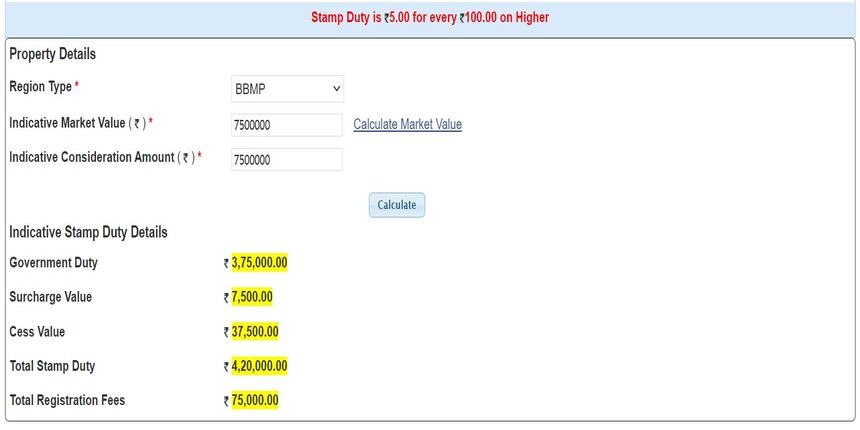
Step 3: As soon as you fill in the necessary information, you will be able to see a drop-down that reflects the types of the regions.
Some of these Regions include:
- Town Panchayat
- City Corporation
- Gram Panchayat
- Municipal Corporation
The above steps mentioned in the Karnataka Stamp Duty Calculator will calculate the amount that needs to be paid for stamp duty and registration charges for your new property.
How to Pay Stamp Duty Online in Karnataka
You pay stamp duty in Karnataka online, through the Kaveri Online Services portal, with the Khajane-2 (K2) portal handling the actual treasury payment behind it. For most transactions, that means no trip to a bank or stamp vendor at all.
- Visit kaverionline.karnataka.gov.in and register or log in
- Select the stamp duty payment option and choose your document type
- Enter your property location, district, and consideration amount
- The system applies the correct slab rate, cess and surcharge automatically
- Pay via net banking, debit card, credit card, UPI, NEFT or RTGS
- Download the e-stamp certificate, required at the Sub-Registrar’s office
- Book your registration appointment slot separately through the same portal
Stamp Duty on Different Property Types in Karnataka
|
Property Type |
Stamp Duty |
Registration |
Notes |
|
New flat under construction |
2% / 3% / 5% by slab |
2% |
GST 5% also applies (1% for affordable housing) |
|
Resale flat |
2% / 3% / 5% by slab |
2% |
No GST, same stamp duty as new |
|
Plot or land (urban) |
2% / 3% / 5% by slab |
2% |
Same slab system applies |
|
Agricultural land |
2% / 3% / 5% by slab |
2% |
Additional RTC and mutation verification required |
|
Commercial property |
2% / 3% / 5% by slab |
2% |
No gender concession, same as residential |
|
Gift deed (blood relatives) |
Rs 1,000 to Rs 5,000 flat |
Rs 500 to Rs 1,000 |
Large saving vs regular sale |
|
Gift deed (non-relatives) |
5% |
2% |
Same as regular sale |
Tax Benefit on Stamp Duty in Karnataka
Paid stamp duty and registration on a new residential property in Karnataka? You can claim it as a deduction under Clause 123 of the Income Tax Act, 2025, the provision most people still know as Section 80C.
- Maximum deduction: Rs 1,50,000 per financial year
- Applies only to new residential property, not resale flats, commercial property or plots
- Available only under the old tax regime
- From FY 2026-27 the new tax regime is the default, you must actively opt for the old regime to claim this
- Co-owners can each claim their proportionate share
- Consult a tax adviser to determine which regime is more beneficial for your overall tax situation
Quick Reference: Stamp Duty and Registration in Karnataka
|
Property Value |
Stamp Duty (Slab) |
Cess + Surcharge (Urban) |
Registration (2%) |
Total (Urban) |
|
Rs 18 lakh |
Rs 36,000 (2%) |
Rs 4,320 |
Rs 36,000 |
Rs 76,320 |
|
Rs 35 lakh |
Rs 1,05,000 (3%) |
Rs 12,600 |
Rs 70,000 |
Rs 1,87,600 |
|
Rs 60 lakh |
Rs 3,00,000 (5%) |
Rs 36,000 |
Rs 1,20,000 |
Rs 4,56,000 |
|
Rs 80 lakh |
Rs 4,00,000 (5%) |
Rs 48,000 |
Rs 1,60,000 |
Rs 6,08,000 |
|
Rs 1 Crore |
Rs 5,00,000 (5%) |
Rs 60,000 |
Rs 2,00,000 |
Rs 7,60,000 |
These numbers assume your property’s value matches or beats the guidance value. Always check the actual guidance value for your specific property at kaverionline.karnataka.gov.in before you rely on any of this.
Conclusion
Add it all up, cess, surcharge, and the revised 2 percent registration fee, and stamp duty in Karnataka adds roughly 7.5 to 7.6 percent to the cost of any flat above Rs 45 lakh. On a Rs 1 crore flat, you’re looking at close to Rs 7.6 lakh in government charges alone.
There’s no gender-based saving to plan around here, unlike Maharashtra or Delhi. Once you know your property’s value slab and whether it sits in a GBA corporation area or a rural Gram Panchayat, budgeting is fairly straightforward.
Pay through the Kaveri portal, check the guidance value before you settle on an agreement price, book your Sub-Registrar slot as soon as stamp duty is paid, and carry every document in original plus a photocopy. Get these four things right and registration day in Karnataka should be a non-event.
Frequently Asked Questions:
1. What is the stamp duty and registration charge in Karnataka in 2026?
It depends on what the property is worth. Up to Rs 20 lakh, you’re paying 2 percent. Between Rs 21 lakh and Rs 45 lakh, it’s 3 percent. Anything above Rs 45 lakh jumps to 5 percent. Registration adds another 2 percent of the property value, up from 1 percent before the August 31, 2025 revision.
2. What are the flat registration charges in Karnataka?
You’ll pay 2 percent of the property’s agreement value or guidance value, whichever is higher, with no cap at all. That’s a real difference from Maharashtra, where the fee stops climbing once it hits Rs 30,000. In Karnataka, it keeps scaling with the property’s value.
3. What is the stamp duty for a resale flat in Karnataka?
No different from a new flat, really, 2, 3 or 5 percent based on the value slab. What resale does save you is GST, since that only applies to under-construction purchases. As always, stamp duty runs on whichever is higher, your agreement value or the guidance value.
4. Does Karnataka offer a stamp duty concession for women buyers?
No, it doesn’t. Karnataka charges the same stamp duty and registration rate no matter who’s buying. Maharashtra and Delhi both offer a lower rate for women; Karnataka simply never adopted that policy.
5. How much stamp duty do I pay on a Rs 1 crore flat in Karnataka?
Work through the math on a Rs 1 crore flat in a GBA corporation area: Rs 5,00,000 in stamp duty at 5 percent, roughly Rs 60,000 more for cess and surcharge, and Rs 2,00,000 for registration at 2 percent. That comes to about Rs 7,60,000 in total.
6. What documents are required for flat registration in Karnataka?
You’ll need Aadhaar and PAN for both buyer and seller, passport photographs, the sale deed, the e-stamp certificate from the Kaveri portal, an Encumbrance Certificate, the Khata certificate, the previous sale deed, property tax receipts, a society NOC, and, for new projects, the RERA certificate. Both buyer and seller need to be there in person.
7. Can stamp duty be paid online in Karnataka?
Yes, through the Kaveri Online Services portal at kaverionline.karnataka.gov.in. Enter your details and the system works out the slab rate, cess and surcharge on its own. Pay however suits you, net banking, card, UPI, NEFT or RTGS.
8. What is the stamp duty for a gift deed in blood relation in Karnataka?
Gift it to a blood relative, spouse, children, parents, siblings, and stamp duty drops to a flat amount: Rs 5,000 within GBA, BMRDA or corporation limits, Rs 3,000 in town panchayats, Rs 1,000 everywhere else. Registration adds a fixed Rs 500 to Rs 1,000 on top.
9. Is stamp duty different for agricultural land in Karnataka?
Not really. Agricultural land follows the same slab-based stamp duty and 2 percent registration fee as any residential property. Where it does differ is the paperwork, expect to need RTC (Pahani) extracts, mutation records, and a conversion certificate if that applies to your land.
10. What is the guidance value and how does it affect stamp duty in Karnataka?
It’s Karnataka’s government-set floor value for a property in a given locality. Stamp duty is charged on whichever is higher, your agreement value or that guidance value, so it pays to check the current figure at kaverionline.karnataka.gov.in before you settle on a purchase price.
11. What replaced BBMP in Bengaluru and does it affect stamp duty?
BBMP was replaced by the Greater Bengaluru Authority on September 2, 2025, and five new city corporations now handle ward-level work. Old stamp duty rules that mention BBMP limits still apply, just under the GBA corporation areas now. The rates themselves haven’t moved.