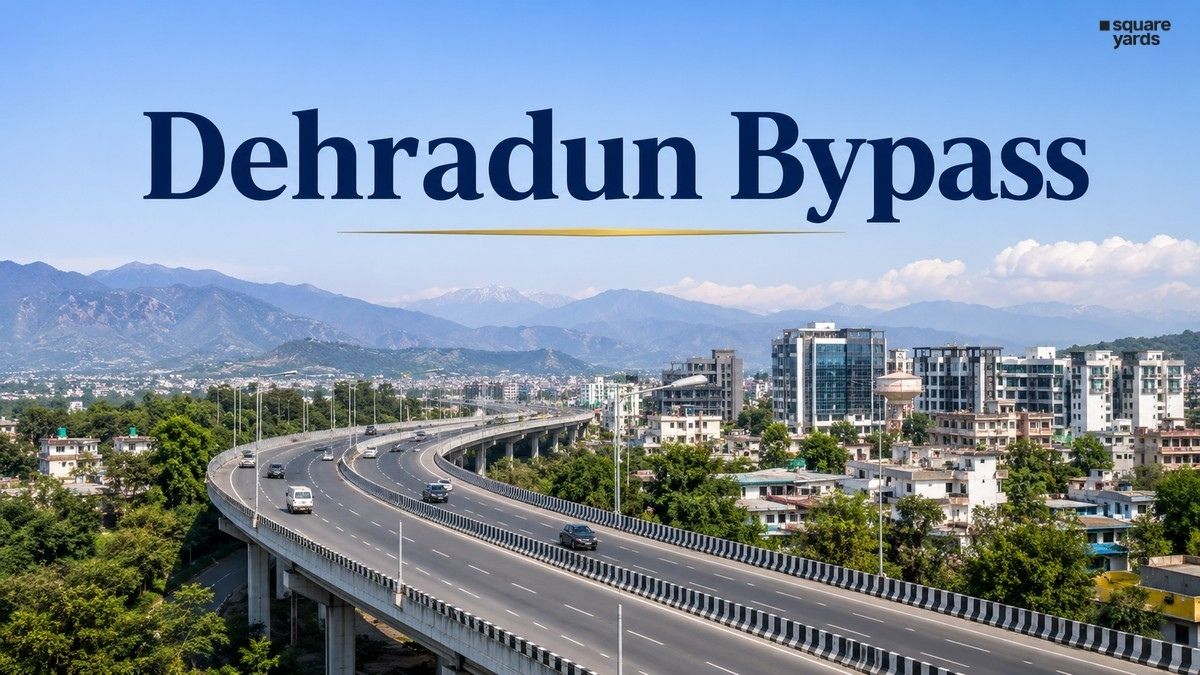
Dehradun is Uttarakhand’s seat of government, a defence hub, an education centre, and the gateway the entire Char Dham pilgrimage passes through. The city was built for a population of a few lakh. Census figures put it at roughly 7 lakh in 2011; current estimates place it past 10 lakh. Today, it carries the daily demands of a state capital, a university town, an army cantonment, and the main approach to Mussoorie, Rishikesh, and the Char Dham circuit, which drew over 47 lakh pilgrims in 2025 alone. All this makes Dehradun a vital city and region for major of developments since the genesis of the city.
This is the backdrop for the National Highway Authority of India’s 12 kms Dehradun bypass. The impact on real estate is worth noting. Big developers, investors and landholders are closely watching and making tactful decisions to drive the real estate sector in nearby regions.
What is actually being built, and why it matters more than it sounds
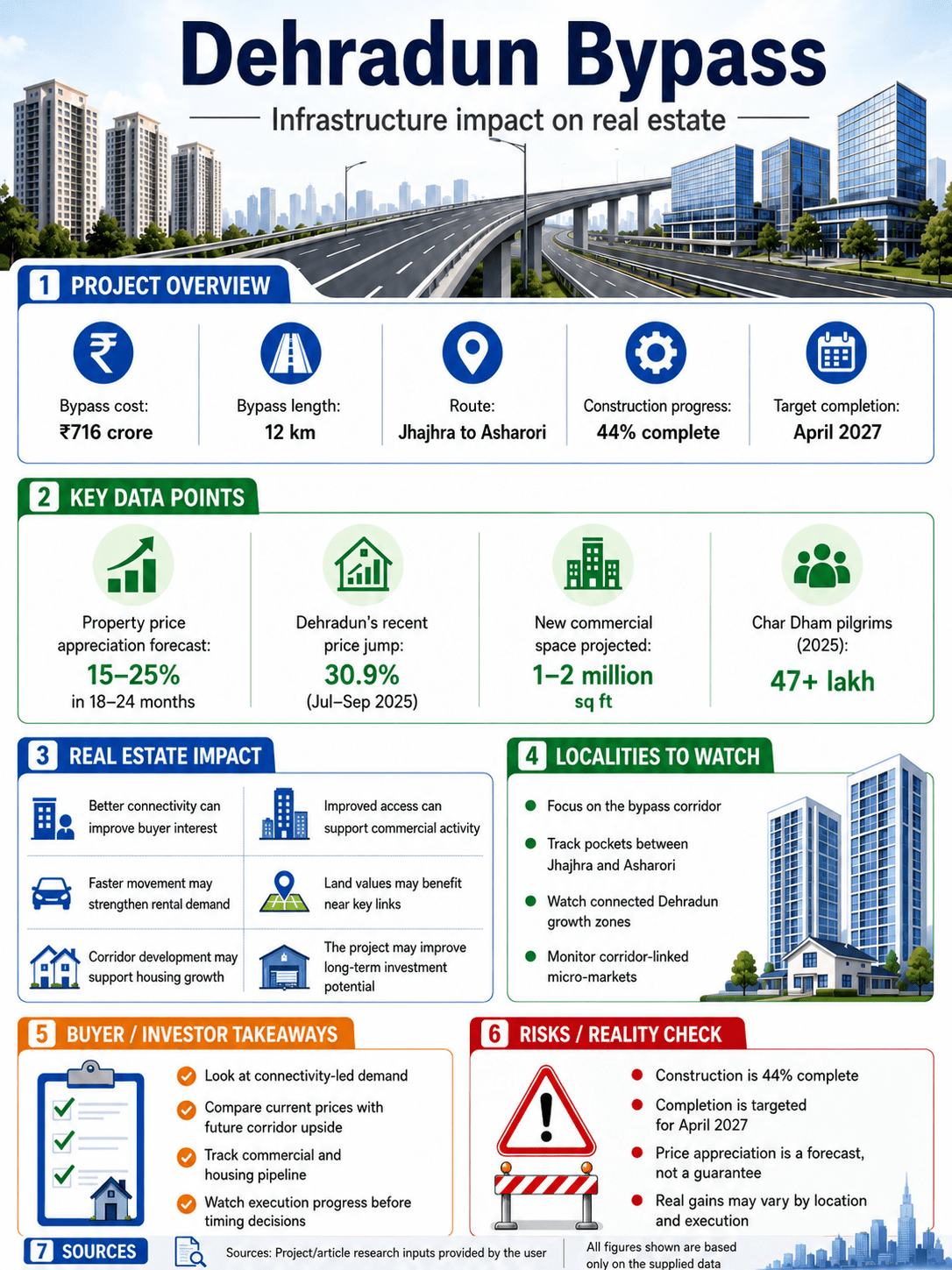
Official data show that the project is a four-lane, access-controlled bypass running from Jhajhra to the Asharori check post, tying into the Delhi-Dehradun Economic Corridor and the Paonta Sahib-Ballupur stretch of NH-7.
The stated objective is to decongest Dehradun’s urban core, cut vehicular pollution, and strengthen connectivity to Haryana, Punjab, and Himachal Pradesh, while supporting tourism traffic headed to Mussoorie. It functions as an alternate south-western corridor, giving heavy vehicles a reason to never enter the city core at all.
Bypass overpowers highways’ impact on real estate of the region
A highway upgrade inflates value along its own length. A bypass does something more interesting: it reallocates value between two zones. The congested core it relieves, and the peripheral nodes it newly connects. Jhajhra and the Asharori-Ballupur belt, largely transit or semi-industrial land until now, suddenly sit at the junction of a national highway, an economic corridor, and a controlled-access bypass. Exactly the kind of triple-connectivity intersection where land banks get quietly assembled years before a project is half-built.
On top of that, this Rs 716 crore project matters more than its price tag suggests because it plugs into the much larger Delhi-Dehradun Economic Corridor – a 213 km, six-lane, access-controlled expressway built at over Rs 12,000 crore, which has cut Delhi-Dehradun travel time from roughly six hours to about 2.5 hours, per industry estimates reported by ANI.
The pattern is fairly clear: the expressway compresses travel time; the bypass then decides how that inflow of people, vehicles, and commerce actually distributes itself once it reaches the city. A fast road into a congested city just moves the bottleneck fifteen minutes closer.
What this means for different kinds of buyers
For an end-use homebuyer, the calculus is daily life, not just entry price.
A flat on Sahastradhara Road, trading in the Rs 2,500-3,500 per sq ft band as per Square Yards data, becomes more attractive if the daily grind of navigating through-traffic eases even modestly.
For investors and developers, the more interesting play is at the bypass’s own termini. Land near Jhajhra and Asharori, at the convergence of the bypass, NH-7, and the economic corridor, is a textbook candidate for warehousing and light industrial use.
Rental markets, typically the last to react, tend to move once construction visibly nears completion rather than at the announcement stage. Worth remembering for anyone expecting an immediate rental spike now, at 44% progress.
Micro-markets to watch near Dehradun Bypass
Jhajhra and the Paonta Sahib-Ballupur stretch sit at the literal starting point of the Dehradun bypass and its junction with NH-7. The zone likeliest to see early land-rate movement as developers position ahead of the 2027 opening. The Asharori-Doiwala belt, where the bypass ties into the Delhi- Dehradun corridor, is emerging as a logical logistics and warehousing corridor given its direct expressway access.
Premnagar and Chakrata Road benefit indirectly, as reduced through-traffic could ease one of the city’s more congested residential-commercial mixes.
The Caution
The bypass is less than halfway done. It’s due by April 2027, but there’s still a lot of work left. If you’re planning to invest in the region, a smart decision would be to wait for more updates upon the progress.
There is also the classic infrastructure-led speculation risk: land near an announced alignment tends to get bid up well ahead of any tangible benefit, and not every parcel near Jhajhra or Asharori will see footfall once the road opens.
Buyers should also weigh construction-phase disruption: years of diversions, dust, and localized snarls before smoother roads materialize. Last-mile connectivity is another underrated risk a bypass is only as useful to a project as the local feeder road connecting to it.
Also, Dehradun’s hill-city constraints like limited flat land, water availability and drainage capacity mean that a demand surge without matched civic investment can strain services as easily as it can build a thriving neighborhood. Yet, experts and analysts believe this could be a game changer in the region owing to its merits over the anticipated challenges.
Why this bypass is a big real estate signal
In real estate, bypasses are quiet, reallocation machines. They don’t just move traffic; they move where a city’s next decade of growth prefers to happen. The version of this story sits atop a much bigger one: a 213 km Delhi- Dehradun expressway that has already compressed a day-long trip from Delhi into a half-morning one, and a bypass that will decide whether that inflow spreads gracefully around the city or simply relocates the traffic jam.
For the city, it’s a test of whether growth this fast can be matched, street by street, with the water, drainage, and feeder-road capacity that turns a boom into something liveable rather than merely crowded. The road will be finished by 2027. Whether Dehradun uses that window well is the part still being decided.