
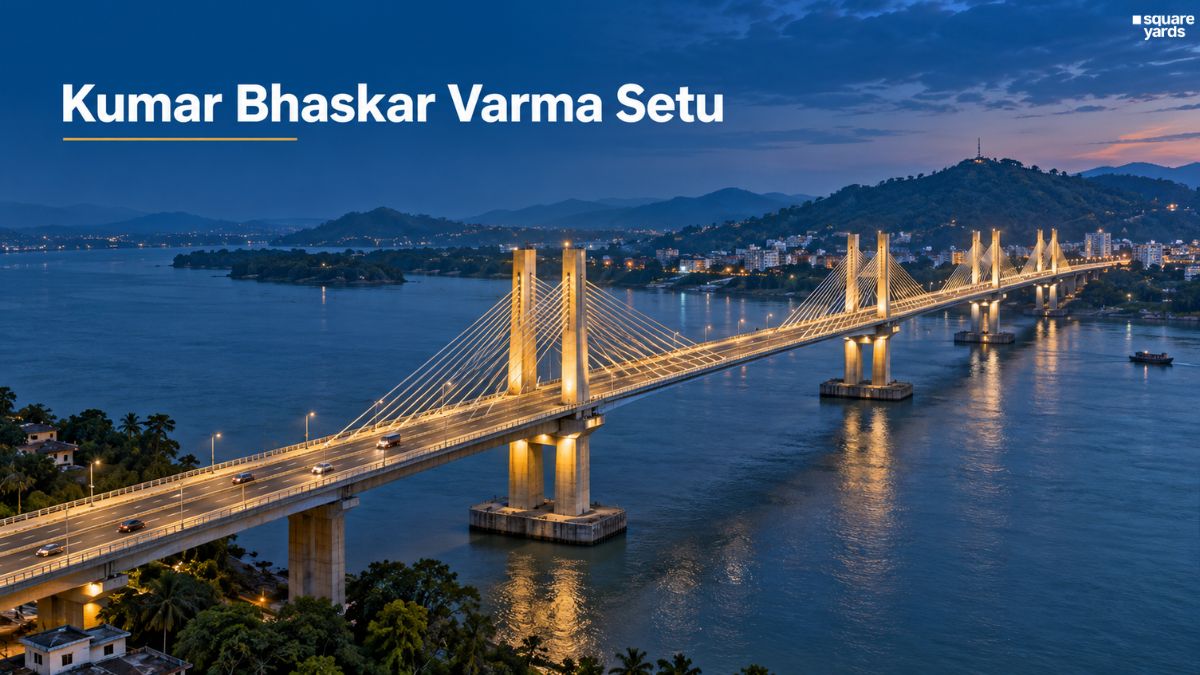
The recently inaugurated bridge across the Brahmaputra connecting Guwahati with North Guwahati is set to give a fresh boost to real estate in the northeastern state. Formally named Kumar Bhaskar Varma Setu, the 8.44 km, six-lane bridge was inaugurated by prime minister Narendra Modi in February this year.
Developed at an estimated cost of Rs 3,030 crore, the bridge is expected to reduce the journey between Guwahati and North Guwahati to approximately 7 minutes. It represents a major compression of economic distance. A locality separated from an employment center by an unpredictable ferry journey or a long road diversion is usually priced differently from one accessible through a reliable, all-weather connection. By shortening and simplifying the journey, the bridge could gradually bring North Guwahati into the capital city’s regular residential and commercial catchment.
The Rs 5,450-cr multi-fold package
The bridge was the headline, but it was inaugurated alongside other projects that, together, tell a broader story about where Assam’s institutional and digital infrastructure is heading:
IIM Guwahati’s temporary campus opened at Tech City, Pongora, spanning 6,410 square meters. Its permanent campus, spread across 76.83 hectares, is coming up at Marapita in Kamrup district, backed by a ₹555-crore Union Cabinet outlay covering both campuses and five years of operations.
A National Data Center for the Northeast came up at Amingaon in Kamrup district, a Rs 350-crore facility built by the National Informatics Center with capacity for over 200 server racks, serving all eight northeastern states and doubling as a disaster-recovery site.
In Upper Assam, an Emergency Landing Facility on the Moran Bypass near Dibrugarh went live. A 4.2 km stretch of NH-127, engineered to double as a runway for fighter jets and transport aircraft, was built by NHIDCL less than 300 km from the China border, with an equally important role in flood and disaster response.
Individually, each is a sectoral upgrade. Together, they read as a coordinated attempt to make Guwahati a genuine institutional and digital anchor for the Northeast — and that combination of physical connectivity plus intellectual and digital infrastructure is precisely what tends to pull real estate demand along with it.
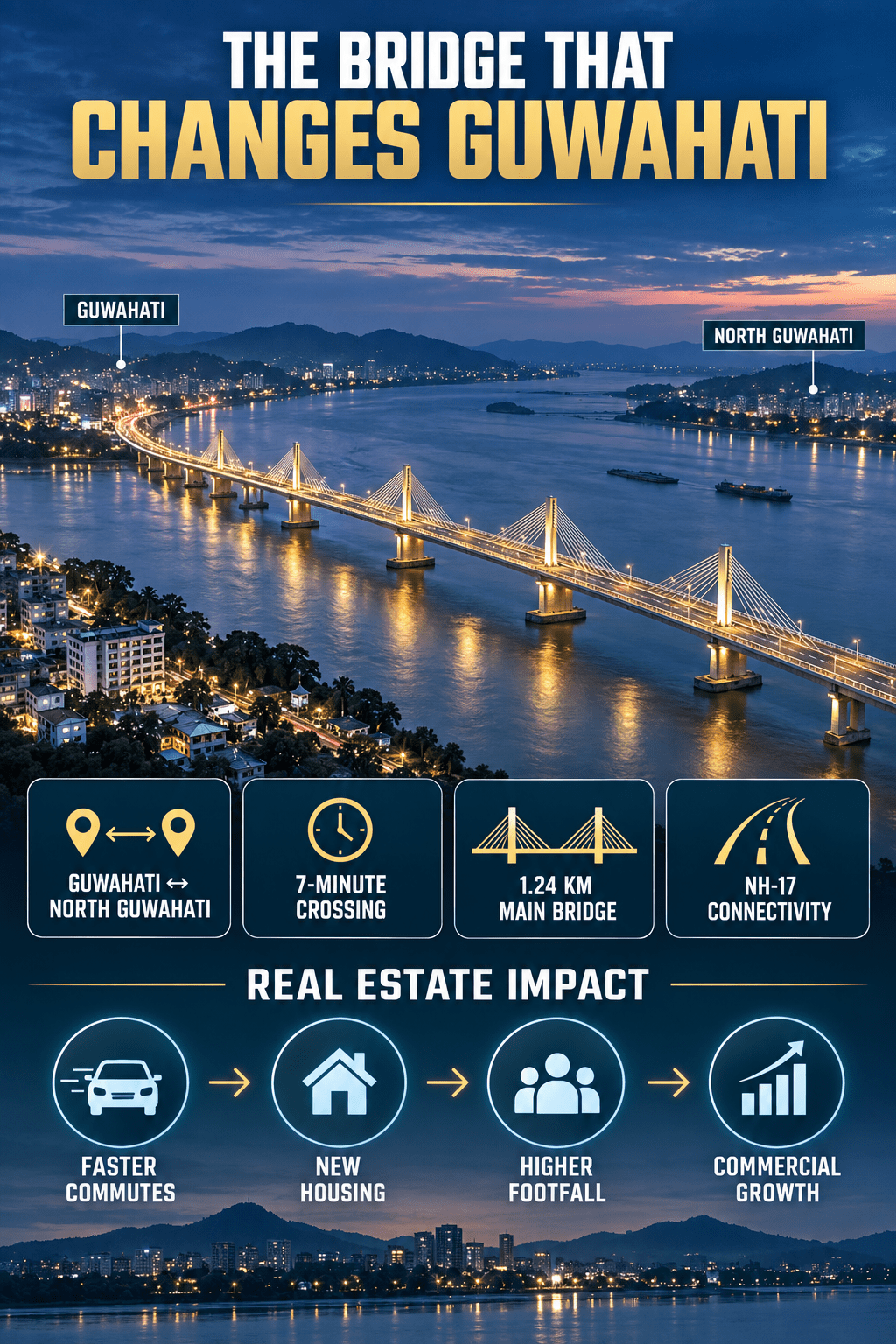
What does this mean for real estate in the region?
North Guwahati today is the most affordably priced micromarket in the city. Per Square Yards’ transaction data, average rates across Guwahati’s core zones stand at roughly Rs 5400 per sq ft, with Guwahati South commanding a premium at Rs 5,750, West at Rs 5,450, East at Rs 5,250, and Guwahati North trailing at Rs 5,050 per sq ft.
When a locality’s biggest handicap – access- disappears, land that was previously priced for its isolation gets re-priced for its proximity. Plots in North Guwahati near the upcoming Judicial City (where Guwahati High Court’s new premises are coming up) are already trading around Rs 1.35 crore for roughly 8,640 sq ft, with 2-3 BHK apartments ranging from Rs 52 lakh to Rs 1.15 crore.
Micro-Markets to watch
North Guwahati and Amingaon stand to gain the most directly; both sit right at the bridge’s northern landing, and Amingaon additionally benefits from hosting the new National Data Center. Jalukbari, already one of Guwahati’s more affordable zones at Rs 27.5-55.5 lakh for typical units, gains an indirect lift from IIT Guwahati’s established presence and its proximity to the North Guwahati corridor. Six Mile to Panjabari, Guwahati’s established IT corridor, remains relevant as commercial activity spreads outward, and industry estimates point to appreciation well above the city average in this belt over the next few years.
The caution points
Bridge-adjacent land in Indian cities has a well-documented tendency to run ahead of actual demand. Speculative pricing often outpaces the rollout of water, sewage, and power infrastructure that a genuine “twin city” needs. North Guwahati’s internal road network, unlike the bridge itself, has not been rebuilt at the same pace, so early-mover residents may face a mismatch between fast river-crossing and slow last-mile connectivity.
The Brahmaputra’s shifting sandbanks and flood patterns also mean environmental and drainage due diligence matters more here than in most Indian suburbs. And with IIM Guwahati’s permanent campus still under construction and RERA-registered supply in North Guwahati still thin, buyers should treat near-term listings with the same scrutiny they’d apply to any pre-infrastructure market, checking land titles, RERA registration, and realistic possession timelines rather than chasing the headline.
Key takeaways
Bridges in cities move capital, institutions and, eventually, entire neighborhoods. The Kumar Bhaskar Varma Setu, paired with IIM Guwahati, a regional data center and a modernizing bus fleet, gives North Guwahati the kind of multi-layered catalyst that most Indian micromarkets never get all at once.