
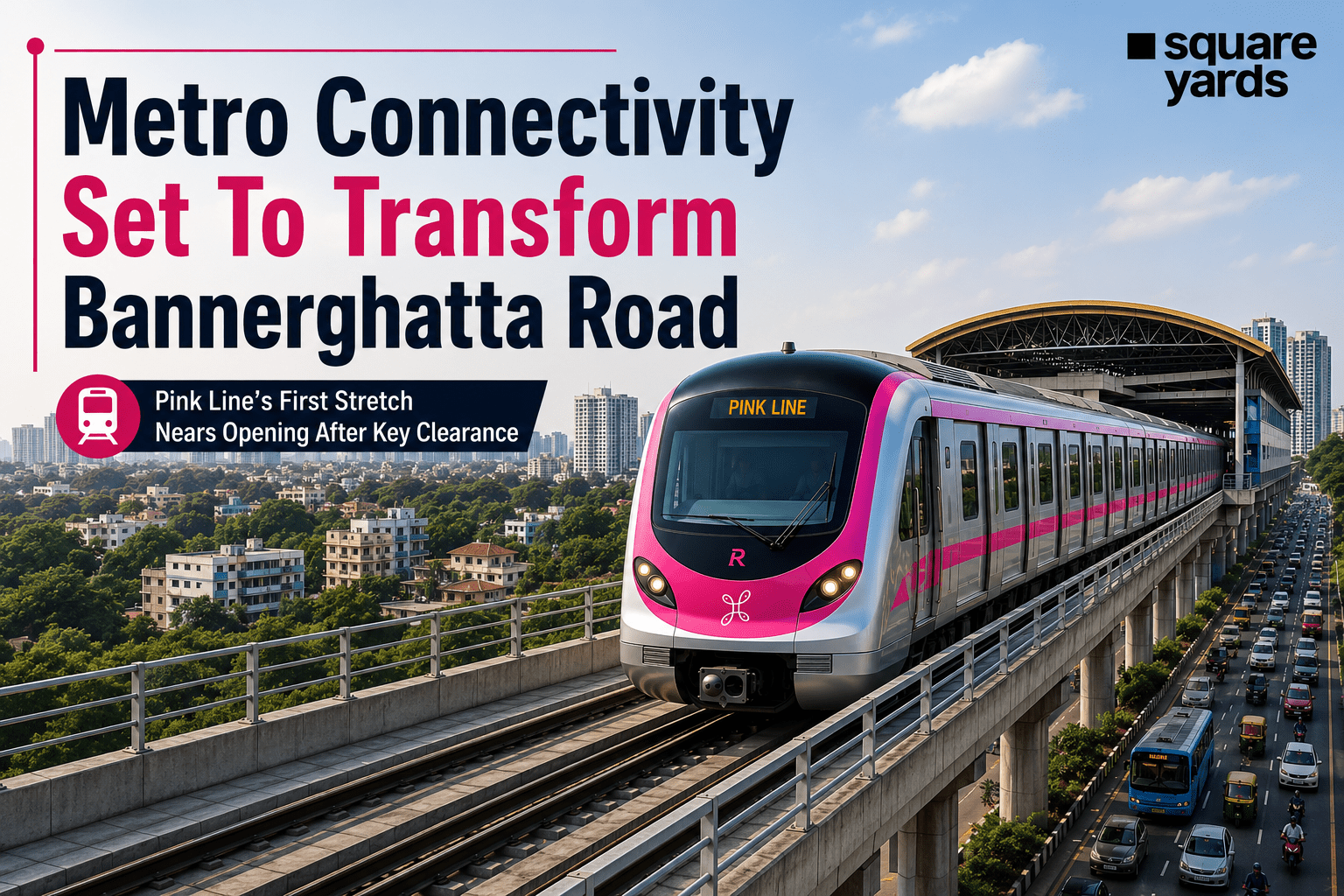
The Pink Line metro is close to opening on Bannerghatta Road. The Commissioner of Metro Railway Safety (CMRS) held a three-day statutory safety inspection on the 7.5-km elevated stretch from Kalena Agrahara to Tavarekere between October 6 and 8, 2026. This is the last major check before passenger services can start. Once the safety clearance is issued, commercial operations are expected in mid-to-late October 2026.
For Bannerghatta Road real estate, the timing matters. The road is one of south Bengaluru’s busiest corridors, and daily traffic has long been the main complaint of people living here. A working metro line changes how buyers and tenants judge the area, often well before the full line is complete.
Here are the key facts about the Pink Line.
Pink Line at a glance
Total length: About 21 km, from Kalena Agrahara to Nagawara
Stations: 18 (6 elevated and 12 underground)
First stretch: 7.5-km elevated section from Kalena Agrahara to Tavarekere
Interchanges: Jayadeva Hospital (Yellow Line) and Nagawara (Blue Line)
Operator: Bangalore Metro Rail Corporation Limited (BMRCL)
Pink Line metro update: where the project stands
The Pink Line is being opened in two stages. The elevated section in the south will open first, while work on the underground section continues. The status of each part is explained below.
Elevated stretch: Kalena Agrahara to Tavarekere
The elevated section runs for 7.5 km and has six stations: Kalena Agrahara, Hulimavu, IIM Bangalore, JP Nagar 4th Phase, Jayadeva Hospital and Tavarekere, also known as Swagath Road Cross. Trial runs and system tests on this stretch are complete.
The CMRS inspection checks tracks, signals, stations and safety systems before the public can use the line. After the inspection, the safety commissioner issues a report and clearance. Earlier, the stretch was expected to open around August 15, 2026, but the date moved while approvals were pending. The current target is mid-to-late October 2026.
Underground section: Dairy Circle to Nagawara
The 13.76-km underground section runs from Dairy Circle to Nagawara and passes through central areas such as MG Road and Cantonment. Tunneling on this section is complete. Trials of the driverless CBTC (Communication-Based Train Control) signaling system are set to begin in late 2026. Full operations on this section are targeted for early 2027.
The table below shows how the two sections compare.
|
Section |
Length |
Stations |
Current status |
|
Kalena Agrahara to Tavarekere (elevated) |
7.5 km |
6 |
CMRS inspection done, opening expected mid-to-late October 2026 |
|
Dairy Circle to Nagawara (underground) |
13.76 km |
12 |
Tunneling complete, full operations targeted for early 2027 |
Travel time advantage along the first stretch
The biggest change for residents will be shorter and more predictable commutes. Today, a trip from Kalena Agrahara to Tavarekere can take up to 45 minutes by road at peak hours. The metro is expected to cover the same distance in 12 to 15 minutes.
The table below compares metro and road travel times from Kalena Agrahara to each station on the elevated stretch.
|
Station |
Distance from Kalena Agrahara |
Metro time |
Typical road time |
|
Hulimavu |
1.5 km |
2 to 3 mins |
8 to 12 mins |
|
IIM Bangalore |
3.0 km |
5 mins |
15 to 20 mins |
|
JP Nagar 4th Phase |
4.5 km |
7 mins |
20 to 25 mins |
|
Jayadeva Hospital (Yellow Line interchange) |
6.0 km |
10 mins |
25 to 35 mins |
|
Tavarekere (terminus) |
7.5 km |
12 to 15 mins |
35 to 45 mins |
The Jayadeva Hospital interchange is the key link. Passengers can switch to the Yellow Line there and travel toward Electronic City and other tech hubs without using the road. This makes Bannerghatta Road more practical for professionals who work in south and southeast Bengaluru.
Pink Line metro to boost Bannerghatta Road real estate demand
Bannerghatta Road is already an established residential market, with a mix of mid-range apartments, luxury gated projects and villas. The metro adds a strong transport link to an area that already has schools, hospitals and malls. Prices, rents and key projects along the corridor are covered below.
Property rates and rental yields
Residential apartments on Bannerghatta Road sell for an average of Rs 12,450 per sq ft. Buyers can explore properties for sale in Bannerghatta Road across budgets, from compact 2 BHK flats to large villas.
The average rent is Rs 39 (psf) per month, which gives a gross rental yield of about 3.76% a year. This is a healthy figure for a mature Bengaluru market. Demand comes mainly from working professionals, hospital staff and families who want to stay close to schools. Those looking to rent can browse apartments for rent in Bannerghatta Road.
Rental demand is likely to grow once the metro opens. Tenants often choose homes based on commute time, and homes within walking distance of a station usually rent faster.
Key projects along the corridor
The table below lists some of the main residential projects on Bannerghatta Road, along with their price ranges and target segments.
|
Project |
Property type |
Price range |
Segment |
|
3 and 4 BHK luxury apartments |
Rs 2.50 crore to Rs 4.30 crore |
Ultra premium |
|
|
3 and 4 BHK apartments |
Rs 3.09 crore to Rs 5.24 crore (about Rs 17,400 (psf)) |
Luxury gated |
|
|
2, 3 and 4 BHK apartments |
From Rs 2.15 crore (about Rs 17,200 (psf)) |
Premium gated |
|
|
3 and 4 BHK luxury villas |
Rs 3.76 crore to Rs 7.85 crore (about Rs 13,850 (psf)) |
Villa and independent |
|
|
2 and 3 BHK apartments |
Rs 51.28 lakh to Rs 88.42 lakh (about Rs 7,017 (psf)) |
Mid-segment |
The range is wide. Premium gated projects such as Mahindra Windchimes and Sobha Magnus are priced at around Rs 17,000 (psf), well above the area average. Century Pragati, at about Rs 7,017 (psf), gives first-time buyers a lower-cost way into the same corridor.
What experts say
Industry experts expect the metro to support demand along the corridor. Bhavesh Kothari, Founder and CEO of Property First Realty, said that improved connectivity invariably enhances the attractiveness of residential and mixed-use developments. Sunil Pareek, Executive Director of Assetz Property Group, noted that metro-led infrastructure upgrades often influence buying decisions well before full project completion.
Why the Pink Line matters beyond Bannerghatta Road
The Pink Line is more than a local link. Once the underground section opens, it will connect south Bengaluru directly to the city center and the north. Several parts of the city stand to benefit. Stations at Dairy Circle, MG Road and Cantonment will give Bannerghatta Road residents a direct route to the city’s main business and shopping areas. The Nagawara terminus will link with the Blue Line, which is planned to reach the airport. Interchanges at Jayadeva Hospital and MG Road connect the Pink Line to the Yellow and Purple Lines.
For Bannerghatta Road real estate, the elevated stretch brings the first real change, with shorter trips to Jayadeva and the Yellow Line. The bigger lift is likely to come in 2027, when the full line connects the area to central and north Bengaluru. Homes close to stations such as Hulimavu, IIM Bangalore and JP Nagar 4th Phase are best placed to gain from both stages.
Frequently Asked Questions:
1. When is Bengaluru's Pink Line Metro expected to open?
The first operational section of the Pink Line, covering the 7.5-km stretch between Kalena Agrahara and Tavarekere, is expected to open around August 15, subject to final safety and statutory approvals from the Commissioner of Metro Railway Safety (CMRS).
2. Which areas will the Pink Line Metro connect?
Once fully operational, the 21-km Pink Line will connect Kalena Agrahara on Bannerghatta Road with Nagawara in north Bengaluru. The corridor will pass through key locations such as Jayadeva Hospital, Dairy Circle, MG Road, Cantonment, and Nagawara.
3. How will the Pink Line benefit Bannerghatta Road residents?
The metro is expected to significantly reduce travel times, offer a reliable alternative to road traffic, and improve access to other metro corridors through interchanges. Residents along Bannerghatta Road could benefit from faster commutes and better connectivity to major employment and commercial hubs.
4. What impact could the Pink Line have on real estate along Bannerghatta Road?
Improved metro connectivity is expected to increase the attractiveness of residential and mixed-use developments along the corridor. Industry experts believe the project could strengthen housing demand, attract investors, and support long-term property value appreciation in nearby micro-markets.