
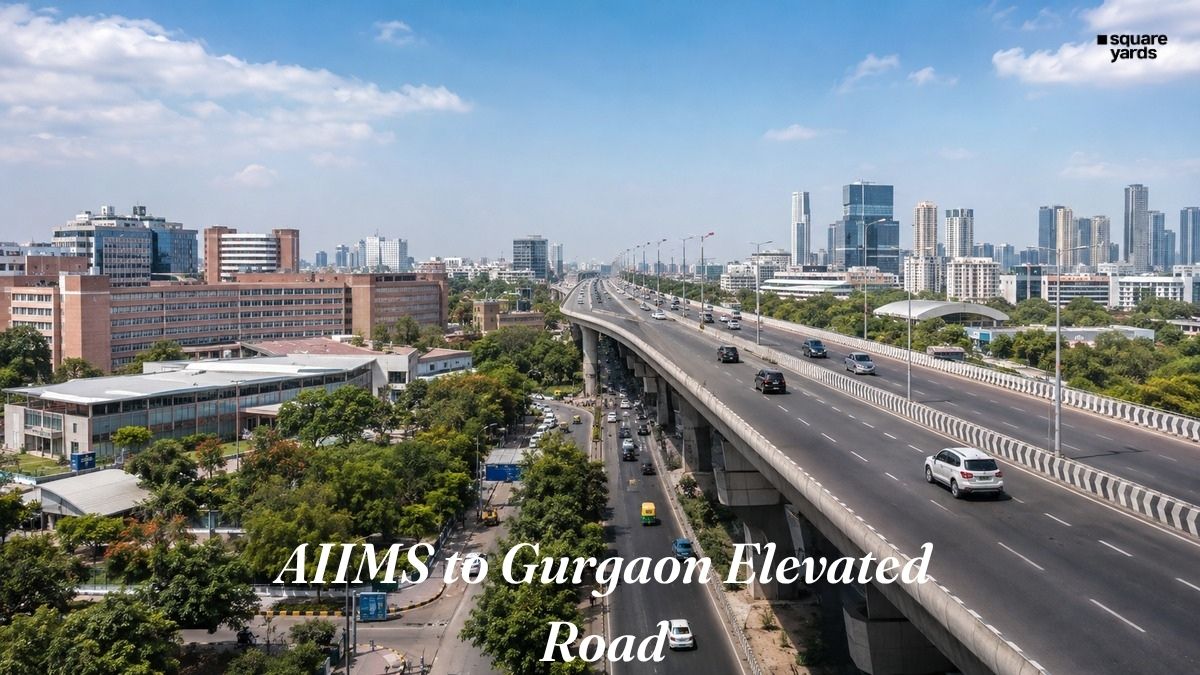
The National Highways Authority of India has resumed paperwork for a 20-km, signal-free elevated corridor connecting AIIMS in South Delhi to the Gurgaon-Faridabad Road via Mahipalpur.
Threading through Mahipalpur and extending to the Gurgaon-Faridabad Road, the Rs 5,000- crore corridor is currently at the Detailed Project Report (DPR) stage under the Ministry of Road Transport and Highways.
NHAI and the Delhi government have already transferred relevant stretches to the former for interim upgrades, including crash barriers and LED lighting on the Mehrauli-Gurugram road, signaling this isn’t purely a paper exercise even at this early stage.
The stated ambition is aggressive: officials say the corridor could cut AIIMS-to-Gurugram travel time to “mere minutes” and roughly halve current commute times on a stretch that presently crawls through some of Delhi-NCR’s worst congestion on NH-48 and the Ring Road.
Why this corridor matters more than a typical bypass announcement
To understand why this specific project deserves attention, look at what happened the last time NCR built exactly this kind of connectivity: the Dwarka Expressway. That 29 km, eight-lane elevated highway, India’s first single-pillar urban expressway, took 18 years from conception to functional completion, but once it opened, the real estate impact was dramatic. Flat rates along the corridor have appreciated 75% over three years and 1.5 times over five years, according to Square Yards Research.
AIIMS-Gurgaon corridor is proposing to relieve pressure on and extend the utility of a corridor that has already demonstrated exactly this kind of appreciation pattern once real connectivity landed. If the elevated link integrates cleanly with Dwarka Expressway as planned, it effectively extends that corridor’s addressable commuter catchment further into South Delhi, which is a meaningfully different proposition than an isolated new road.
For homebuyers, the practical signal here is about commute-time arbitrage rather than an immediate price trigger. Dwarka Expressway sectors currently trade between roughly Rs 9,000 and Rs 24,000 per square foot depending on location and project tier, with steady 8-12% annual appreciation now more typical than the 50-60% jumps of the early boom.
For investors, the DPR stage is exactly the point in a project’s life where informed capital typically starts positioning, after the idea is credible enough to track, but before execution risk is priced out. For renters and working professionals, particularly those commuting to South Delhi or the airport, materially shorter Ring Road and NH-48 travel times would directly improve the rental case for New Gurgaon and Dwarka Expressway sectors that today lose some appeal purely on commute friction.
For commercial developers, better AIIMS-Mahipalpur-Gurugram flow strengthens the corridor’s existing appeal as a plug-and-play business park destination; M3M IFC, DLF Downtown, and similar developments are already operational along Dwarka Expressway, and faster Delhi-side access only reinforces that positioning.
Micro-Markets Positioned to Benefit
- Sectors 99-113 along Dwarka Expressway: The direct beneficiaries of any AIIMS-side integration, with Sectors 104, 106, 108, and 113 already flagged by market analysts as the corridor’s prime capital-appreciation zones.
- New Gurugram (Sectors 76-95A): A broader planning zone with existing links to Cyber City and Manesar, positioned to gain secondary benefit from improved Delhi-side access rather than being directly on the new route.
- Mahipalpur and the Mehrauli-Gurugram stretch, Delhi: Already receiving interim NHAI upgrades (crash barriers, lighting) ahead of any elevated construction — often an early, low-cost signal of a corridor being prioritized.
Where this could realistically go wrong
DPR-stage NCR road projects frequently face multi-year delays even after formal sanction, and this one has yet to reach that stage. Land acquisition along the Mahipalpur and South Delhi stretch, some of the most built-up, expensive real estate in the country, is likely to be far more complex and costly than acquiring land was for the Gurugram side of Dwarka Expressway, which ran through comparatively undeveloped sectors when construction began.
Buyers should also weigh the speculative pricing risk that tends to follow any “revived” infrastructure news in NCR. Sellers and brokers are quick to cite such announcements to justify price increases well before a DPR is even finalized, let alone before construction begins.
Finally, the broader Dwarka Expressway market itself is now explicitly described by analysts as past its explosive-growth phase, meaning even a successful AIIMS link may produce steadier, single-digit appreciation rather than a repeat of the corridor’s early boom years.
Key Takeaways
This project is best understood as a second chapter in a story real estate watchers have already seen play out once on this exact stretch of NCR. The Dwarka Expressway took nearly two decades to go from proposal to payoff, and when it finally arrived, it transformed a quiet corridor into one of Gurugram’s most active investment zones. The AIIMS-Gurgaon elevated link is now attempting the same arc. Reviving a 2006-era bottleneck fix into a modern, signal-free corridor designed to plug directly into that success story. Whether it takes two years or twelve to move from DPR to reality will determine who actually captures the value this connectivity promises.