
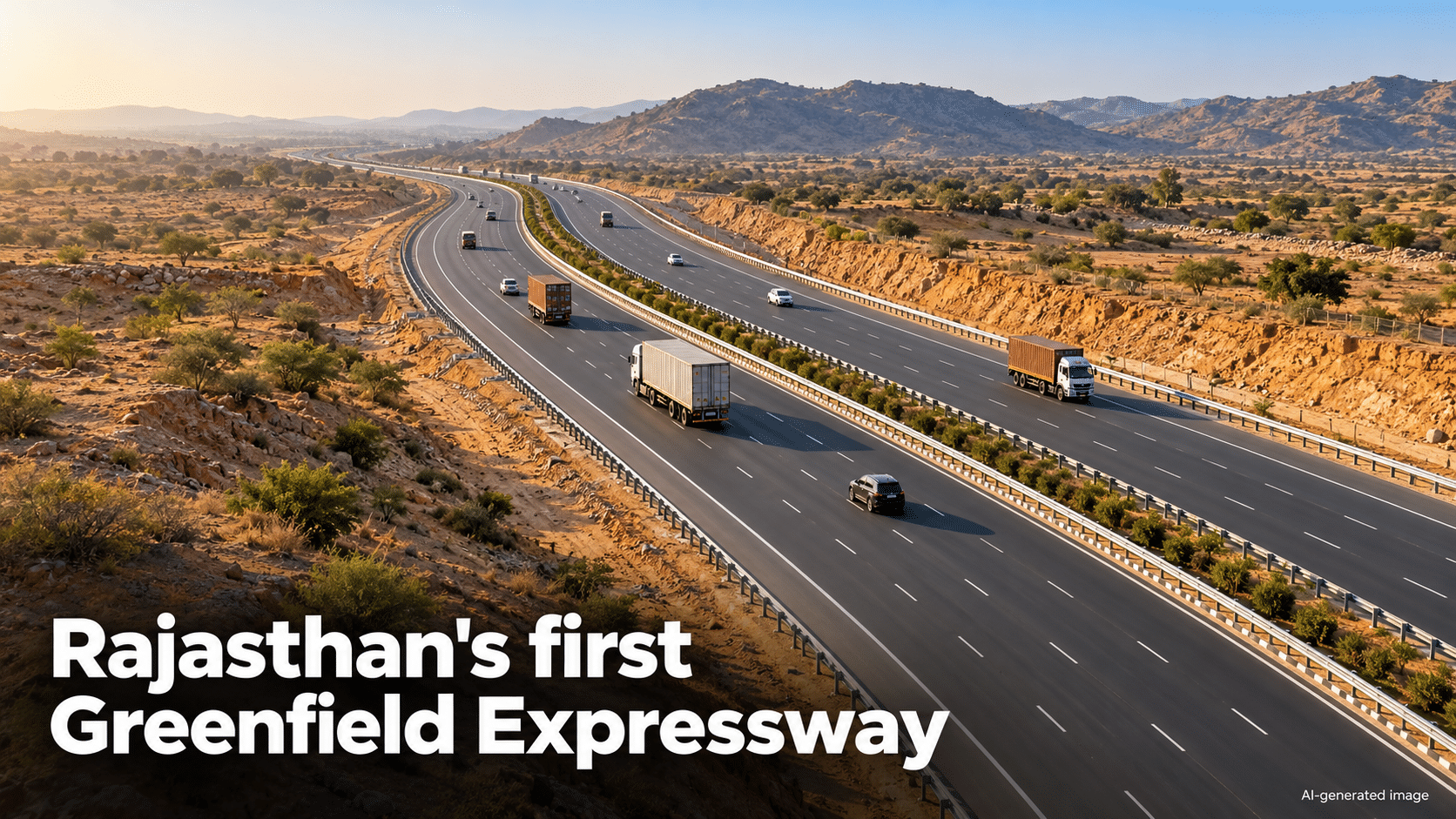
Rajasthan’s first greenfield expressway is heading to bidding
Most Indians judge a location by its distance from a good road. A greenfield expressway changes that distance overnight, and it also changes who can afford to live, work and invest along the route!
Rajasthan is about to start that process. The state plans to invite bids for its first greenfield expressway in November 2026. This is the Kotputli–Kishangarh corridor, the first of nine expressways the state has proposed. Here is what it means for buyers, renters and investors.
A Rs 6,906 crore bypass for a highway that is running out of room
The Rajasthan State Road Development and Construction Corporation (RSRDC) has approved Rs 43.98 billion in borrowing for land acquisition across the Kotputli–Kishangarh and Beawar–Bharatpur expressways. The Kotputli–Kishangarh highway stretch is tentatively 181 km long and estimated at Rs 69.06 billion. Reports put the land requirement at about 1,679 hectares.
It is one piece of a larger plan. The state’s budget proposed nine expressways covering 2,756 km, with five targeted for completion by 2030. The corridor starts near Kotputli, joins NH-48 and NH-448 near Kishangarh, and cuts across central Rajasthan. An environmental clearance filing describes it as an alternative to the congested NH-48, with the Kotputli–Kishangarh trip falling from nearly four hours to about two.
Reading between the numbers
Three figures matter more than the headline cost.
- Land. About 1,679 hectares of mostly farmland is being converted into a corridor. Once a road exists, nearby land stops being “agricultural” in buyers’ minds, and prices often move before a single vehicle does.
- Time. Cutting a four-hour trip to two changes which towns count as commutable, or at least as reachable for a weekend. Jaipur’s economic orbit widens.
- Access control. Local reporting says the expressway will have nine entry-exit points. Few access points mean value concentrates around interchanges, not along the whole 181 km. A village 15 km from an exit gains far less than one 2 km away.
For homebuyers, the interchange matters more than the expressway itself. For investors, most of the 181 km will see modest change, while a handful of nodes will see most of the action.
Micro-Markets that will see positive impacts
Kotputli: The northern gateway, close to the Delhi side and the Jaipur–Delhi highway. It is the most natural spot for warehousing, small industry and budget housing. Square Yards data shows buyer interest here is concentrated in independent houses in the Rs 50 lakh to Rs 2 crore range, while listed supply covers only about a third of that demand.
Jobner and the Jaipur-district belt: Reports name a major interchange near Jobner, at the Dyodhi-Harnathpura turn. Square Yards data for Jobner shows buyer demand concentrated entirely in plots priced below Rs 50 lakh, with supply at about 88% of that demand. In plain terms, buyers want small-ticket plots and stock is thin. That points to real appetite, but thin stock can also push asking prices up faster than fundamentals justify, so compare rates before paying an expressway premium.
Chomu and Phulera: Local reports list these among the areas on the alignment in Jaipur district. They sit between established Jaipur suburbs and the new corridor, which makes them candidates for plotted development.
Kishangarh, Makrana and the Khatu Shyam belt: Kishangarh is known for marble, Makrana for its stone, and Khatu Shyam draws steady pilgrim traffic. Better access can help logistics, hospitality and small commercial space more than premium housing.
What this means for realtors?
Homebuyers: Do not expect a Gurugram-style housing boom. These are small towns, and demand will be gradual. The upside is affordability: entry prices are low, and ready homes near interchanges may become attractive to families who work along the corridor.
Investors: Treat this as a 5 to 10-year land-and-logistics play, not a quick flip. Warehousing, fuel and food stops, and small industrial sheds near interchanges often outperform housing in the early years.
Renters: Rentals follow jobs, and jobs follow construction and then industry. Expect a bump in worker and contractor housing during the build, with more stable rental demand arriving only if commerce follows.
Local businesses: Trucking, stone and marble trade, and tourism all gain from shorter delivery and visit times. That feeds directly into demand for commercial space.
Where this can go wrong?
A bid invitation is a milestone, not construction: the Jalore–Jhalawar expressway, announced in Rajasthan’s February 2024 budget, was still reported as being on paper in early 2026. Land acquisition is the likeliest bottleneck, with Jaipur district alone involving about 50 villages and over 13,000 families, and compensation disputes can add years. Sellers also quote tomorrow’s prices today, so buying near an expressway that is three years away means paying interest in advance. Since reports still disagree on length, cost and land needs, treat every figure as an estimate until the final tender documents are out.
Key Takeaways
- The expressway is Rajasthan’s first greenfield test of a nine-corridor plan. Its success will shape how seriously buyers treat the other eight.
- Value will concentrate around nine interchanges, not along the full route.
- Raw land and logistics space tend to move before housing. Housing follows jobs.
- Verify land status, conversion and last-mile access before buying anything on expressway hype.
- Watch for three signals before committing: final bids and awards, land acquisition progress, and environmental clearance.
A road creates options, and value shows up where those options meet real demand. For Rajasthan, this corridor is a bet that central Rajasthan’s towns can become destinations and not just stops along NH-48. Buyers who understand that difference will make better decisions than those who simply follow the headline.