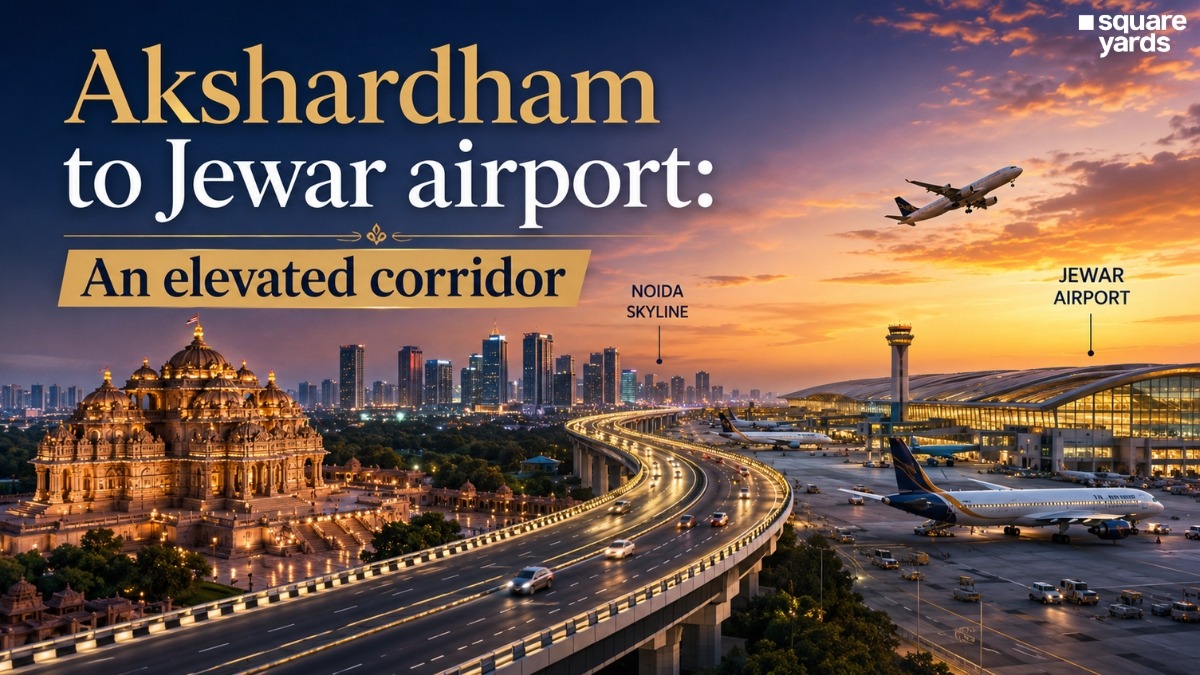
Infrastructure projects in the NCR have a habit of changing shape mid-plan, and few illustrate that better than the elevated expressway now taking form between Delhi and Noida International Airport. What started earlier in 2026 as a fairly contained 31 km corridor along the Yamuna embankment has, within a matter of months, grown into a roughly 50 km elevated run connecting Akshardham in Delhi all the way to the Noida airport aka Jewar Aiport.
This Akshardham-Noida elevated expressway real estate story is exactly the kind of slow-build infrastructure signal that’s easy to miss in the headlines but hard to ignore once you trace the pattern of revisions.
From a bypass idea to an airport link
The project’s original brief was modest: give Noida’s most overloaded road, the Noida-Greater Noida Expressway, an alternative route. That expressway currently carries over 10 lakh vehicles a day, and with Noida International Airport having begun commercial flight operations on 15 June 2026, airport-bound traffic has piled onto a corridor that was already straining.
NHAI’s first draft alignment, submitted to the Noida Authority in June 2026, proposed an 8-lane elevated road of about 31 kms, starting near the Okhla Barrage in Sector 94 and running along the Yamuna embankment to the Chi-I area of Greater Noida, near Gharbara village, where it would merge with the Yamuna Expressway opposite Gautam Buddha University.
During a joint review on 3 June 2026, NHAI and Noida Authority officials revised the starting point from Sector 94 to the DND Flyway instead. This was a change made specifically to route around environmental objections tied to the Okhla Bird Sanctuary and the Dalit Prerna Sthal memorial. The realignment added almost 5 kms to the corridor and shifted the effective starting point to the Akshardham end of Delhi, since the DND Flyway sits immediately adjacent to it.
In effect, the project had quietly turned into an Akshardham to Noida corridor rather than a Sector 94 bypass. Taking the total length to approximately 50 kms at an estimated NHAI cost of around Rs 4,000 crore.
What that trajectory tells you matters more than any single number in the plan. Each revision has moved the project from “relief road for a congested expressway” toward “primary high-speed spine linking Delhi directly to India’s newest international airport.”
What this means once you get past the route map
For a corridor still in the DPR stage, it’s tempting to treat every announcement as noise. But there’s a specific reason the Akshardham Noida elevated expressway real estate conversation deserves attention right now rather than once construction is visibly underway: alignment finalization is historically the single biggest de-risking event in an infrastructure project’s life.
For homebuyers, that de-risking is the signal to watch, not the headline length figure. Property markets along Sectors 94, 95, and the 125-135 belt have spent years anchored to the Noida-Greater Noida Expressway as their only serious connectivity asset; a second elevated spine running parallel to it changes the calculus for anyone buying with a 5-10 year horizon. A working Noida to Akshardham stretch would, for the first time, give this belt a genuine second route into Delhi instead of a single congested lifeline.
For investors, the more interesting exposure sits further out. At the Chi-IV/Gharbara junction and along the YEIDA sectors near the airport, where Sector 22D is already being positioned as a premium residential zone roughly ten minutes from Jewar. Industry analysis is candid on this point: alignment finalization “reduces execution risk and confirms connectivity,” but prices in these zones are unlikely to see dramatic appreciation until the road is actually operational — the gain right now is confidence, not liquidity.
Micro-Markets Positioned to Benefit
- Sector 150, Noida: Already the fastest-appreciating residential sector in the city, with prices reported to have doubled since 2019; a second high-speed corridor to Delhi only reinforces an existing growth story rather than starting a new one.
- Sector 94, Sector 95, and Sectors 125–135: Currently reliant on internal roads despite Yamuna-adjacent locations; direct elevated access would be a genuine first for this belt rather than an incremental upgrade.
- Chi-IV and Gharbara village, Greater Noida: The interchange point with the Yamuna Expressway — semi-developed today, but positioned to become a logistics and commercial node once the junction is functional.
- YEIDA Sector 22D and the Yamuna Expressway corridor: Marketed as premium, airport-proximate residential zones; the expressway extension to Jewar directly reinforces this corridor’s core investment pitch.
- Pari Chowk and Knowledge Park, Greater Noida: Established institutional and educational hubs that stand to gain secondary footfall and connectivity benefits from a functioning corridor nearby.
Where the Optimism Needs a Reality Check
Three revisions in under a year is not a stability signal; it’s a reminder that this project has yet to settle into its final form, and further changes to length, lane count, or alignment remain possible before the DPR is locked.
NHAI’s consultants indicated the detailed project report was expected within roughly three months of the June 2026 submission, meaning the corridor is, at the time of writing, still in the planning and technical-evaluation stage.
There’s also a real risk of speculative pricing running ahead of the project’s actual milestones, a pattern common to every NCR corridor that has ever been “finalized” in the press before a single foundation was poured. Every Noida expressway announcement of the last decade has carried some version of this risk, and this one is no exception. With all these speculated shortcomings as per the industry experts, the project does hold a lot of significance in the region and should majorly benefit the regions connected to it.
Closing note
What makes this project worth watching isn’t its current length. It’s the direction of every revision so far. Track the Akshardham Noida elevated expressway real estate angle closely over the next few DPR updates, because a road that began as a bypass for one congested expressway has, in under a year, evolved into a proposed high-speed spine linking central Delhi directly to India’s newest international gateway. That kind of scope creep is unusual, and when it happens because the project keeps absorbing more strategic purpose rather than losing momentum, it’s typically a sign that the underlying infrastructure logic is proving stronger than the original plan anticipated.