
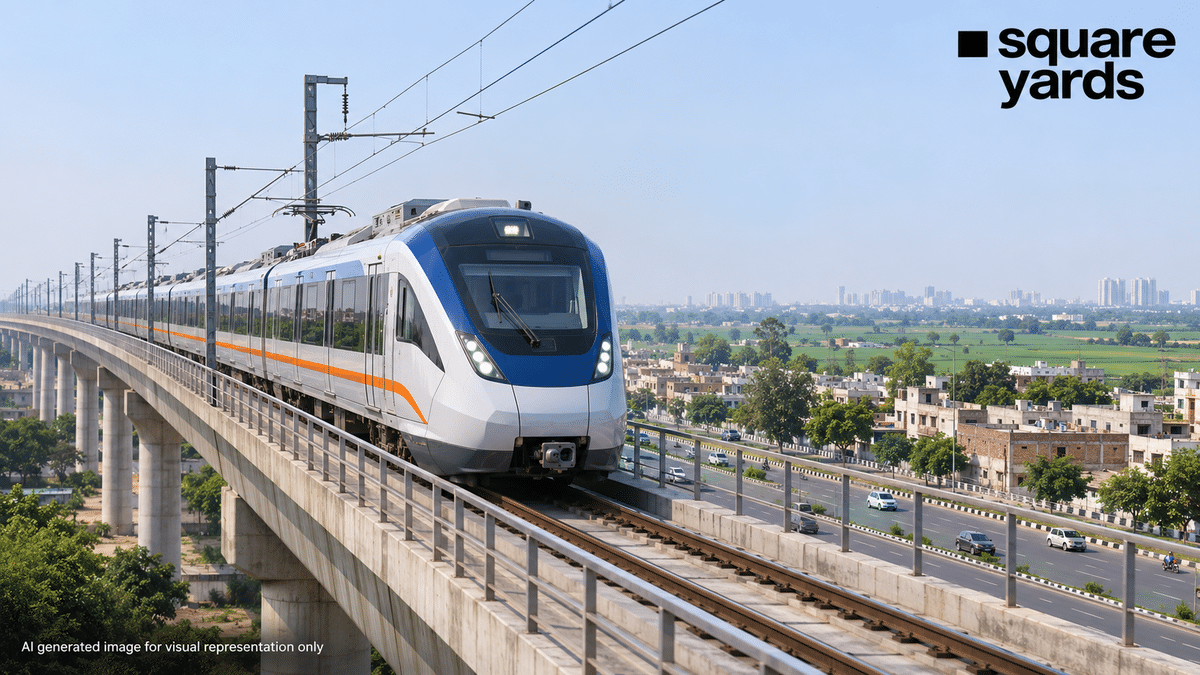
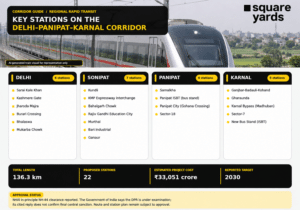
The proposed Delhi–Panipat–Karnal Namo Bharat corridor, estimated to cost about Rs. 33,051 crore, has received key approvals and is targeted for completion by 2030. The 136.3-km route will connect Sarai Kale Khan in Delhi with Karnal in Haryana, passing through Narela, Kundli, Sonipat, Ganaur, Samalkha and Panipat along the NH-44 corridor. The Haryana Cabinet approved the project in March 2026, and the National Highways Authority of India (NHAI) granted land-use permission for works along the route in November.
The approvals mark progress for the corridor, but 2030 remains the target. Preparatory work, including utility shifting on parts of the route, has reportedly begun. The National Capital Region Transport Corporation (NCRTC) is developing the project.
What the approvals cover
The Haryana Cabinet approved the corridor in March, including a state contribution of about Rs. 7,472 crore. The state also approved transit-oriented development provisions around stations. Separately, NHAI’s land-use permission covers infrastructure works along the highway alignment, including piers, stations and the shifting of high-tension power lines. Recent reports also say the project has received Center-level clearance.
Preparatory work does not mean passenger services are imminent. The route, station plans and construction schedule will determine how the project proceeds; no opening date has been confirmed.
Delhi–Panipat–Karnal Namo Bharat: project details
|
Project detail |
Current proposal or reported status |
|
Route |
Sarai Kale Khan, Delhi, to Karnal, Haryana |
|
Length |
About 136.3 km |
|
Alignment |
Along the NH-44 corridor |
|
Key Haryana towns |
Kundli, Sonipat, Ganaur, Samalkha, Panipat and Karnal |
|
Proposed stations |
Up to 22, including Sarai Kale Khan |
|
Estimated cost |
About Rs. 33,051 crore |
|
Haryana’s share |
About Rs. 7,472 crore |
|
Travel-time estimates |
About 60 minutes to Panipat and 90 minutes to Karnal |
|
Target |
2030; no confirmed opening date |
The corridor is planned to operate at up to 160 km/h. The journey times are projections and may change as the project advances.
Station access could influence housing demand
The Delhi–Panipat–Karnal RRTS could make towns along NH-44 more accessible to Delhi and to one another. If the corridor advances as planned, Kundli, Sonipat, Panipat and Karnal may attract interest from homebuyers seeking improved regional connections. The potential effect is likely to be strongest around confirmed stations with reliable feeder transport and access to jobs, schools, healthcare and other services.
Haryana’s transit-oriented development provisions create a planning framework for development around stations. They do not, on their own, guarantee new housing projects or price increases. Demand will also depend on the final station locations, local transport links, employment growth and civic infrastructure.
Asking rates offer a market baseline
Square Yards’ residential asking-rate data provides a snapshot of selected areas along the corridor. The figures are for apartments and cover different reporting periods.
|
Area |
Indicative apartment asking rate |
Data period |
|
Kundli |
About Rs. 4,650 psf |
September 2026 |
|
Sonipat |
About Rs. 4,550 psf |
September 2026 |
|
TDI City, Panipat |
About Rs. 6,000 psf |
September 2026 |
|
Karnal |
About Rs. 4,700 psf |
March 2026 |
Source: Square Yards Research
These are asking rates, not registered transaction prices. The reporting periods differ, and the figures do not show that the proposed corridor has affected property values.
The project’s approvals and preparatory activity move the corridor forward, while its 2030 target remains dependent on construction progress. For the housing market, improved connectivity could support demand in station-linked areas, but the scale and timing will depend on the final route, local access, and growth in jobs and services. The current rate data offers a baseline for comparison as the project develops; it does not establish an existing Namo Bharat-related price rise.