
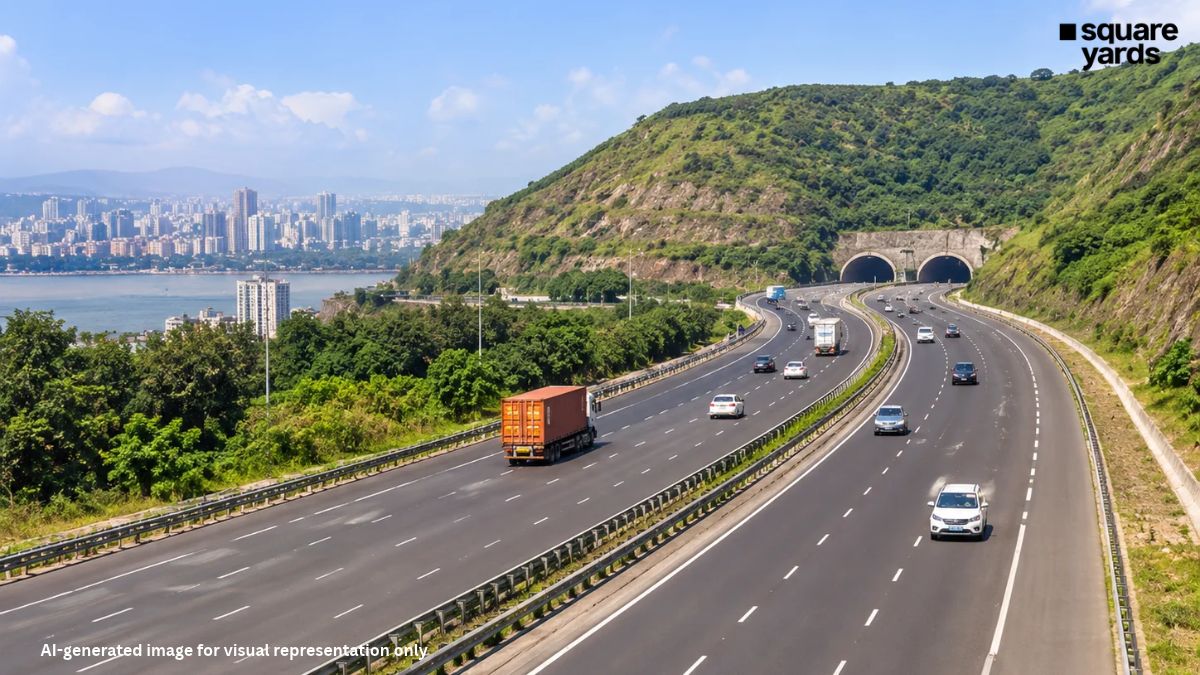
The National Highways Authority of India (NHAI) has moved the first package of the proposed Rs 15,000-crore Mumbai-Pune Greenfield Expressway into the tender process. The wider project is planned as a roughly 130-km, eight-lane corridor connecting the Navi Mumbai region with Pune. It is expected to provide an additional high-capacity road link between the two regions. The expressway also aims to improve access to the Jawaharlal Nehru Port Authority (JNPA) area and reduce the Mumbai-Pune journey time to around 90 minutes.
The first tender covers a 29.2-km stretch from Pagote to Chowk in Maharashtra. The NHAI e-procurement schedule lists 24 December 2026 as the bid opening date. This section is planned as a six-lane highway under the BOT (Toll) model and includes two tunnels through the Sahyadri range. The remaining stretch of around 100 km towards Pune is still at the planning and detailed project report (DPR) stage.
Mumbai-Pune Expressway: Key project details
The proposed Mumbai-Pune Greenfield Expressway is expected to strengthen road connectivity between the Mumbai Metropolitan Region and Pune. Here are the key details of the proposed expressway.
|
Particulars |
Details |
|
Project |
New Mumbai-Pune Greenfield Expressway |
|
Proposed length |
Around 130 km |
|
Planned configuration |
Eight lanes for the wider corridor |
|
Estimated project cost |
Rs 15,000 crore |
|
Target travel time |
Around 90 minutes |
|
First tendered package |
29.2 km, Pagote to Chowk |
|
First package configuration |
Six lanes, BOT (Toll) mode |
|
Key structures |
Two tunnels through the Sahyadri range |
|
Implementing agency |
National Highways Authority of India (NHAI) |
NHAI advances tender process for Pagote-Chowk stretch
The first package Mumbai-Pune Greenfield Expressway covers 29.2 km, starting near Pagote at its junction with NH-348 (earlier referred to as NH4B) and ending at Chowk, where it will meet NH-48. It has an estimated tender value of around Rs 3,653 crore. The tender specifies a construction period of 910 days. The tender describes this section as a six-lane greenfield highway to be developed under the build-operate-transfer (Toll) model. This is distinct from the wider 130-km corridor, which is being described as an eight-lane expressway.
The package includes two tunnels through the Sahyadri range. These tunnels are expected to help the road pass through the hilly terrain while reducing the need for a longer surface alignment. The tender schedule has been revised through subsequent corrigenda. The NHAI e-procurement listing records the bid opening date as 24 December 2026. The tender process is not the same as the start of full-scale construction.
Mumbai-Pune Greenfield Expressway route and key connectivity
The proposed Mumbai-Pune Greenfield Expressway corridor is intended to strengthen road links between the Navi Mumbai region, the Jawaharlal Nehru Port Authority (JNPA) area and Pune. It is planned as an alternative route running parallel to the existing Mumbai-Pune Expressway. The Pagote end will connect with the NH-348 network, while the Chowk end meets NH-48. The wider route is planned to continue towards Shivare village near Bhor, with a link to the Pune Ring Road.
The corridor is also expected to improve access to the Atal Setu and the wider Navi Mumbai transport and logistics network. For freight movement, the link could benefit businesses operating around JNPA and industrial areas in the Raigad belt. The final travel pattern will depend on the completed alignment, junction design, and connecting road infrastructure.
A new road link between Mumbai and Pune
The existing Mumbai-Pune road journey is served by established highway infrastructure, including the Mumbai-Pune Expressway and the old Mumbai-Pune highway. The proposed Mumbai-Pune Greenfield Expressway route is intended to add capacity and provide another connection between the two urban regions, particularly for traffic linked to Navi Mumbai, JNPA and the Pune side.
The proposed 90-minute journey is an indicative target. Actual travel times will depend on the final route, access points, traffic conditions, toll arrangements, and the time needed to connect from local destinations to the expressway.
Real estate markets along the proposed corridor
Large road projects can influence where homebuyers, businesses and logistics operators look for property. The effect is usually gradual and depends on more than the expressway alone. Local employment, public transport, social infrastructure, project supply and the quality of last-mile access also shape demand. The corridor may bring added attention to parts of Navi Mumbai, Raigad and Pune.
Panvel and Ulwe: Navi Mumbai’s growth belt
Panvel is an important junction in the wider Navi Mumbai growth area, with access to major road links and the JNPA side. Square Yards lists an indicative average asking price of about Rs 15,450 per square foot (psf) for Panvel. Ulwe, which is part of the wider Navi Mumbai market, has an indicative average asking price of around Rs 17,700 psf. These are asking-price indicators and can vary by project, sector, property type, and configuration.
Kharghar and Taloja: Residential markets at different price points
Kharghar has an established residential base and access to key parts of Navi Mumbai. Its indicative average asking price on Square Yards is around Rs 19,150 psf. Taloja offers a comparatively lower entry point in parts of the market, with an indicative figure of around Rs 11,400 psf. The two locations serve different buyer budgets and should not be treated as one uniform market.
Hinjewadi and Wakad: Pune’s employment-linked markets
On the Pune side, Hinjewadi and Wakad are relevant because of their links to the city’s employment and residential belt. Square Yards lists indicative average asking prices of around Rs 11,400 psf in Hinjewadi and Rs 12,700 psf in Wakad. The expressway’s eventual connection with the Pune Ring Road and local road network will matter more to these markets than the headline project length alone.
Note: The quoted rates are indicative asking prices, not registered transaction values. Prices can differ considerably across sectors, buildings, age of construction and amenities.
Potential boost to logistics and industrial activity
The Mumbai-Pune Greenfield Expressway corridor could have a wider role beyond passenger travel. Improved road access between Navi Mumbai, JNPA and industrial locations in Raigad may support freight movement, warehousing and distribution activity. The Pune end could also benefit businesses that need road access to the city’s manufacturing and technology employment clusters.
For property markets, this may create demand for industrial plots, warehouses and worker housing in selected locations. The scale of that demand will depend on the final alignment, access-controlled entry points, supporting infrastructure and the pace at which the project is delivered.