
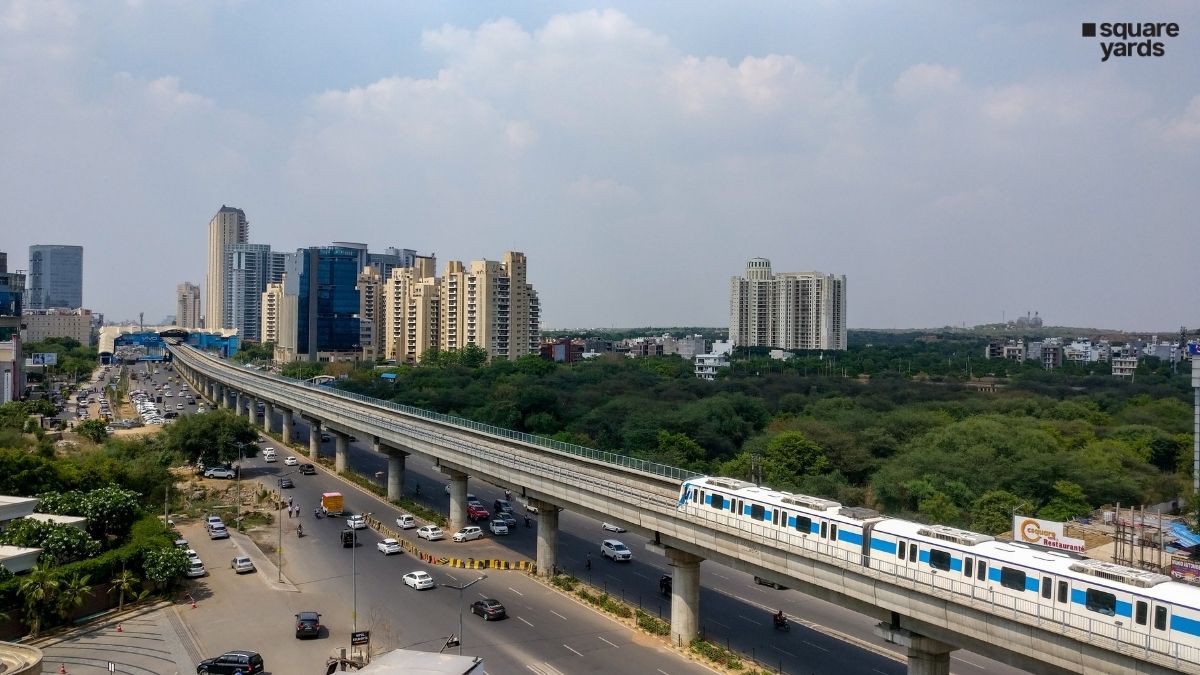
GURUGRAM, May 4, 2026 – The Haryana government has cleared the final alignment for the ₹15,000 crore Gurugram-Faridabad-Noida Namo Bharat RRTS corridor. The 64 km high-speed rail network will connect the major economic hubs of Haryana and Uttar Pradesh, slashing travel time between Gurugram and Noida from 2 hours to just 40 minutes. Executed by the National Capital Region Transport Corporation (NCRTC), the construction is slated to begin in December 2026, promising to unlock significant capital appreciation in residential and commercial pockets along its route.
A Regional Mobility Backbone
The project, part of the Prime Minister’s Namo Bharat initiative, is being planned as a hybrid RRTS-cum-Metro system. This allows high-speed regional trains to share tracks with local metro services, ensuring both rapid long-distance transit and frequent local access.
Haryana Chief Minister Nayab Singh Saini said that through a mix of integrated RRTS-cum-Metro stations and local metro-only stops, the network will link the Delhi Metro Yellow Line, the Rapid Metro, and the Violet Line. Along with reducing travel time between key economic centres, the corridor will also open up new investment corridors across NCR.
Beyond the speed, the infrastructure includes 18 planned stations (8 in Gurugram and 10 in Faridabad). By routing the line through the Surajpur interchange, the government is effectively tying the industrial heart of Haryana directly to the upcoming Jewar Airport, a move expected to stabilise and then drive up commercial land values across the transit-oriented development (TOD) zones.
Real Estate Impact
For real estate stakeholders, the corridor identifies specific high-growth zones. In Gurugram, the 14.5 km integrated section between IFFCO Chowk and Gwal Pahari will link established hubs like Sector-29 and Millennium City Centre with emerging luxury residential belts.
In Faridabad, the corridor is expected to be a game-changer for Greater Faridabad (Sectors 75–89). Industry experts suggest that the 20-minute connectivity to Noida will shift Faridabad from a peripheral suburb to a primary residential choice for professionals working in UP’s tech hubs.
Connectivity across NCR
The corridor is being planned as a multimodal link starting from IFFCO Chowk in Gurugram, where it connects with the Delhi–Alwar RRTS and the Delhi Metro Yellow Line. In Faridabad, Bata Chowk will be the key interchange, linking to the Violet Line. From there, the route moves into Noida through the Sector 142–168 stretch, ending at Surajpur Junction.
Surajpur Junction is expected to connect with the upcoming Ghaziabad–Jewar Airport RRTS, which would create a direct high-speed link to the Noida International Airport. For anyone tracking real estate movement, that kind of connectivity usually changes how these micro-markets behave.
With the Detailed Project Report now finalised by NCRTC and the alignment locked in, the next steps are land acquisition and tendering. There’s also some attention being given to execution details. For instance, elevated sections will have noise barriers to minimise impact on nearby residential areas.
As things move towards a likely construction start in December 2026, there’s already a visible uptick in interest across Gurugram, Faridabad, and Greater Noida.