
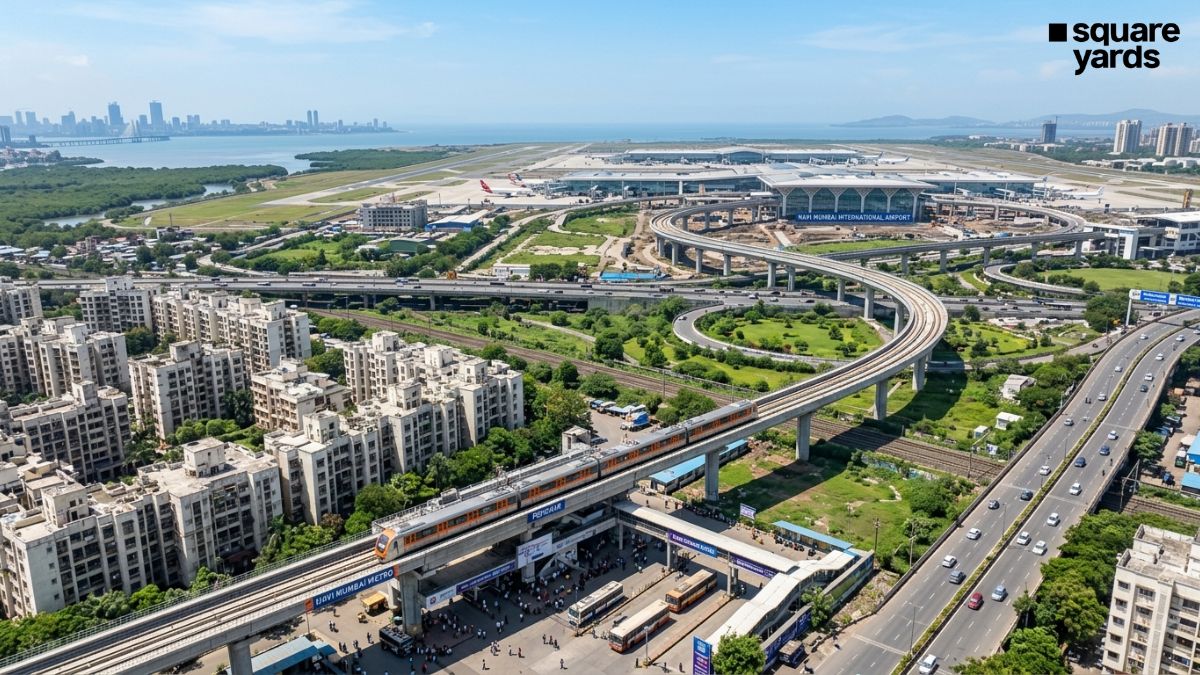
Navi Mumbai’s transport network is entering a major expansion phase, with the Maharashtra government approving a Rs 5,575-crore extension of the Navi Mumbai Metro. The plan is important for daily commuters and for the city’s long-term growth around the Navi Mumbai International Airport (NMIA).
The expansion covers Metro Lines 1A and 2, which will connect the existing metro network directly to the airport. Together with the operational Line 1, these corridors will create an approximately 28-km continuous metro route from Sagar Sangam to NMIA. The expanded network is expected to eventually handle close to 12 lakh passengers a day.
What is being added?
Navi Mumbai Metro currently operates between CBD Belapur and Pendhar. This 11.1-km Line 1 has 11 stations and has been operational since November 2023. City and Industrial Development Corporation of Maharashtra Limited (CIDCO) had estimated its project cost at about Rs 3,063.63 crore.
Line 1A will extend the network from CBD Belapur to Sagar Sangam. The proposed elevated stretch is about 3.02 km long with two stations. Line 2, the more significant extension, will run approximately 14.07 km from Pendhar to NMIA Terminal 4, with 11 stations.
The project therefore adds 13 stations and provides a direct mass-transit connection between established Navi Mumbai nodes and the airport influence zone. Areas expected to benefit from improved connectivity include CBD Belapur, Kharghar, Taloja, Pendhar, Kalamboli, Roadpali, and Kamothe.
The network will also become part of a much larger regional transport system. Line 2 is planned to connect with Mumbai Metro Line 12 at Amandoot, strengthening access towards Kalyan and other parts of the Mumbai Metropolitan Region. MMRDA lists Line 12 at 23.57 km.
Airport connectivity is the bigger story
The Navi Mumbai Metro expansion should be viewed alongside the proposed Metro Line 8, which is planned to connect Mumbai’s Chhatrapati Shivaji Maharaj International Airport with NMIA.
The state has approved the 34.9-km Line 8 at an estimated Rs 22,862 crore. The corridor is planned with 20 stations and a combination of elevated and underground sections. It is expected to carry about 9.82 lakh passengers daily by 2031.
If these projects are implemented as planned, Navi Mumbai will move from being largely dependent on suburban railways and roads to having a more integrated rail-based transport system connecting residential areas, employment centers, and two international airports.
Real estate impact: Taloja stands out
The strongest real estate impact is likely to be visible along the Pendhar-Taloja-Kalamboli-Kamothe belt, where metro accessibility will combine with airport-led development. Square Yards Data Intelligence shows Taloja at an average asking price of Rs 12,600 per square foot (psf) in March 2026, up from Rs 8,900 psf in June 2025. The locality recorded a 14.44% quarter-over-quarter increase in the latest reported period.
This matters because Taloja remains less expensive than more established Navi Mumbai locations while gaining direct metro connectivity. It could therefore continue to attract homebuyers seeking relatively affordable properties with improving access to employment and airport-related infrastructure.
Kharghar, by comparison, had an average apartment sale price of around Rs 18,500 psf, according to Square Yards Data Intelligence. The locality already has stronger social infrastructure and is likely to benefit from better integration with the wider metro network rather than connectivity being its only growth driver.
In Kamothe, the average asking price stood at approximately Rs 14,250 psf, while nearby Kalamboli was reported at around Rs 13,500 psf. Kamothe’s recent overall price movement has been relatively stable, suggesting that improved airport and metro connectivity could become an important future demand catalyst.
Outlook
The metro expansion does not automatically guarantee property appreciation. Construction timelines, station accessibility, housing supply, and actual passenger usage will determine the scale of the impact.
However, the structural direction is clear. Navi Mumbai is gradually building a transport network around CBD Belapur, Kharghar, Taloja, Kamothe, Kalamboli, and NMIA rather than relying on a single suburban rail corridor. Transit-oriented development has also received in-principle approval around Lines 1A and 2, strengthening the possibility of denser residential and commercial development near stations.
For the real estate market, Taloja and the airport-facing growth corridor offer the strongest catch-up potential, while Kharghar and other established nodes are likely to gain through improved connectivity and market depth. The larger transformation will unfold as the airport, the Navi Mumbai Metro extensions, and the regional Metro Lines 8 and 12 progressively become part of a single connected transport ecosystem.