
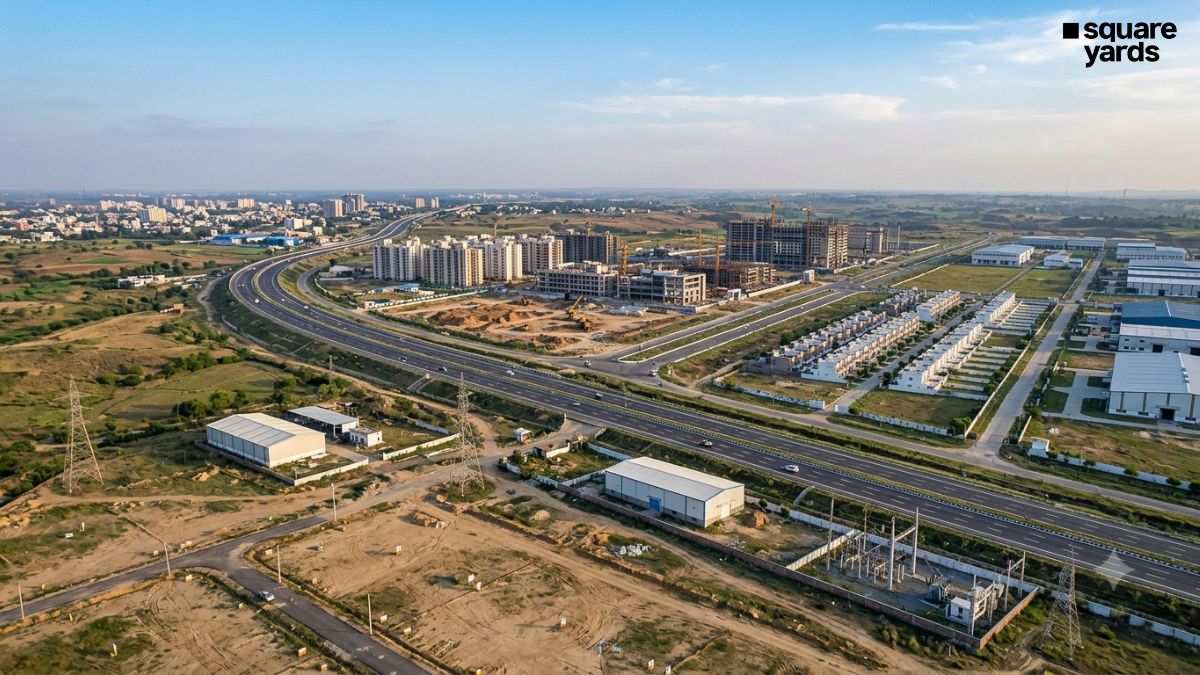
Uttar Pradesh has approved two major expressway projects worth nearly Rs 18,730 crore as part of a wider Rs 24,000 crore infrastructure push. This is expected to strengthen connectivity across the western and Bundelkhand regions. The state has earmarked Rs 10,761 crore for the Meerut-Haridwar extension of the Ganga Expressway and Rs 7,968.30 crore for the 106.3 km Jhansi Link Expressway, with both projects fully state-funded.
The announcements could also give a fresh boost to real estate along the emerging corridors, as improved road access, industrial activity and logistics infrastructure create conditions for housing, commercial and land demand to expand beyond established urban centers.
Two corridors with a wider economic reach
The biggest allocations include Rs 10,761 crore for the Meerut-Haridwar extension of the Ganga Expressway and Rs 7,968.30 crore for the 106.3-km Jhansi Link Expressway. Both are planned as six-lane corridors with provision for future expansion, and the projects are being pursued through UPEIDA.
The Meerut-Haridwar corridor is particularly significant for western Uttar Pradesh because it is planned to improve connectivity between Meerut, Muzaffarnagar, Bijnor and Haridwar, while extending the economic reach of the wider Ganga Expressway network. The project is also expected to strengthen tourism and trade linkages towards Haridwar.
The Jhansi Link Expressway, meanwhile, will connect the Bundelkhand Expressway near Phoolpura in Jalaun with NH-44 at Ambabai in Jhansi. Its strategic importance goes beyond mobility: the corridor is intended to support the Bundelkhand industrial ecosystem and the Jhansi defense corridor.
Infrastructure and real estate market connection
The real estate impact of such projects is likely to emerge through a familiar chain. Better connectivity will lead to greater business activity, job creation, and higher demand for housing and commercial space.
UPEIDA itself identifies industrialization, employment generation, and balanced regional development as key objectives of its expressway-linked Integrated Manufacturing and Logistics Cluster program. Its stated development vision includes opportunities for warehousing, cold storage, food processing, and other industries, as well as new educational, medical, and satellite-city development. This makes the latest approvals important for property markets beyond the established centers of Lucknow and the NCR. As industrial and logistics activity moves closer to new corridors, demand is increasingly emerging for worker housing, plotted development, rental accommodation, and retail and commercial space.
The Jhansi region is especially well positioned in this respect. UPEIDA’s plans identify Jhansi as one of six nodes of the Uttar Pradesh Defense Industrial Corridor, with the broader corridor having more than 5,125 hectares of proposed land across its six nodes.
Existing markets show the opportunity
The current market data from Square Yards Data Intelligence indicates how infrastructure-linked markets can perform.
In Lucknow, North Lucknow is currently at Rs 6,950 per square foot (psf), up 14.73% year-on-year, while West Lucknow is at Rs 6,850 psf, up 14.98% YoY. The wider Lucknow market is also showing a 6.42% increase in apartment prices, suggesting continued residential demand.
The stronger illustration comes from the Yamuna Expressway belt. Square Yards places the Yamuna Expressway micromarket at Rs 9,700 psf, up 5.13%, with specific locations showing further momentum. Sector 25 is at Rs 9,000 psf and has recorded an 8.9% rise in the latest period; Sector 23D is at Rs 7,650 psf, while Sector 22A stands at Rs 9,850 psf.
These numbers are not forecasts for the new expressway corridors. Rather, they demonstrate the broader market relationship among infrastructure improvements, accessibility, and property demand.
Industrial growth could be the bigger catalyst
The most important long-term opportunity may therefore lie outside conventional housing. UPEIDA’s existing expressway strategy explicitly combines highways with manufacturing and logistics clusters. Its plans for the Bundelkhand region, for instance, envisage an expressway network connecting less-developed districts such as Jalaun, Hamirpur, Banda and Chitrakoot to larger markets via the Agra-Lucknow and Yamuna Expressways.
For real estate, this creates the potential for a broader development cycle. Industrial units require warehouses and logistics facilities; these create employment, which in turn generates demand for housing, retail, and social infrastructure. Over time, locations that are currently peripheral can acquire the characteristics of established urban markets.
The Sultanpur manufacturing and logistics cluster announced alongside the infrastructure program adds another layer to this strategy, linking road investment with productive economic activity rather than treating expressways simply as transport projects.
A positive outlook for emerging UP markets
The immediate impact will be construction-led, but the larger opportunity is structural. Uttar Pradesh is increasingly building an interconnected network of expressways, industrial corridors and logistics infrastructure. UPEIDA’s current proposed project list includes both the Meerut-Haridwar Expressway and the Jhansi Link Expressway, along with other planned links.
For real estate, this could gradually shift the growth story from a handful of established cities towards corridor-led development. Established markets such as Lucknow and Greater Noida already demonstrate strong demand in infrastructure-oriented micromarkets, while the new corridors could create the next generation of investment and development locations.