
Buying property in Maharashtra means budgeting for more than the sticker price. Whether it is a flat in Mumbai, a plot in Pune or a home in Nagpur, stamp duty and registration charges add roughly 6 to 8 percent to the total cost – and that is before you factor in GST or brokerage. On a ₹1 crore flat in Thane, government charges alone can cross ₹6.3 lakh.
This guide covers every current 2026 rate: the city-wise sale deed rates, the women’s concession, and the separate charges for gift deeds, release deeds, partnership deeds, share certificates, loan agreements and mortgage deeds. It also walks you through calculation, documents and the online IGR Maharashtra process.
- What Is Stamp Duty in Maharashtra?
- Stamp Duty and Registration Charges in Maharashtra 2026 : City-Wise Rates
- Women’s Stamp Duty Concession in Maharashtra
- How to Calculate Stamp Duty and Registration Charges in Maharashtra
- Gift Deed Stamp Duty in Maharashtra
- Stamp Duty on Release Deed in Maharashtra
- Stamp Duty on Partnership Deed in Maharashtra
- Stamp Duty on Share Certificate in Maharashtra
- How to Pay Stamp Duty Online in Maharashtra
- Stamp Duty on Loan Agreement in Maharashtra
- Stamp Duty on Mortgage Deed in Maharashtra
- Stamp Duty on Different Instruments in Maharashtra : Quick Table
- Documents Required for Property Registration in Maharashtra
- Tax Benefit on Stamp Duty in Maharashtra
- Quick Reference : Sale Deed Stamp Duty in Maharashtra
- Conclusion
What Is Stamp Duty in Maharashtra?
Stamp duty in Maharashtra is a tax you pay to the state government on the instrument – the document – that creates or transfers a right in property. It is governed by the Maharashtra Stamp Act, 1958 (originally the Bombay Stamp Act), which has been amended several times, most recently in 2021 and 2025.
Registration is a separate step. Under Section 17 of the Registration Act, 1908, most property documents must be registered at the local Sub-Registrar Office. Paying stamp duty legalises the document; registration records your ownership in the public record. Without both, your sale deed cannot be used as evidence in court and you cannot take a home loan against the property.
Important 2026 change: Maharashtra has introduced a penalty of up to ₹1 lakh for insufficient stamp duty payment, on top of recovering the shortfall. Under-stamping is no longer a cheap mistake.
Stamp Duty and Registration Charges in Maharashtra 2026 : City-Wise Rates
What makes Maharashtra distinctive is that the rate depends on the city and on the buyer’s gender. Cities like Pune, Thane and Nagpur add a Local Body Tax on top of the metro cess, which pushes their rate one point higher than Mumbai.
|
City / Area |
Male Buyer |
Female Buyer |
Registration |
|
Mumbai |
6% |
5% |
1% (max ₹30,000) |
|
Pune, Thane, Nagpur |
7% |
6% |
1% (max ₹30,000) |
|
Navi Mumbai, Nashik |
6% |
5% |
1% (max ₹30,000) |
|
Municipal Council areas |
4% |
3% |
1% (max ₹30,000) |
|
Gram Panchayat / rural |
3% |
2% |
1% (max ₹30,000) |
How the Mumbai 6% breaks down
Mumbai’s 6 percent for men is a 5 percent base rate plus a 1 percent metro cess. Pune, Thane and Nagpur add a further 1 percent Local Body Tax, taking them to 7 percent. Women buyers get 1 percent off in every case for residential property held in their sole name.
Women’s Stamp Duty Concession in Maharashtra
Maharashtra gives women buyers a 1 percent reduction in stamp duty – the opposite of a state like Telangana, which offers no gender concession at all. This is one of the biggest legitimate savings available to Maharashtra buyers.
- The concession applies only when the property is residential and registered in a woman’s sole name
- Joint ownership with a male co-owner attracts the full male rate
- It does not apply to commercial property
- The earlier 15-year resale lock-in was removed in 2026, so a woman can now resell without repaying the 1 percent differential
What it saves: on a ₹1 crore flat in Pune, a male buyer pays 7 percent (₹7,00,000) while a female sole buyer pays 6 percent (₹6,00,000) – a clean ₹1,00,000 saving before registration.
How to Calculate Stamp Duty and Registration Charges in Maharashtra
Stamp duty is never simply calculated on the price you negotiated. It is charged on the higher of two numbers: your agreement value or the Ready Reckoner Rate (also called the circle rate) for that locality. The Ready Reckoner is the government’s minimum assessed value, revised around 1 April each year.
If you buy a flat in Pune for ₹80 lakh but the Ready Reckoner Rate works out to ₹85 lakh, your duty is calculated on ₹85 lakh. Under-declaring the price to save duty is treated as evasion and now attracts the ₹1 lakh penalty.
Worked Example : Male Buyer, ₹80 Lakh Flat in Pune
|
Item |
Calculation |
Amount |
|
Value considered (higher of the two) |
Assume ₹80,00,000 |
₹80,00,000 |
|
Stamp duty at 7% (5% + 1% metro + 1% LBT) |
7% of ₹80,00,000 |
₹5,60,000 |
|
Registration (1%, capped at ₹30,000) |
1% capped |
₹30,000 |
|
Total statutory cost |
About 7.4% |
₹5,90,000 |
Worked Example : Female Buyer, Same Flat
|
Item |
Calculation |
Amount |
|
Stamp duty at 6% (4% + 1% metro + 1% LBT) |
6% of ₹80,00,000 |
₹4,80,000 |
|
Registration (capped) |
1% capped |
₹30,000 |
|
Total |
About 6.4% |
₹5,10,000 |
|
Saving vs male buyer |
|
₹80,000 |
Gift Deed Stamp Duty in Maharashtra
A gift deed transfers property without any money changing hands. The stamp duty on a gift deed in Maharashtra depends entirely on who is receiving the property. This is where families save the most.
|
Type of Gift |
Stamp Duty |
Registration |
|
Residential or agricultural property to a blood relative |
Flat ₹200 |
1% (max ₹30,000) |
|
Gift to a non-family member |
3% of market value |
1% (max ₹30,000) |
Stamp Duty on Gift Deed in Blood Relation in Maharashtra
This is the headline concession. When residential or agricultural property is gifted to a close blood relative, the stamp duty on the gift deed in blood relation in Maharashtra is a flat ₹200, no matter how valuable the property is. On a ₹2 crore flat, that is still just ₹200 in stamp duty instead of lakhs on a sale deed.
Who counts as a blood relative: under the Maharashtra Stamp Act this covers spouse, children, parents, siblings, and grandchildren. The relationship must be documented, and it is worth confirming the current definition of “family member” before executing the deed, as eligibility affects the duty.
Gift to anyone else: if the recipient is not a close relative, the stamp duty for the gift deed in Maharashtra jumps to 3 percent of the market value, plus a 1 percent metro cess in cities where it applies. In that situation a sale deed and a gift deed cost almost the same.
Stamp Duty on Release Deed in Maharashtra
A release deed (or relinquishment deed) is used when one co-owner gives up their share in a property to another co-owner – common when siblings divide inherited property. The stamp duty on a release deed in Maharashtra depends on whether the property is ancestral and whether the parties are blood relatives.
|
Situation |
Stamp Duty |
Registration |
|
Ancestral property released among close blood relatives |
Flat ₹200 |
₹1,000 (or 1%, max ₹30,000) |
|
Any other case (non-ancestral or unrelated parties) |
5% of market value (+1% metro cess where applicable) |
1% (max ₹30,000) |
So a brother releasing his share of an inherited family home to his sister pays a nominal ₹200. But if the release is of a self-acquired property, or between people who are not close relatives, it is taxed at the full conveyance rate of 5 percent. Always confirm whether your property qualifies as ancestral before assuming the ₹200 rate.
Stamp Duty on Partnership Deed in Maharashtra
When two or more people form a partnership firm, the partnership deed attracts stamp duty under Article 47 of the Maharashtra Stamp Act. The stamp duty on a partnership deed in Maharashtra is based on the capital each partner brings in, not on any property value.
|
Capital Contribution |
Stamp Duty |
|
No contribution, or share up to ₹50,000 |
₹500 |
|
Share above ₹50,000 (cash) |
1% of the contribution, up to a maximum of ₹15,000 |
|
Contribution brought in as property (not cash) |
5% of the market value of the property |
|
Dissolution or retirement : property taken by a partner who did not bring it |
5% of market value |
|
Dissolution or retirement : any other case |
₹500 |
For most small firms that start with a modest cash capital, the partnership deed stamp duty is just ₹500. The rate only becomes significant when property is contributed as capital, because that is treated like a conveyance. Because the maximum on cash contributions has been revised over the years, confirm the current cap on the IGR Maharashtra portal before you execute the deed.
Stamp Duty on Share Certificate in Maharashtra
When a company issues shares, the share certificate is a stampable instrument. The stamp duty on a share certificate in Maharashtra is charged on the value of the shares issued, and companies must pay it within the statutory time after allotment.
- The commonly applied rate is ₹1 for every ₹1,000 (or part thereof) of the value of the shares – effectively 0.1 percent-
- It is paid by the company issuing the shares, not the shareholder
- Physical share certificates are stamped; for shares issued in demat form the central rules under the Indian Stamp Act apply instead
- Late payment can attract penalty, so pay within the prescribed window after allotment
Note: share certificate stamp duty rules interact with central securities rules and have been revised over time. Confirm the current rate and time limit with a company secretary or on the IGR Maharashtra portal before filing.
How to Pay Stamp Duty Online in Maharashtra
The revision in the Maharashtra Stamp Act deployed the online payment of stamp duty. How to pay Maharashtra stamp duty online? Here, you will find all the steps to be followed in order to make a successful online stamp duty payment in Maharashtra-
Step 1- First of all, you have to hop to the Maharashtra Stamp Duty online portal.
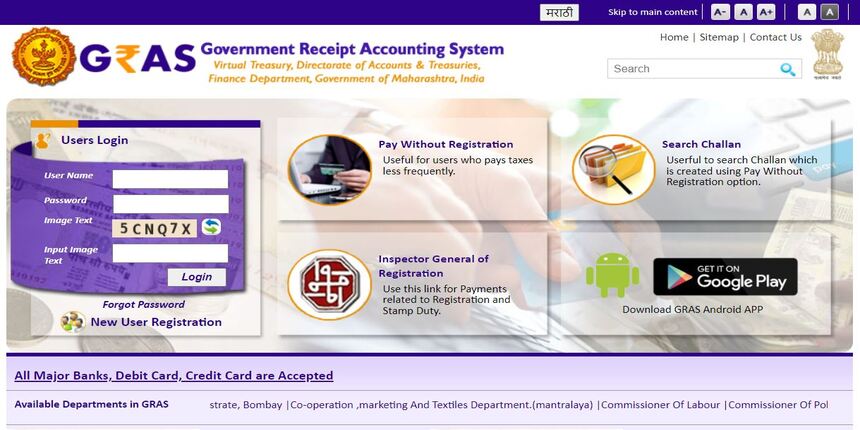
Step 2- Then, tap the “Pay Without Registration” option. This step is for you in case you haven’t registered yourself on the portal already. Fill in the login information if you have come as a registered user.
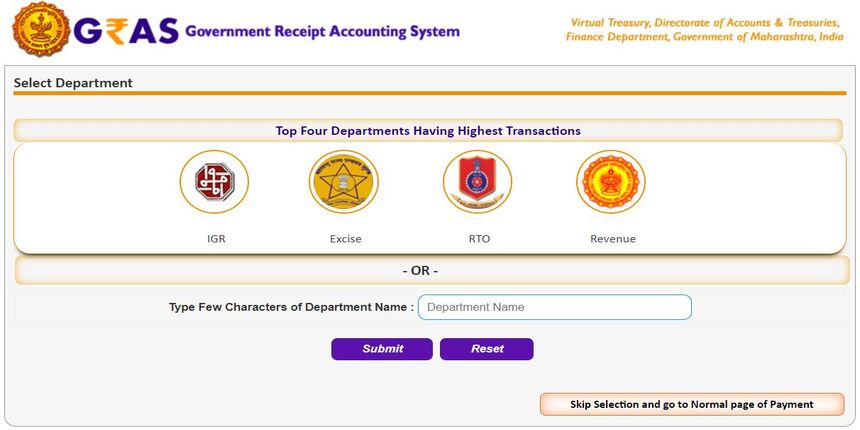
Step 3- In case you have chosen the “Pay Without Registration” option, you will land on the new page where you will have to select the “Citizen” option.
Step 4- After that, you need to choose the type of transaction you would like to make.
Step 5- In the next step, you will choose the “Make Payment to Register your Document” option. Then you can move on to the payment of stamp duty and registration charges.
Step 6- You can now fill in the required details including sub-registrar’s office, district, party details, payment details, property and property value details.
Step 7- Select the payment option. Once you have done that, you can generate the challan. This challan will be presented during the execution of the deed.
Stamp Duty Charges in Other States
| State | Stamp Duty Charges |
| Madhya Pradesh | Stamp Duty in Madhya Pradesh |
| Gujarat | Stamp Duty in Gujarat |
| Kolkata | Stamp Duty in Kolkata |
| West Bengal | Stamp Duty in West Bengal |
| Delhi | Stamp Duty in Delhi |
| Haryana | Stamp Duty in Haryana |
| Punjab | Stamp Duty in Rajasthan |
| Mumbai | Stamp Duty in Mumbai |
| Goa | Stamp Duty in Goa |
| Noida | Stamp Duty in Noida |
Stamp Duty on Loan Agreement in Maharashtra
A loan agreement, together with any hypothecation, pledge or deposit of title deeds, is charged under Article 6 of the Maharashtra Stamp Act. The stamp duty on a loan agreement in Maharashtra is calculated on the loan amount secured.
|
Instrument |
Stamp Duty |
|
Loan agreement / hypothecation / pledge / deposit of title deeds |
0.3% of the loan amount (minimum ₹100) |
|
Collateral or additional security where duty is already paid on the principal security |
Flat ₹500 |
For a typical home loan, the security documents attract this Article 6 duty on the loan amount. Where a single facility is secured by more than one document, only the principal security carries the full duty and the collateral security is stamped at the nominal ₹500. Overall stamp duty on such security instruments is subject to an upper cap, so a very large loan does not attract unlimited duty – verify the current cap on IGR Maharashtra.
Stamp Duty on Mortgage Deed in Maharashtra
A mortgage deed is charged under Article 40 of the Maharashtra Stamp Act. The stamp duty on a mortgage deed in Maharashtra turns on one thing: whether the borrower hands over possession of the property to the lender.
|
Type of Mortgage |
Stamp Duty |
|
Mortgage with possession (Article 40(a)) |
5% of the loan amount (conveyance rate) |
|
Mortgage without possession / simple mortgage (Article 40(b)) |
0.3% of the loan amount (min ₹100, max ₹10,00,000) |
|
Reconveyance of mortgaged property (Article 51) |
₹500 + ₹100 registration |
Most home loans are mortgages without possession, so they fall under the lower 0.3 percent rate with a ₹10 lakh ceiling. A mortgage with possession, where the lender actually takes over the property, is far more expensive because it is taxed like a sale. When the loan is repaid, the reconveyance deed that releases the charge costs a nominal ₹500.
Stamp Duty on Different Instruments in Maharashtra : Quick Table
Here is every instrument covered above in one place, so you can see the stamp duty charges in Maharashtra at a glance.
|
Instrument |
Stamp Duty |
Registration |
|
Sale / conveyance deed (Mumbai) |
6% male / 5% female |
1% (max ₹30,000) |
|
Sale / conveyance deed (Pune, Thane, Nagpur) |
7% male / 6% female |
1% (max ₹30,000) |
|
Gift deed : blood relative |
₹200 |
1% (max ₹30,000) |
|
Gift deed : non-family |
3% |
1% (max ₹30,000) |
|
Release deed : ancestral, blood relatives |
₹200 |
₹1,000 / 1% |
|
Release deed : other cases |
5% |
1% (max ₹30,000) |
|
Partnership deed : small cash capital |
₹500 |
As applicable |
|
Partnership deed : property contribution |
5% |
As applicable |
|
Share certificate |
₹1 per ₹1,000 (0.1%) |
Not applicable |
|
Loan agreement / hypothecation |
0.3% of loan (min ₹100) |
As applicable |
|
Mortgage without possession |
0.3% (max ₹10 lakh) |
As applicable |
|
Mortgage with possession |
5% |
As applicable |
Verify before you pay: these rates and caps are revised periodically by the Department of Registration and Stamps. Always confirm the current figure for your exact instrument and city on the IGR Maharashtra portal before executing any deed.
Documents Required for Property Registration in Maharashtra
Carry every document in original plus one self-attested photocopy. Both buyer and seller, with two witnesses, must be present at the Sub-Registrar Office for biometric verification. A missing document usually means registration cannot go ahead that day.
Identity and Personal Documents
|
Document |
Details |
|
Aadhaar card |
Original, for biometric verification. Name must match across all documents. |
|
PAN card |
Mandatory for both parties for higher-value transactions. |
|
Passport-size photographs |
Recent colour photos of buyer, seller and witnesses. |
|
Address proof |
Voter ID, driving licence or a recent utility bill. |
Core Property Documents
|
Document |
Provided By |
Notes |
|
Sale deed |
Buyer & seller |
Drafted and e-stamped for the correct value before the SRO visit. |
|
Stamp duty e-challan |
Buyer |
Generated on the GRAS portal after online payment. |
|
Encumbrance / index verification |
Buyer verifies |
Confirms the property is free of registered charges. |
|
Previous / chain sale deeds |
Seller |
Establish the seller’s clear title. |
|
Property tax receipts |
Seller |
Latest receipts with no dues. |
|
Society NOC & share certificate |
Seller |
For flats in a cooperative housing society. |
|
Occupancy Certificate / RERA |
Seller / builder |
For completed and new projects respectively. |
Register within four months
Maharashtra requires the deed to be registered within four months of paying stamp duty. Missing this window can mean fresh payment with penalty, so book your SRO slot as soon as the duty is paid.
Tax Benefit on Stamp Duty in Maharashtra
Stamp duty and registration charges on a new residential property can be claimed as a tax deduction, which softens the upfront cost for buyers.
- Deduction up to ₹1,50,000 in the financial year the payment is made
- For payments up to 31 March 2026 the claim is under Section 80C of the Income Tax Act, 1961
- From FY 2026-27 the benefit continues under Section 123 read with Schedule XV of the Income Tax Act, 2025, at the same ₹1.5 lakh limit
- Available only under the old tax regime, and only for residential house property
- Joint buyers can each claim their proportionate share within the overall limit
Quick Reference : Sale Deed Stamp Duty in Maharashtra
|
Property Value |
Mumbai Male (6%) |
Mumbai Female (5%) |
Pune Male (7%) |
Pune Female (6%) |
|
₹50 lakh |
₹3,00,000 |
₹2,50,000 |
₹3,50,000 |
₹3,00,000 |
|
₹80 lakh |
₹4,80,000 |
₹4,00,000 |
₹5,60,000 |
₹4,80,000 |
|
₹1 crore |
₹6,00,000 |
₹5,00,000 |
₹7,00,000 |
₹6,00,000 |
|
₹1.5 crore |
₹9,00,000 |
₹7,50,000 |
₹10,50,000 |
₹9,00,000 |
Add registration of 1 percent, capped at ₹30,000, to each figure. These assume the property value equals or exceeds the Ready Reckoner Rate. Verify the current Ready Reckoner Rate for your locality on IGR Maharashtra before finalising your budget.
Conclusion
Stamp duty and registration charges in Maharashtra add roughly 6 to 8 percent to the cost of a land. property in Mumbai and Navi Mumbai sit at 6 percent for men, while Pune, Thane and Nagpur are one point higher at 7 percent because of the Local Body Tax. Women buyers save 1 percent across the board on residential property held in their sole name, now with no resale lock-in.
The bigger picture is that Maharashtra charges very different duty depending on the instrument. A sale deed can cost 7 percent, but a gift deed to a blood relative is a flat ₹200, a release of ancestral property among relatives is also ₹200, a small partnership deed is ₹500, and a home loan mortgage without possession is just 0.3 percent. Choosing the right instrument for your situation can save lakhs – legally.
Check the Ready Reckoner Rate for your locality on IGR Maharashtra, pay online through GRAS, register within four months, and carry every document in original plus photocopy. Do that and your registration day in Maharashtra will be smooth.
Frequently Asked Questions:
1. What is the stamp duty and registration charge in Maharashtra in 2026?
In Mumbai it is 6 percent for men and 5 percent for women; in Pune, Thane and Nagpur it is 7 percent for men and 6 percent for women. Registration is 1 percent of the value, capped at ₹30,000 for properties above ₹30 lakh. Women get a 1 percent concession on residential property held in their sole name.
2. What is the stamp duty on a gift deed in Maharashtra?
For residential or agricultural property gifted to a close blood relative, the stamp duty is a flat ₹200 regardless of value. For a gift to a non-family member, it is 3 percent of the market value plus registration. Blood relatives include spouse, children, parents, siblings and grandchildren.
3. What is the stamp duty on a gift deed in blood relation in Maharashtra?
It is a flat ₹200 when residential or agricultural property is gifted to a close blood relative such as a spouse, child, parent, sibling or grandchild. The nominal rate applies no matter how valuable the property is, which makes gift deeds among family a very cheap way to transfer property.
4. What is the stamp duty on a release deed in Maharashtra?
A release of ancestral property among close blood relatives is a flat ₹200. For any other case, such as non-ancestral property or unrelated parties, the stamp duty is 5 percent of the market value at the conveyance rate, plus metro cess where applicable, with 1 percent registration capped at ₹30,000.
5. What is the stamp duty on a partnership deed in Maharashtra?
It depends on the capital contributed. If there is no contribution or the share is up to ₹50,000, the duty is ₹500. Above ₹50,000 in cash, it is 1 percent of the contribution up to a maximum of ₹15,000. If a partner brings in property instead of cash, it is taxed at 5 percent of the market value.
6. What is the stamp duty on a share certificate in Maharashtra?
The commonly applied rate is ₹1 for every ₹1,000 or part thereof of the value of the shares, roughly 0.1 percent. It is paid by the company issuing the shares. Rules differ for demat shares under central securities law, so confirm the current rate and time limit before filing.
7. What is the stamp duty on a loan agreement in Maharashtra?
A loan agreement with hypothecation, pledge or deposit of title deeds is charged at 0.3 percent of the loan amount, subject to a minimum of ₹100 and an overall cap. Where collateral security is created and full duty is already paid on the principal security, the collateral document is stamped at a flat ₹500.
8. What is the stamp duty on a mortgage deed in Maharashtra?
A mortgage without possession, which covers most home loans, is charged at 0.3 percent of the loan amount, with a minimum of ₹100 and a maximum of ₹10 lakh. A mortgage with possession, where the lender takes over the property, is taxed at 5 percent like a conveyance.
9. Is there a stamp duty concession for women in Maharashtra?
Yes. Women buyers get a 1 percent reduction in stamp duty on residential property registered in their sole name, across the state. Joint ownership with a male co-owner attracts the full male rate, and commercial property does not qualify. The earlier 15-year resale lock-in was removed in 2026.
10. How are stamp duty and registration charges calculated in Maharashtra?
Both are calculated on the higher of your agreement value or the Ready Reckoner Rate for that locality. Stamp duty is the applicable city rate times that value; registration is 1 percent, capped at ₹30,000 for properties above ₹30 lakh. The Ready Reckoner Rate is revised around 1 April each year.
11. Can stamp duty be paid online in Maharashtra?
Yes. Stamp duty and registration fees are paid online through the GRAS portal linked to IGR Maharashtra. You enter the property details, the system applies the correct city rate including metro cess and Local Body Tax, and you download an e-challan that is accepted at every Sub-Registrar Office.