
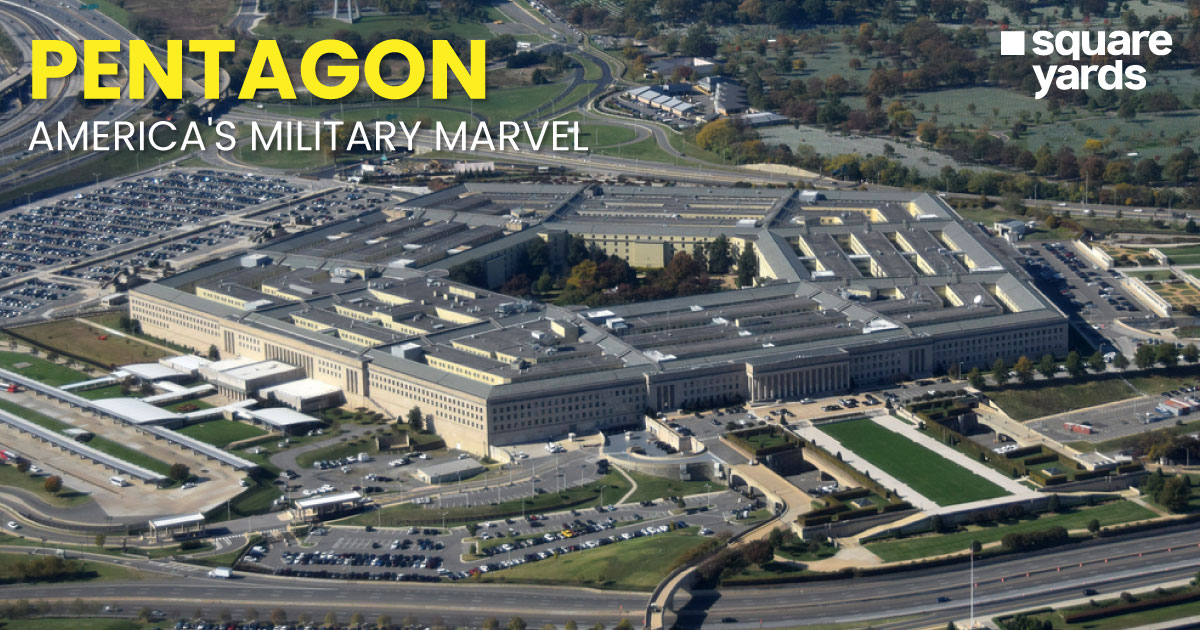
Here’s a question that trips people up more than you’d think: is the Pentagon a shape, a building, or a shopping mall? Turns out it’s all three, but only one of them houses the entire U.S. military.
The Pentagon is the headquarters of the U.S. Department of Defense, located in Arlington, Virginia, just across the Potomac River from Washington, D.C. It’s also the second-largest office building on the planet by floor space, and the name really is that simple, five sides, Pentagon. No hidden meaning.
That’s the quick version. The real story is better than that: how the whole thing got built in 16 months, why the five-sided shape happened almost by chance, and what took place inside these walls on September 11, 2001.
This guide walks through all of it, checked against the Pentagon’s own historical records and Wikipedia’s current figures
What Is the Pentagon?
The Pentagon is the headquarters building for the entire U.S. Department of Defense. Every branch of the American military, Army, Navy, Air Force, Marine Corps, and Space Force, has senior offices inside this one building.
A few quick facts worth knowing:
- It sits in Arlington County, Virginia, directly across the Potomac River from Washington, D.C.
- It’s the world’s second-largest office building by floor space, at roughly 6.5 million square feet
- About 23,000 military and civilian employees work here, plus another 3,000 support contractors
- The name “Pentagon” comes directly from its five-sided shape, nothing more mysterious than that
People sometimes mix up “the Pentagon” with Pentagon City, a shopping and business district just south of the building, or with the geometric shape you learned about in fifth grade math. This guide is about the real thing, the actual headquarters, not the mall and definitely not the math term.
Quick Facts About the Pentagon Building
Here’s the Pentagon building’s key stats at a glance, verified against Wikipedia and the Pentagon’s own historical records.
|
Fact |
Detail |
|---|---|
|
Location |
Arlington County, Virginia, across the Potomac from Washington, D.C. |
|
Construction started |
September 11, 1941 |
|
Completed |
January 15, 1943 |
|
Construction time |
About 16 months |
|
Cost to build |
$83 million (about $1.36 billion in 2024 dollars) |
|
Floor count |
7 total (5 above ground, 2 basement levels) |
|
Floor area |
6.5 million square feet, about 3.7 million of it office space |
|
Height |
77 feet (about 5 stories) |
|
Length per side |
921 feet |
|
Employees |
23,000 military and civilian staff, plus 3,000 contractors |
|
Corridors |
17.5 miles total |
|
Parking |
67 acres, thousands of vehicles |
|
ZIP codes |
6 separate ZIP codes for different departments |
Why Does the Pentagon Have Five Sides?
The Pentagon’s five-sided shape wasn’t the original plan. It was a leftover from a site that got swapped out at the last minute. The first location picked, a plot called Arlington Farms, had an oddly shaped, roughly pentagonal footprint, so architects designed the building to fit it.
Then President Franklin D. Roosevelt got involved. He worried the new building would block the view of Washington, D.C. from Arlington National Cemetery, so he picked a different site instead, the old Hoover Airport grounds. That site had no shape constraints at all. A clean slate.
Here’s the twist nobody expects: Roosevelt liked the pentagon shape anyway. Redesigning the whole thing from scratch would’ve cost time and money nobody had in 1941, with a war on the horizon. So the five-sided design stuck around, just cleaned up into a perfect, symmetrical pentagon instead of the original lopsided one.
That’s genuinely the whole story. Why is the Pentagon five-sided? Because a president liked how it looked, and starting over wasn’t worth the hassle.
When Was the Pentagon Built?
Construction started September 11, 1941, exactly 60 years before the September 11 attacks would strike the same building. That coincidence still gives people chills, and honestly, it should.
The building went up fast. Sixteen months, officially wrapped on January 15, 1943. Around 1,000 architects and 14,000 construction workers pulled round-the-clock shifts to hit that deadline, which is a genuinely wild number of people to coordinate on one job site.
The materials list alone tells you how massive this project was:
- 435,000 cubic yards of concrete
- 43,000 tons of steel
- 680,000 tons of sand and gravel, dredged straight out of the Potomac River
Steel was scarce during the war, so builders swapped in concrete ramps instead of elevators wherever they could, saving what little steel there was for the war effort. Workers moved in wedge by wedge. Some employees were already at their desks in finished sections by April 1942, nearly a year before the rest of the building was even done.
Pentagon Architecture and Layout
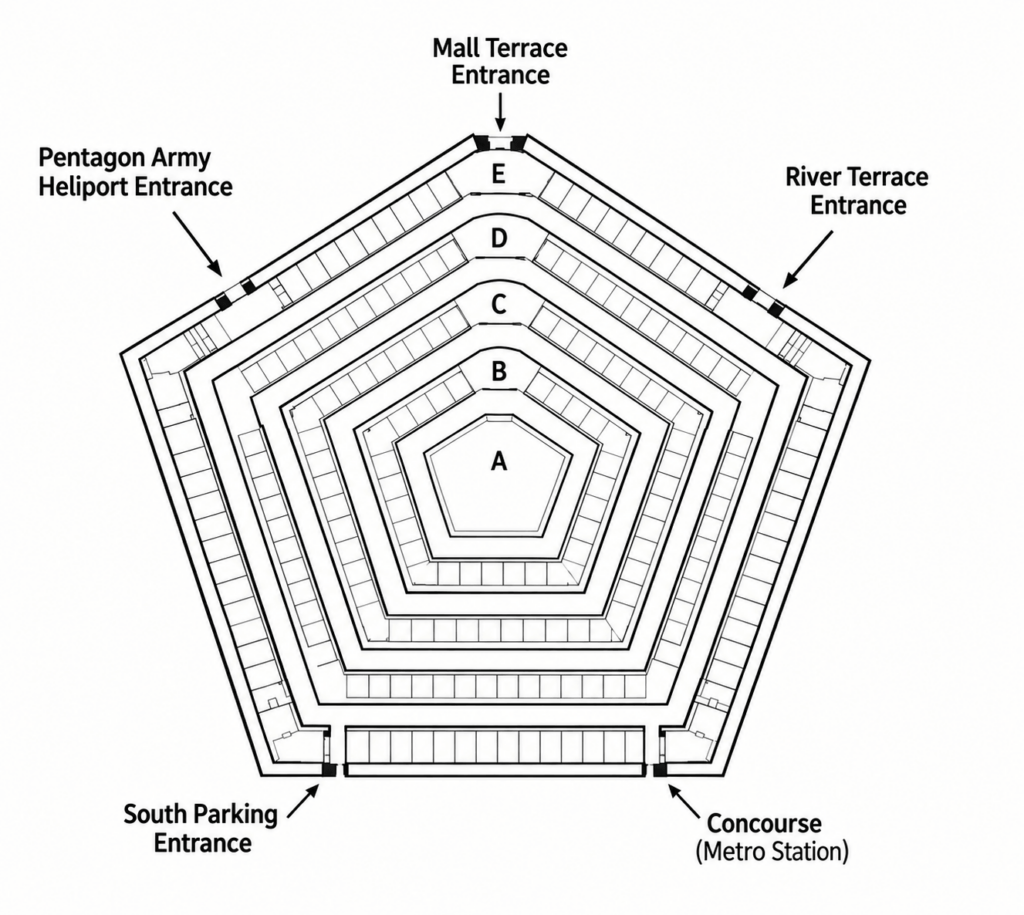
Forget hallways, the Pentagon runs on rings. Each of the five above-ground floors has five ring-shaped corridors, labeled A through E from the center outward, with two more basement rings tucked underneath called F and G.
Ring E gets all the windows and views, and not coincidentally, that’s where senior officials tend to end up. Nice office, heavy responsibility, the usual trade-off.
Finding a specific room here takes some getting used to. Room numbers stack the floor, the ring letter, and a corridor-and-bay number together, so “2B315” means second floor, B ring, near corridor 3. Sounds like a maze on paper. In practice, you can walk between any two points in the entire building in under ten minutes, which is honestly more impressive than the room-numbering system deserves credit for.
Five entrances match the five sides: the Mall Terrace, the River Terrace, the Concourse (which connects straight into the Pentagon’s own Metro station), the South Parking entrance, and the Pentagon Army Heliport. There’s even a small shopping concourse inside, food court included, basically a mini mall hiding inside a military headquarters.
The Pentagon on September 11, 2001
On September 11, 2001, five hijackers crashed American Airlines Flight 77 into the Pentagon’s western side. The attack killed 184 people, 59 aboard the plane and 125 inside the building. Every one of those numbers represents a person who went to work that morning and didn’t come home.
Here’s a detail most people never hear: the building was mid-renovation at the time, so a lot of offices in that section sat empty. Only about 800 people were in that part of the building that day, versus the usual 4,500. The section that got hit had also just been reinforced with blast-resistant windows and steel bracing, upgrades that likely kept that part of the structure standing for 30 extra minutes, just long enough for people to get out.
The rebuild effort earned its own name, the Phoenix Project. Crews already working on the earlier renovation simply pivoted to repairing the damage instead. By August 15, 2002, less than a year after the attack, the first employees were back at their desks in the rebuilt offices.
Today, a small memorial and chapel mark the exact point of impact inside the building. Outside, the Pentagon Memorial holds 184 benches, one for each victim, arranged by age from youngest to oldest, 3 years old to 71.
Interesting Facts About the Pentagon Building
A few facts about the Pentagon building that surprise most people:
- It has six ZIP codes. The Secretary of Defense, the Joint Chiefs of Staff, and each of the four military service branches each get their own.
- You can walk anywhere in under 10 minutes. Despite covering 6.5 million square feet, the ring layout keeps travel times short.
- It’s LEED certified. Despite being built in the 1940s, decades of renovation brought the building up to modern sustainability standards.
- It was segregated when it opened. Built under Virginia’s segregation laws at the time, it had separate dining and restroom areas for Black and white employees. President Roosevelt ordered the “Whites Only” signs removed before the building’s official dedication.
- It’s a protected historic landmark. The Pentagon building has been on the National Register of Historic Places since 1988.
- It survived a bombing in 1972. A radical group called the Weather Underground bombed a restroom on the building’s fourth floor in protest of the Vietnam War. No one was killed.
Visiting the Pentagon
Yes, you can tour the Pentagon, but it takes real planning, not a walk-up visit. Tours run Monday through Thursday, 10 a.m. to 4 p.m., and Fridays from noon to 4 p.m. Every visitor needs advance scheduling and a security screening before they even see the front door.
Tour guides are active-duty military members who memorize roughly 33 pages of historical content and recite it while walking backward, for the entire tour. That’s not a typo. Over 100,000 visitors take this tour every year, which says something about how much curiosity this building still generates eight decades in.
Bring valid government ID, a U.S. passport, or a REAL ID-compliant driver’s license. Leave the phone and camera in the car, electronics aren’t allowed during the tour, and anything resembling a weapon or an oversized bag will get you turned away at the door.
Wrapping Up
The Pentagon building is proof that a rushed wartime decision can turn into one of the most recognizable buildings on Earth. It was never meant to be permanent, just a quick fix for a space problem during World War II. Eighty-plus years later, it’s still the beating heart of America’s military, five-sided accident and all.
Between the shape, the 16-month construction sprint, and the weight of what happened here on September 11, the Pentagon isn’t just a famous building in America. It’s a working monument to how fast a country can build under pressure, and how it rebuilds when it’s tested.
Don’t miss It!
| Types of Houses | Know about Types of Houses |
| Ghar Ka Naksha | Complete Info about Ghar ka Naksha |
| Cabin House | What is a Cabin House? |
| Open House | What is a Open House? |
| Modern House Design | Modern House Design Ideas |
| 2 Storey House Design | What is Two Storey Modern House? |
| Duplex House | What is a Duplex House? |
| Standalone Building | What is Standalone Building? |
| Kerala House Design | Kerala House Design Ideas |
Frequently Asked Questions:
1. Why does the Pentagon have five sides?
The original site had an irregular pentagon shape, so the building was designed to match it. When the site changed, President Roosevelt liked the pentagon shape enough to keep it anyway.
2. How many people work in the Pentagon?
About 23,000 military and civilian employees, plus roughly 3,000 non-defense support contractors.
3. Is the Pentagon the largest building in the world?
Not quite. It’s the world’s second-largest office building by floor space, at about 6.5 million square feet.
4. How many people died in the Pentagon on 9/11?
184 people total, 59 aboard American Airlines Flight 77 and 125 inside the building.
5. Can you visit the Pentagon?
Yes, guided tours run most weekdays, but you need to book in advance and pass a security screening. Cameras and large bags aren’t allowed inside.
6. How many floors does the Pentagon have?
Seven total: five floors above ground and two basement levels.
7. How long did it take to build the Pentagon?
About 16 months. Construction started September 11, 1941, and finished January 15, 1943.
8. Why is it called the Pentagon?
Simply because of its shape. A pentagon is a five-sided geometric figure, and the building has five sides, five ring corridors per floor, and five main entrances.