If you are looking to buy affordable, government-allotted land in Gurugram, Faridabad, Panchkula or another Haryana city, HSVP is the authority you will keep running into. Formerly known as HUDA, it has been allotting planned residential and commercial plots across the state since the late 1970s, and it remains one of the few ways to get a clear-title plot at government rates rather than inflated private-market prices.
This guide explains what HSVP is, how it is different from HUDA and from Housing Board Haryana, what plot categories and sizes are available, current eligibility and pricing, the online application process for both draw of lots and e-auction, required documents, and what happens after allotment, including transfer, resale and the newer land pooling scheme.
- What Is HSVP?
- What is the HSVP Act, 1977?
- What is the full form of HSVP?
- Why do people prefer HSVP plots over private colony plots?
- When was HUDA (now HSVP) established?
- HSVP vs HUDA: Is There Any Difference?
- HSVP vs Housing Board Haryana:
- HSVP Plot Categories and Sizes
- How many marla is one kanal, and what does a plot size actually mean?
- What is the minimum plot size HSVP allots for residential use?
- How Are HSVP Plots Allotted? Draw of Lots vs E-Auction
- How is the HSVP draw of lots conducted?
- How does the HSVP e-auction process work?
- HSVP Plot Prices 2026
- Who Is Eligible for HSVP Plot Allotment?
- How to Apply for HSVP Plot Scheme Online
- What is the HSVP application fee?
- Documents Required for HSVP Scheme Application
- How to Check HSVP Plot Status Online
- HSVP Land Pooling Scheme
- HSVP Oustee Plot Allotment
- HSVP Cities and Popular Sectors
- Possession, Transfer and Resale of HSVP Plots
- HSVP Plot Booking and Payment Options
- HSVP vs Private Plots: A Quick Comparison
- Is HSVP Worth It Compared to Buying a Private Plot?
- Conclusion
What Is HSVP?
HSVP stands for Haryana Shehri Vikas Pradhikaran, the state authority responsible for planning, developing and allotting residential, commercial and institutional plots across urban Haryana. It was formerly called HUDA, the Haryana Urban Development Authority, and was renamed HSVP in 2017 to better reflect its Hindi identity, though its legal powers and functions stayed the same.
HSVP operates under the Haryana Shehri Vikas Pradhikaran Act (originally the Haryana Urban Development Authority Act), 1977. Under this Act, HSVP acquires land, develops it with roads, sewage, water supply and other infrastructure, and then allots developed plots to the public, mainly through a draw of lots for freshly developed sectors and through e-auction for later-stage or repossessed inventory.
Because HSVP is a government authority and the land under an HSVP plot carries a clean, traceable title, plots allotted by it are considered lower-risk than many private colony plots in the same cities, and most banks are comfortable financing construction loans against them once the conveyance deed is in the owner’s name.
What is the HSVP Act, 1977?
The Haryana Urban Development Authority Act, 1977, later renamed to reflect HSVP, is the law that created the authority and gives it its powers: to acquire land for planned development, to prepare sector layouts, to build infrastructure, and to allot developed plots to the public through transparent processes like draw of lots and auction. It also lays down the rules for transfer of allotted plots, penalties for unauthorised construction, and the process for resuming a plot in case of default on payment or violation of allotment conditions. Nearly every rule an HSVP allottee encounters, from payment schedules to transfer restrictions, traces back to provisions in this Act and the regulations framed under it.
What is the full form of HSVP?
HSVP stands for Haryana Shehri Vikas Pradhikaran, which translates to the Haryana Urban Development Authority in English. It is sometimes misspelled as “Shahari” instead of “Shehri,” but both refer to the same body.
Why do people prefer HSVP plots over private colony plots?
The biggest reason is title clarity. In many private colonies across Haryana, especially older ones near Gurugram and Faridabad, land was converted from agricultural use informally, or sold through a chain of General Power of Attorney transfers rather than proper registered sale deeds. This creates real legal risk for the buyer years later. An HSVP plot, by contrast, comes with a clear line of ownership starting from HSVP itself, backed by a statutory Act, which is why banks lend against it more readily and why resale values tend to hold up better over time. The second reason is infrastructure. HSVP is responsible for building roads, sewage lines, water supply and street lighting in a sector before plots are handed over, whereas in many private colonies this infrastructure depends entirely on the developer’s own execution and can lag for years.
When was HUDA (now HSVP) established?
The Haryana Urban Development Authority, now HSVP, was established in 1977 under the Haryana Urban Development Authority Act, 1977, to plan and develop urban estates across the state. It was renamed Haryana Shehri Vikas Pradhikaran in 2017, though its structure, powers and core functions carried over unchanged from the HUDA era.
HSVP vs HUDA: Is There Any Difference?
No, HSVP and HUDA are the same organisation. HUDA, the Haryana Urban Development Authority, was renamed Haryana Shehri Vikas Pradhikaran (HSVP) by the state government in 2017. Any plot, scheme, sector or document that references “HUDA” from before 2017 is legally the same as an HSVP record today; you do not need a separate transfer or update just because of the name change. Older signage, some legacy documents, and casual conversation still use “HUDA,” which is why both terms remain heavily searched.
HSVP vs Housing Board Haryana:
|
Factor |
HSVP |
Housing Board Haryana (HBH) |
|
Full form |
Haryana Shehri Vikas Pradhikaran |
Housing Board Haryana |
|
Established |
1977 (as HUDA) |
1971 |
|
What it allots |
Mainly developed plots (residential, commercial, institutional); some flats through its Housing Wing |
Mainly built flats, largely for EWS and BPL households |
|
Governing law |
HSVP Act, 1977 |
Haryana Housing Board Act, 1971 |
|
Official website |
hbh.gov.in |
If you are searching for “Haryana Housing Board Scheme” hoping to find a ready-built, low-cost flat, HBH’s own schemes are the relevant ones to check, not HSVP’s plot allotments. If you want a plot of land to build on yourself, or a developed sector plot in a city like Gurugram or Panchkula, HSVP is the correct authority.
HSVP Plot Categories and Sizes
HSVP plots are sold in standard sizes, traditionally measured in marla and kanal rather than square feet, though the metric equivalent is what most buyers actually need to compare against private listings.
|
Plot size |
Approx. area (sq yards) |
Approx. area (sq m) |
Typical buyer profile |
|
4 marla |
About 30.25 sq yd |
About 25 sq m |
Smallest residential category, EWS/LIG-oriented |
|
6 marla |
About 45.5 sq yd |
About 38 sq m |
Small independent house plots |
|
10 marla |
About 75.75 sq yd |
About 63 sq m |
Mid-size independent house plots |
|
14 marla |
About 106 sq yd |
About 89 sq m |
Larger family homes |
|
1 kanal |
About 605 sq yd (8 marla x ~2) |
About 505 sq m |
Premium plots, larger independent houses |
A quick reference: 1 kanal equals 20 marla, and 1 marla is roughly 25.3 square yards in the standard Haryana measurement, though the exact conversion can vary marginally by region and old revenue records, so always confirm the exact area in square metres mentioned on your specific allotment letter rather than relying only on the marla figure.
How many marla is one kanal, and what does a plot size actually mean?
One kanal equals 20 marla, and this traditional unit system, common across Haryana and Punjab, can confuse buyers used to square feet or square metres. A 10 marla plot, for instance, is exactly half a kanal. When you see a plot advertised as “10 marla” without a metric figure attached, it is worth converting it yourself or checking the exact square metre area on the allotment letter, since minor regional variations in the marla-to-square-metre conversion do exist depending on old revenue survey records for that particular urban estate.
What is the minimum plot size HSVP allots for residential use?
The smallest standard residential plot size HSVP allotted is generally 4 marla, aimed at EWS and LIG applicants who want to build a modest independent house rather than live in an apartment. Larger sizes, 6 marla, 10 marla, 14 marla and 1 kanal, cater to progressively higher income categories and larger households, with 1 kanal plots generally reserved for premium sectors and often allotted through e-auction rather than a subsidised draw of lots.
How Are HSVP Plots Allotted? Draw of Lots vs E-Auction
HSVP uses two main routes to allot plots, and it matters which one applies to the plot you are interested in.
|
Allotment route |
How it works |
Best suited for |
|
Draw of lots |
Used mainly for newly developed sectors; HSVP invites applications through advertisements, then conducts a computerised draw among eligible applicants |
First-time applicants targeting a freshly developed sector at the base allotment price |
|
E-auction |
Used for developed, repossessed, surrendered or resurveyed plots, and for commercial and institutional sites; bidding happens online through the HSVP e-auction portal |
Buyers who want a specific plot in an established sector and are willing to bid above the reserve price |
In recent years, HSVP has leaned more heavily on e-auction for residential and commercial plots in developed sectors, since it lets the authority realise current market value rather than a fixed base price, while draw of lots remains the primary route for allotting plots in genuinely new sectors as they are developed.
How is the HSVP draw of lots conducted?
The draw of lots is a computerised, algorithm-based random selection among all eligible applicants for a given sector and category, conducted on a notified date after the application window closes. It is not a manual or physical lottery; the system randomly matches application numbers against the available plot inventory, and results are published on the HSVP portal and in local newspapers as required under the scheme advertisement.
How does the HSVP e-auction process work?
HSVP e-auctions are conducted entirely online through the HSVP e-auction portal. Interested bidders register, pay an earnest money deposit to become an eligible bidder for a specific plot, and then place bids within the notified auction window. The plot goes to the highest bidder above the reserve price, and the earnest money is adjusted against the final payment for winning bidders, while unsuccessful bidders get a refund. HSVP typically runs these auctions periodically, sometimes as large, multi-city events covering residential, commercial and institutional properties together across cities like Gurugram, Faridabad, Panchkula, Rohtak and Hisar.
HSVP Plot Prices 2026
HSVP plot prices vary significantly by city and sector, since Gurugram and Panchkula command far higher rates than smaller towns like Hisar or Rohtak.
|
City |
Indicative price range (per sq yard) |
Positioning |
|
High premium, among HSVP’s costliest sectors |
Strong connectivity, corporate hubs nearby |
|
|
Upper-mid range |
NCR-adjacent, good industrial and residential demand |
|
|
Upper-mid range |
Close to Chandigarh, strong civic infrastructure |
|
|
Comparatively affordable |
Developing infrastructure, lower entry cost |
Because HSVP revises reserve and allotment prices scheme to scheme, and e-auction prices depend entirely on live bidding, it is best to treat the numbers above as a general sense of relative positioning across cities rather than fixed figures, and to check the specific sector’s advertisement or e-auction listing for the actual reserve price before budgeting.
Who Is Eligible for HSVP Plot Allotment?
To apply for an HSVP plot through the draw of lots, you generally need to meet these conditions, though exact terms can vary slightly scheme to scheme.
- You must be an Indian citizen and at least 18 years old.
- You should generally be a resident of Haryana, though some schemes have allowed applications from outside the state with specific conditions; always check the current scheme advertisement.
- Neither you nor your spouse nor dependent children should already own a residential plot or house allotted by HSVP, HUDA, or another government housing body in the same urban estate.
- Your household income should fall within the defined band for the category (EWS, LIG or MIG) if you are applying under an income-linked category.
- You can hold only one application per scheme; multiple applications under different names for the same household can lead to cancellation of all linked applications.
- Reserved categories, including Scheduled Castes, Backward Classes, ex-servicemen, and persons with disabilities, get defined quotas and relaxed terms under most schemes, subject to producing the relevant category certificate.
E-auction eligibility is generally simpler: any citizen able to pay the earnest money deposit and meet basic KYC requirements can typically bid, since e-auction is priced at or above market reserve rather than being an income-restricted subsidy allotment.
How to Apply for HSVP Plot Scheme Online
Users can apply for an HSVP plot entirely online through the HSVP portal, in five broad steps: check the live scheme, register and complete KYC, fill the application and choose your category, pay the registration or earnest money amount, and track the draw or auction result.
- Check the current scheme or e-auction. Visit hsvphry.org.in and look under Online Services for the current plot scheme advertisement or the live e-auction listing, which will specify sectors, categories, sizes and dates.
- Register on the HSVP portal. Create an account using your mobile number and email, then complete KYC using Aadhaar and PAN.
- Fill the application form. Enter personal and income details, select your category, and for e-auction, select the specific plot you want to bid on.
- Pay the registration or earnest money deposit. Payment is made online through the HSVP challan or payment gateway, using net banking, RTGS or NEFT.
- Download your receipt and application number. Keep this safe; it is needed for any status check, grievance, or refund claim later.
- Track the draw of lots or bidding result. Draw results are published on the portal after the notified draw date; e-auction results are visible on the auction portal once bidding closes.
What is the HSVP application fee?
The HSVP application fee, more precisely called the registration amount or earnest money deposit depending on the route, varies by plot size and category, and is specified in each scheme’s advertisement or e-auction notice. As a rule, it is a percentage of the plot’s estimated price rather than a flat processing fee, and it is adjusted against the final plot price for successful applicants, while unsuccessful applicants get it refunded, generally within a few weeks of the result.
Documents Required for HSVP Scheme Application
Keep these ready before starting your application, since missing or mismatched documents are among the most common reasons applications get held up.
|
Document |
Why it is needed |
|
Aadhaar card |
Primary identity and KYC verification on the HSVP portal |
|
PAN card |
Required for financial KYC and for payments above specified thresholds |
|
Residence proof (voter ID, ration card, utility bill) |
Confirms domicile status where the scheme requires Haryana residency |
|
Passport-size photographs and signature specimen |
Required for the application form and allotment records |
|
Income certificate or salary slips |
Confirms eligibility for EWS, LIG or MIG category applications |
|
Category certificate (SC, BC, ex-servicemen, PwD) |
Required only where applicable, to claim reserved-quota benefit |
|
Bank account details |
Used for refund of registration amount if unsuccessful |
|
Payment proof (challan receipt, bank statement) |
Confirms the registration or earnest money amount paid to HSVP |
|
Affidavit of non-ownership |
Declares you or your family do not already hold an HSVP or similar government plot in the same urban estate |
How to Check HSVP Plot Status Online
You can check your HSVP plot status online through the HSVP portal by entering your application number, registration number, or plot and sector details, without needing to visit an HSVP office.
- Visit the HSVP portal. Go to hsvphry.org.in and open the Online Services section.
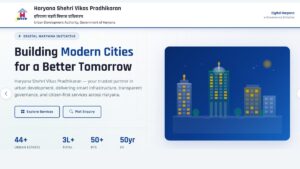
- Select the relevant status option. Choose “Allotment and Possession Status” to check whether a plot has been allotted and possession handed over, or the specific application status option if you are still waiting on a draw or e-auction result.
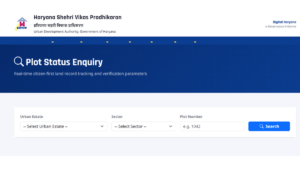
- Enter your details. Use your application number, registration number, or in some cases your name and father’s name along with the sector and urban estate, depending on which lookup the portal offers.
- View your status. The portal will display where your application currently stands, such as under scrutiny, allotted, payment pending, or possession granted.
HSVP Land Pooling Scheme
Separate from its regular plot allotment, HSVP also runs a land pooling scheme aimed at landowners rather than homebuyers. Under this scheme, individuals who own agricultural or undeveloped land in areas HSVP has identified for planned expansion can voluntarily pool their land with the authority. In exchange, once HSVP develops the area with roads, sewage, water supply and other infrastructure, the original landowners receive back a share of high-value, developed residential or commercial plots proportional to the land they contributed, rather than a straightforward cash acquisition payout.
This mechanism lets HSVP expand planned urban sectors without a lengthy, adversarial land acquisition process, and it gives landowners a stake in the appreciated value of the developed land rather than a one-time compensation figure. If you own land in a notified pooling zone, this is a distinct process from applying for a plot as a buyer, and it involves a different set of forms, timelines and eligibility checks specific to landownership rather than income category.
HSVP Oustee Plot Allotment
HSVP periodically runs a smaller, separate scheme to allot plots to “oustees,” meaning landowners who were displaced when HSVP originally acquired their land for a sector’s development. These oustees are given priority access to a limited pool of plots at the prevailing HSVP rate, as a form of resettlement rather than a general public scheme. If you or your family lost land to an HSVP acquisition in the past, it is worth checking whether an oustee scheme is currently open in that urban estate, since eligibility here does not follow the same income-category rules as the general public draw of lots.
HSVP Cities and Popular Sectors
HSVP develops and allots plots across most major urban centres in Haryana, though demand and pricing vary sharply between them.
|
City |
Known for |
|
Gurugram |
Highest-priced HSVP sectors, strong corporate and IT demand |
|
Faridabad |
NCR-adjacent, strong industrial and residential mix |
|
Panchkula |
Close to Chandigarh, well-planned sectors, strong civic infrastructure |
|
Rohtak |
Comparatively affordable, growing educational and institutional hub |
|
Hisar |
Affordable entry prices, developing infrastructure |
|
Karnal, Sonipat, Yamunanagar |
Mid-range pricing, steady residential demand |
If your priority is long-term appreciation and immediate infrastructure, Gurugram and Panchkula sectors are worth the higher entry price. If your priority is the lowest possible entry cost with room to build over time, Rohtak and Hisar generally offer HSVP’s most accessible pricing.
Possession, Transfer and Resale of HSVP Plots
Once you are allotted a plot, whether through draw of lots or e-auction, you are given a defined payment schedule, either a lump sum with a rebate for early payment or a structured instalment plan with interest on the outstanding balance. Possession and site handover generally happen once your payments and documentation are complete, though basic infrastructure like roads and sewage in a newly developed sector can sometimes lag behind individual plot handovers.
HSVP Plot Booking and Payment Options
|
Payment mode |
How it works |
|
Lump sum payment |
Pay the full plot price within a fixed window after allotment; many schemes offer a rebate for full upfront payment |
|
Instalment plan |
Pay in scheduled instalments over a defined number of years, with interest charged on the outstanding balance |
|
E-auction payment |
Pay the earnest money deposit at the time of bidding, then the balance amount within the notified schedule after winning the bid |
HSVP vs Private Plots: A Quick Comparison
|
Factor |
HSVP Plots |
Private Colony Plots |
|
Price |
Generally lower for comparable location and size in a given city |
Higher, includes developer margin and brokerage |
|
Title |
Government-issued, low ownership dispute risk once conveyance deed is executed |
Varies by developer and colony; needs careful due diligence |
|
Infrastructure |
Roads, sewage and water developed by HSVP as part of the sector plan |
Depends entirely on the private developer’s execution |
|
Allotment |
Draw of lots or e-auction, based on scheme |
Direct booking, first come first served |
|
Resale flexibility |
Requires HSVP’s transfer approval, especially before full payment |
Usually unrestricted, subject to loan clearance |
Is HSVP Worth It Compared to Buying a Private Plot?
For most buyers who qualify and are patient with the process, yes, mainly on title security and long-term value. You get a government-backed plot with planned infrastructure, at a price that is often meaningfully below comparable private colony land in the same city, with fewer legal complications down the line. The trade-offs are real: you may not get your first-choice sector or plot number in a draw of lots, e-auction prices for the best sectors can run close to open-market rates, and construction and transfer rules add some procedural steps that a private purchase does not have. If your priority is the lowest possible entry cost and you are flexible on city, a 4 or 6 marla plot in Rohtak or Hisar through draw of lots is worth considering. If you want an established location with strong infrastructure and are comfortable bidding, a Gurugram or Panchkula e-auction plot tends to hold and grow in value more reliably over the long run.
Conclusion
HSVP remains the most reliable route to a government-allotted, clear-title plot in Haryana’s growing cities, whether you are looking at a modest 4 marla plot in a smaller town or a premium sector plot in Gurugram or Panchkula. The process, whether draw of lots for a new sector or e-auction for developed inventory, follows the same broad pattern: check the live scheme on the HSVP portal, confirm your eligibility and category, apply and pay online, and track the result. Keep your documents accurate and ready, understand the difference between HSVP and Housing Board Haryana before you apply to the wrong body, and treat land pooling and oustee allotments as separate processes if they apply to your situation. Since scheme dates, prices and e-auction listings change frequently, always confirm the latest details directly on the HSVP portal before applying, and use this guide as the framework for what to expect.
Frequently Asked Questions:
1. What is the full form of HSVP?
HSVP stands for Haryana Shehri Vikas Pradhikaran, the state authority responsible for allotting residential and commercial plots across Haryana, formerly known as HUDA.
2. When was HUDA established, and when was it renamed HSVP?
HUDA, the Haryana Urban Development Authority, was established in 1977 and was renamed Haryana Shehri Vikas Pradhikaran (HSVP) in 2017, with its powers and functions carried over unchanged.
3. Is HSVP the same as Housing Board Haryana?
No, HSVP and Housing Board Haryana are separate state bodies. HSVP mainly allots developed plots under the HSVP Act, 1977, while Housing Board Haryana mainly builds and allots flats under a separate 1971 Act.
4. How do I apply for an HSVP plot online?
Register on the HSVP portal, complete your Aadhaar and PAN based KYC, fill the application and select your category or plot, pay the registration or earnest money amount, and track the draw of lots or e-auction results.
5. What is the difference between HSVP draw of lots and e-auction?
Draw of lots is a random, computerised selection among eligible applicants for newly developed sectors at a fixed base price, while e-auction is an online bidding process for developed, repossessed or resurveyed plots, where the highest bidder above the reserve price wins.
6. Can I sell my HSVP plot before full payment is complete?
Only through HSVP’s formal transfer process, which usually requires the authority’s prior approval and settlement of outstanding dues if installments are still pending.
7. What is an HSVP oustee plot allotment?
It is a resettlement allotment given to landowners who were displaced when HSVP originally acquired their land for a sector’s development, allotted at the prevailing HSVP rate outside the regular income-category draw of lots.
8. How long do I have to construct an HSVP plot after possession?
Most allotment letters specify around five years to complete basic construction, after which a non-construction penalty can apply, though extensions are generally available on payment of the applicable fee.