
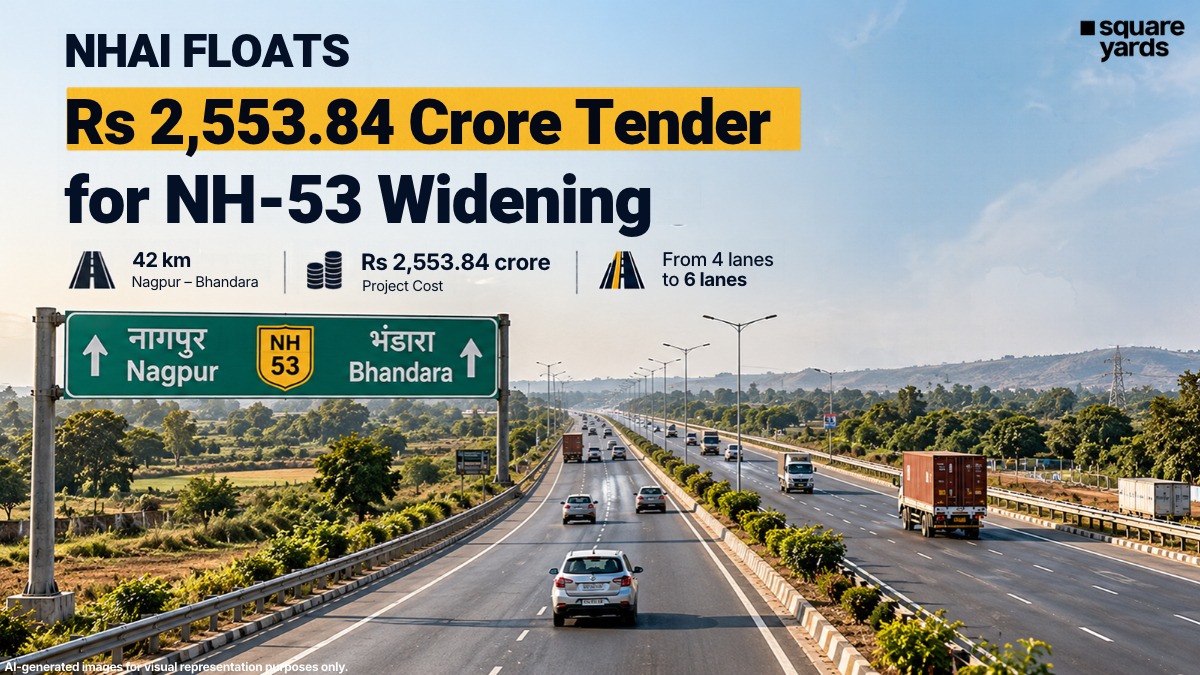
The National Highways Authority of India (NHAI) invited bids for a Rs 2,553.84 crore project to widen a 42 km stretch of National Highway 53 (NH-53) between Nagpur and Bhandara in Maharashtra. The project aims to expand the road to six lanes, increasing capacity on a corridor used by passenger and freight traffic.
According to the official government e-procurement listing, the government published the tender on October 9, 2026. The bid submission deadline was November 26, with bids scheduled to open on November 27. The contract covers the Nagpur-Wainganga section, from kilometer 499.800 to kilometer 541.800, under a build-operate-transfer (BOT) toll model.
NHAI invites bids for 42 km stretch of NH-53
The proposed work will widen the identified 42 km section from four to six lanes. The tender lists an estimated cost of Rs 2,553.84 crore and a work period of 912 days, or about 30 months. This is the stated execution period, not a confirmed completion date, as the final timeline depends on the contract award and implementation schedule.
The contract follows the BOT toll model. Under this arrangement, a private concessionaire typically finances and develops the road, operates it for a specified period, and recovers the investment through toll revenue, subject to the concession agreement. The tender documents outline the project’s specific obligations and toll terms.
The bid notice also lists an earnest money deposit of Rs 25.54 crore and a tender fee of Rs 2.60 lakh. These requirements are part of the bidding process for companies seeking the contract.
When Will Work Begin on the NH-53 Project?
NHAI India published the tender on October 9, 2026. The official e-procurement listing set the bid submission deadline for November 26, with the opening scheduled for November 27 at 11.30 am. The tender specified a 912-day work period.
With the scheduled bidding dates now past, the next question is whether NHAI has completed its evaluation and awarded the contract. The award status will clarify when construction could begin and whether the original execution period still applies.
This distinction matters for readers tracking the project. A tender announcement means NHAI sought a contractor. It does not establish that work has started on the ground..
Six-laning plan aims to add road capacity
The project aims to add more road capacity along the Nagpur-Wainganga stretch. Six lanes can handle more traffic than four, though the actual impact on congestion will depend on traffic growth, junction design, local access, and connections to adjoining sections.
The official tender confirms the six-lane scope and the BOT toll model. Verify details on flyovers, underpasses, service roads, bridge works, and drainage against the technical documents before presenting them as confirmed parts of the contract.
For motorists, the wider road could improve traffic flow if it addresses existing bottlenecks. Freight operators may also benefit from a more consistent route, particularly where heavy vehicles encounter delays. However, the tender information reviewed has not provided a verified estimate of travel time savings.
The project should therefore be viewed as a planned capacity upgrade, not a guarantee of faster journeys once construction is complete.
NH-53 upgrade to strengthen Nagpur’s link to Eastern Maharashtra
NH-53 connects parts of Maharashtra with Chhattisgarh and other regions farther east. The Nagpur-Bhandara section serves traffic traveling between Nagpur and eastern Maharashtra, including freight vehicles moving goods between industrial and commercial centers.
The project also aligns with the Center’s broader highway development plans for Maharashtra. On May 4, 2026, the Ministry of Road Transport and Highways said that Union Minister Nitin Gadkari reviewed several proposed high-speed and high-density corridors, including plans to six-lane the Nagpur-Bhandara section.
Earlier Highway Upgrades Set the Context
Parts of the wider corridor have already seen improvements. On July 5, 2025, the Ministry of Road Transport and Highways reported the inauguration of the six-lane Bhandara bypass and a six-lane flyover at the Mouda Y junction on NH-53. The event also included the foundation stone laying for road surfacing and strengthening works on other routes in Bhandara district.
These upgrades provide context for the latest tender, but they are separate projects and should not be confused with the new 42 km contract.
The proposed Nagpur-Wainganga expansion would add six-lane capacity to another section of the corridor. Its eventual impact will depend on the quality of the completed road and how traffic moves between upgraded and existing stretches.
For commuters, freight operators and businesses using the route, continuity matters. A wider road can improve capacity, but bottlenecks at junctions or on adjoining sections may still affect overall journey times.
How Could the Highway Upgrade Affect Real Estate?
The proposed widening could influence development along parts of the Nagpur-Bhandara corridor, particularly where highway access supports industrial activity, warehousing and regional trade. However, the tender alone does not establish that property demand or prices have increased.
Industrial and logistics properties could be one area to watch. Businesses that move goods by road may value access to a highway with greater traffic capacity. Any resulting demand for warehouses or industrial land will also depend on local infrastructure, land-use rules, and proximity to employment centers.
Residential development is another possible area of interest. Better road connectivity may make some locations outside Nagpur more practical for people who travel regularly along the corridor. Actual demand will depend on commuting needs, access to schools and healthcare, and the availability of jobs and housing.
Commercial activity near major junctions could also attract attention as the project progresses. But direct access to a national highway isn’t guaranteed for every nearby property, and some areas may face development restrictions.