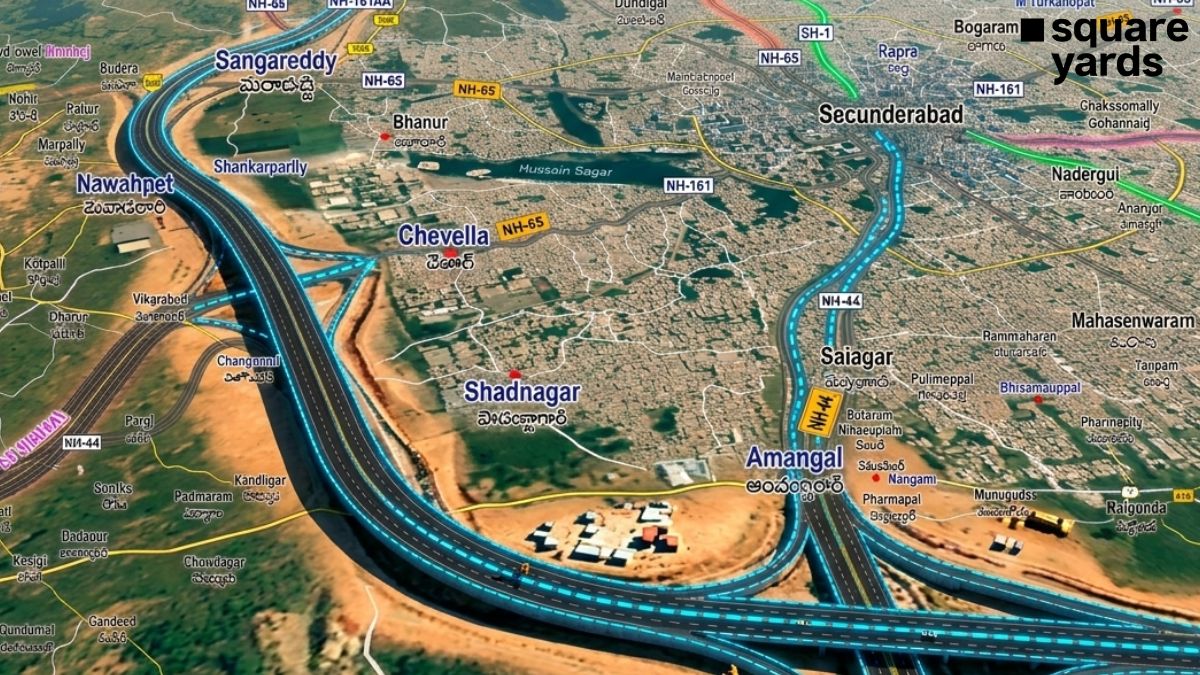
The Telangana government is advancing Hyderabad’s proposed 340-km Regional Ring Road (RRR), a six-lane corridor planned to connect key national highways and towns beyond the existing Outer Ring Road, with the northern section entering the tendering process and further clearances still required for construction. This move may influence the city’s next phase of real estate expansion, with peripheral locations such as Sangareddy, Chevella, Shadnagar, and Narsapur emerging as potential beneficiaries of improved regional connectivity.
While the city’s Metro Rail expansion remains relevant to urban mobility, Hyderabad’s Regional Ring Road could have a broader geographical impact on real estate by opening up new development corridors, improving access to peripheral districts, and attracting investment beyond established residential markets.
What is Hyderabad’s Regional Ring Road route and project status?
The RRR is planned as an outer orbital corridor connecting towns across the northern and southern peripheries of Hyderabad. Its proposed alignment includes Sangareddy, Narsapur, Toopran, Gajwel, Bhongir, Choutuppal, Chevella, and Shadnagar.
Unlike the Metro, which primarily improves connectivity within the urban area and its adjoining neighborhoods, the RRR is designed to facilitate longer-distance movement between regional centers. Better highway connectivity could support residential development, industrial activity, logistics facilities, and commercial establishments along its route.
The project’s potential significance extends beyond shorter travel times. Improved access to employment centers and transport networks can make previously peripheral locations more attractive to homebuyers and businesses. However, the extent of this transformation will depend on construction progress, land acquisition, supporting infrastructure, and the emergence of sustainable economic activity.
Property prices indicate growing interest in peripheral markets
Square Yards’ real estate market intelligence provides a snapshot of how prices in selected locations around the proposed RRR compare with Hyderabad’s broader residential market.
According to market figures available for mid-2026, average residential prices stood at approximately Rs 4,500 per square foot (psf) in Sangareddy, Rs 3,000 psf in Narsapur, Rs 2,500 psf in Chevella, and Rs 3,000 psf in Shadnagar. Shankarpally recorded approximately Rs 3,500 psf, while Ibrahimpatnam stood at around Rs 3,200 psf. The corresponding Hyderabad-wide average was approximately Rs 5,800 psf.
Square Yards data also indicates annual price growth of around 8% in Sangareddy, 10% in Narsapur, 12% in Chevella, 11% in Shadnagar, and 9% in Shankarpally. Hyderabad’s broader market recorded growth of approximately 6%.
However, the price differences do not establish that the RRR alone has driven appreciation. Local demand, land availability, existing connectivity, development activity, and speculative expectations can also influence property values.
Infrastructure expectations versus project execution
The RRR received in-principle approval in 2018, followed by further planning and clearances. In December 2024, tenders were issued for the northern section in five packages, with an estimated value of Rs 7,100 crore, according to government-related project updates reported at the time. Land acquisition, environmental clearances, funding arrangements and construction schedules will determine how quickly the proposed connectivity translates into tangible benefits. Locations close to confirmed interchanges and established roads may be better positioned than areas whose appeal depends entirely on a future alignment.
For investors, this makes due diligence particularly important. Verifying land titles, zoning permissions, road access and the precise distance from planned interchanges can help distinguish viable opportunities from speculative land purchases.
Metro Rail remains relevant, but the RRR offers a different growth proposition
Hyderabad’s Metro Rail network and its proposed expansion continue to matter for residential markets within the city. Metro connectivity can support daily commuting, improve access to employment hubs, and strengthen demand in established urban neighborhoods.
If supporting roads, utilities, public services, and employment opportunities develop alongside the RRR, its influence could extend to plotted developments, residential townships, warehousing, and other commercial uses. Without these complementary investments, improved road connectivity alone may not be sufficient to sustain long-term housing demand.
Affordability, supply, and economic activity will shape demand
Infrastructure is only one part of Hyderabad’s real estate growth story. Employment generation, household income, access to schools and healthcare, water supply, and social infrastructure will also influence whether peripheral locations develop into established residential markets.
Lower entry prices could attract first-time buyers and investors priced out of more expensive urban locations. At the same time, a rapid increase in plotted developments or residential launches could create excess supply if population growth and employment do not keep pace. Square Yards’ market figures also indicate that some emerging peripheral markets have experienced slower inventory absorption than the wider Hyderabad market. This highlights an important distinction: rising prices do not necessarily mean that every project is selling quickly or that buyers will be able to exit investments easily.