
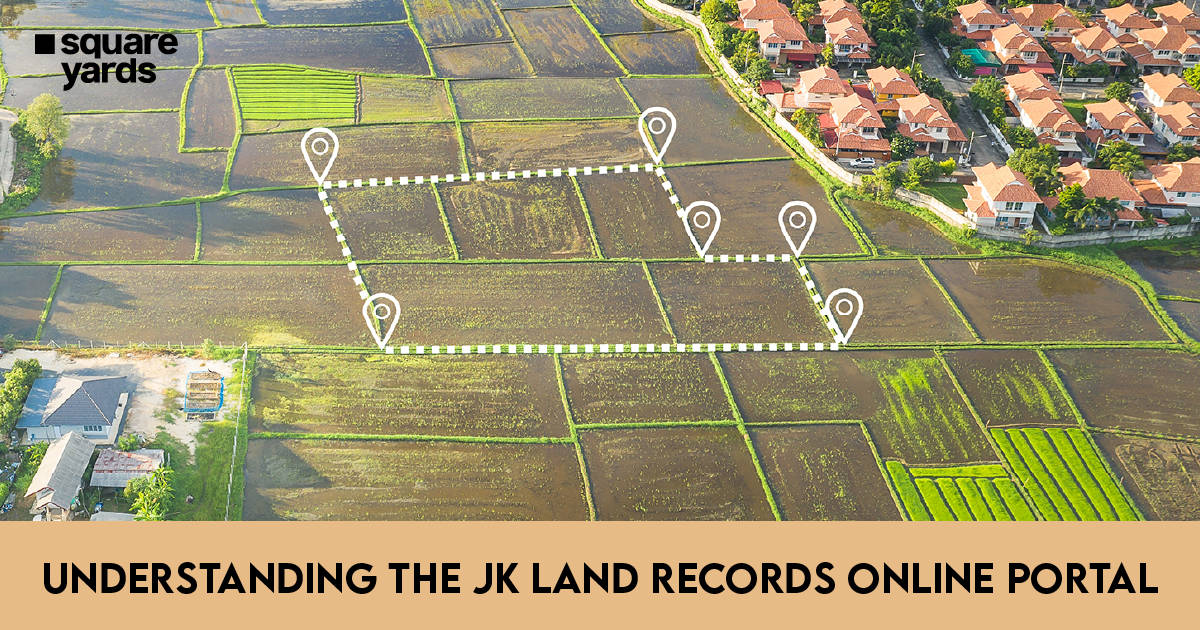
Trying to check a JK land record, or any land record in Jammu and Kashmir? Good news: you probably don’t need to go to the Tehsil office just to see it.
The J&K Revenue Department has put the digitized Jamabandi of each village online on its Land Records Portal, also known as JK Zameen Sudhar. Better still, anyone can view it for free, without logging in. You just pick your district, tehsil and village. Below, we cover how to check J&K land records online, the exact steps, what to do since you can’t download the file, and how to fix a mistake in your record.
- What Is a JK Land Record?
- Where Is the Official JK Land Record Portal?
- How to Check a Land Record JK Online, Step by Step
- How to Find Your Khasra or Name in the Jamabandi
- Can You Download the JK Jamabandi as a PDF?
- How to Get a Certified Copy or Fard
- What Is Jamabandi JK, and Why Does It Actually Matter?
- JK Land Record Terms Worth Knowing
- Documents You’ll Probably Need
- Common Problems (and What Actually Fixes Them)
- How to Raise or Track a Grievance
- Conclusion
- Other State-wise Land Records in India
What Is a JK Land Record?
It’s the government’s answer to a simple question: who owns this land, how much of it, and what’s it classified as, whether agricultural, residential, waste or something else. In J&K this document goes by the name Jamabandi. Other states call the same thing a Record of Rights, or RoR, but it’s the same idea underneath.
A typical JK land record will show you:
- The owner’s name, plus father’s or husband’s name
- Khasra number. Think of it as a serial number for that exact plot
- Khata or Khewat number, which groups land under one family or holding
- Land area and how it’s classified
- Tenancy or cultivation details, where they exist
- Mutation history, meaning every ownership change from sale, gift, or inheritance
Where Is the Official JK Land Record Portal?
The official site for land records JK is jkzameensudhar.jk.gov.in. It’s called the Land Records Portal, and the Revenue Department of the Government of Jammu and Kashmir runs it. On government notices and at grievance camps, you’ll also see the campaign name “Aapki Zameen Aapki Nigrani” (“Your Land, Your Watch”).
Once you open it, you’ll see six options in the menu:
| Menu option | What it does |
| Dashboard | The home page |
| View Digitized Jamabandi | Shows the digitized Jamabandi of your village |
| View Scanned document | Shows older land record documents that were scanned |
| Submit Grievance | Lets you report a mistake in your record |
| Track Grievance | Shows the status of your complaint, using your Grievance ID or mobile number |
| Officer Login | For revenue officials only, not for the public |
You may also come across older guides that point to landrecords.jk.gov.in, the earlier Land Records Information System (LRIS). However, for viewing your Jamabandi today, use jkzameensudhar.jk.gov.in. Either way, don’t enter anything personal unless you can see .jk.gov.in in your address bar. A few unofficial lookalike sites exist, so this small habit is worth keeping.
The Revenue Department’s own website, jkrevenue.nic.in, is the other official site you should know. Under Core Services, it has options like “ROR Status / Jamabandi Status” and “Public Services”. It also has an “Apply For Revenue Services” link, but that one needs you to log in.
How to Check a Land Record JK Online, Step by Step
You don’t need an account to view your village’s Jamabandi. Here’s the sequence:
- Go to jkzameensudhar.jk.gov.in.
- Click “View Digitized Jamabandi” in the menu.
- Choose your district. This field is required.
- Then choose your tehsil and village from the dropdowns.
- Click “Search Records”.
- The result shows the Jamabandi file for that village, along with the date it was uploaded and who uploaded it (usually the village Patwari).
- Read the file in the PDF preview on the right. Use “Next” and “Prev” to move between pages, and the plus and minus buttons to zoom in or out.
Also, one thing to know up front: the portal marks each file as a “Secured Document”. You can read it on screen, but right-click, download and print are switched off.
How to Find Your Khasra or Name in the Jamabandi
The portal doesn’t have a box to type in your khasra number or name. Instead, it shows the full Jamabandi of your village, so you then find your entry inside it.
- First, keep your khasra number handy. It’s the quickest way to spot your plot, since names repeat but khasra numbers don’t.
- Then go page by page with “Next”, and zoom in so the columns are easy to read.
- If you only know the owner’s name, however, look for it together with the father’s name. That helps when several families share a surname.
- Also, check the spelling against any old paper record, since names sometimes changed slightly during digitization.
Villages where several families share a surname make this genuinely tricky. If there’s an old paper Jamabandi or a tax receipt sitting in a drawer somewhere, grab the khasra number off it first. It’ll save you a lot of scrolling.
Can You Download the JK Jamabandi as a PDF?
No, not from the portal. A lot of people search for a free Jamabandi PDF download. However, the Land Records Portal only lets you view the file. Download and print are turned off for security, so nobody can copy or misuse the records.
So what can you do instead?
- To check your details, view the record on screen and note down your khasra number, area and the owner’s name.
- For personal reference, some people also take a screenshot. Keep in mind that a screenshot is not an official document, so banks, courts and registry offices won’t accept it.
- For any official use, though, get a certified copy or Fard, as explained below.
Also, be careful with websites or apps that offer “free JK Jamabandi PDF downloads”. They aren’t official, and their files may be old or wrong.
How to Get a Certified Copy or Fard
For a loan, a sale, a court case or a mutation, however, you need an official copy, not a screen view. In J&K, this is usually called a Fard, which is a certified extract of the Jamabandi for your holding.
So here’s how to get one:
- Go to your village Patwari or the Tehsil office.
- Take your ID, your khasra or khewat number, and any old land papers you have.
- Ask for a Fard or a certified copy of the Jamabandi.
- Pay the small fee the office asks for.
Besides the office route, the Revenue Department also offers some services online through the “Apply For Revenue Services” link on jkrevenue.nic.in. You’ll need to log in there, and the services on offer can change, so check what’s available for your district.
What Is Jamabandi JK, and Why Does It Actually Matter?
Jamabandi is the master ownership document for a village. It lists every landholder, their share, what the land is used for, and the revenue paid on it.J&K traditionally updates the Jamabandi every four years, in what’s called the Chaharsala cycle. That’s why it’s treated as the most current legal snapshot of who owns what, more current than whatever’s written on an old deed sitting in a cupboard.
You’ll typically need it when you:
- Buy or sell land, to confirm the seller actually owns it. For a deeper check of past owners and loans, a title search helps too
- Apply for a home or agriculture loan (banks want it as collateral proof)
- Settle a family dispute or a boundary disagreement
- Update records after inheritance or a mutation
- Apply for a government scheme that asks for proof of landholding
JK Land Record Terms Worth Knowing
A handful of terms show up again and again on the portal. Quick reference:
| Term | What it means |
| Jamabandi | The Record of Rights, the master ownership document |
| Misalhaquat | The original Record of Rights made during a land settlement survey |
| Khasra number | Unique ID for a single land parcel |
| Khata / Khewat number | Groups land under one owner or family |
| Girdawari | Seasonal record of crops and who’s actually in possession |
| Mutation (Intikhab) | Updating ownership after a sale, gift, or inheritance |
| Fard | A single extract of the Jamabandi for one holding |
| Mussavis / Latha | The cadastral maps that go with the record |
| Patwari | The village revenue official who keeps the land records |
| Chaharsala | The four-year cycle in which the Jamabandi is updated |
What Is Girdawari in J&K?
Girdawari is the crop inspection record. Each harvest season, the village Patwari visits the fields and notes who is farming each plot and what crop is grown there.
It doesn’t prove ownership, as only the Jamabandi does that. Still, girdawari is useful in a few cases. It shows who is actually using a plot, which helps in tenancy questions and crop loss claims. Banks may also ask for it for crop loans. For your girdawari details, ask your village Patwari or the Tehsil office.
Documents You’ll Probably Need
To view the record online, you only need your district, tehsil and village names. But for a certified copy, a correction or a mutation, keep these ready:
- A valid ID, such as Aadhaar or voter ID
- Khasra or khata number, or an old Jamabandi copy if you’ve kept one
- A working mobile number, to track your grievance later
- Your district, tehsil, and village, using the exact names, not approximations
Common Problems (and What Actually Fixes Them)
My name doesn’t match the record. Happens more than you’d think. Old paper records had spelling quirks that carried over during digitization. Use “Submit Grievance” on the portal, or take your ID and old documents straight to the Tehsildar.
The record shows an old owner. The mutation probably hasn’t gone through yet. Apply for Intikhab at the revenue office, with proof of the sale, gift deed, or inheritance.
My village isn’t in the dropdown. This turns up with newly formed or recently renamed villages, or villages whose Jamabandi hasn’t been uploaded yet. A call to the local Patwari, or a grievance filed on the portal, usually gets it sorted.
The file won’t open or loads slowly. Try a different browser, clear the cache, or come back during off-peak hours. Also remember that downloading isn’t allowed, so a missing download button isn’t an error.
How to Raise or Track a Grievance
If something’s wrong in your record, there’s no need to keep visiting the office in person about it. Better still, you don’t need to log in for this either.
- Go to jkzameensudhar.jk.gov.in and click “Submit Grievance”. You can also click “Submit Grievance” right under your village’s Jamabandi in the search results.
- Fill in the details the form asks for, such as your location and contact number.
- Describe the problem clearly, for example a wrong name, wrong area or a missing mutation, and submit.
- Note down your Grievance ID.
- Then, to check progress later, click “Track Grievance” and enter your Grievance ID or mobile number.
Conclusion
Checking a JK land record doesn’t have to mean a morning lost at the Tehsil office anymore. Head to jkzameensudhar.jk.gov.in, open “View Digitized Jamabandi”, pick your district, tehsil and village, and read your village’s record for free. Keep your khasra number handy, since it makes finding your entry much faster. If you need an official copy, get a Fard from your Patwari or Tehsil office. And if something looks off, use “Submit Grievance” instead of letting the mistake sit there indefinitely.
Other State-wise Land Records in India
| Karnataka | Bhoomi Online RTC |
| Chhattisgarh | CG Bhuiya |
| Uttarakhand | Bhulekh UK |
| Punjab | PLRS |
| Madhya Pradesh | Bhulekh MP |
| West Bengal | Banglarbhumi |
| Odisha | Bhulekh Odisha |
| Bihar | Land Record Bihar |
| Jharkhand | Jharbhoomi |
| Tamilnadu | Patta Chitta |
| Maharashtra | Mahabhulekh |
| Telangana | Dharani |
| Gujarat | AnyROR |
| Assam | Dharitree |
| Goa | Land Records Goa |
| Delhi | Bhulekh Delhi |
| Uttar Pradesh | UP Bhulekh |
Frequently Asked Questions
1. What is a JK land record, exactly?
It’s the official document — usually the Jamabandi — showing who owns a plot in Jammu and Kashmir, how big it is, how it’s classified, and its revenue history.
2. What's the official website for JK land records?
It’s jkzameensudhar.jk.gov.in, the Land Records Portal run by the J&K Revenue Department. You may also see it called JK Zameen Sudhar or linked to the Aapki Zameen Aapki Nigrani campaign.
3. Can I check my JK land record online for free?
Yes. Viewing your village’s digitized Jamabandi costs nothing, and you don’t need to log in. You only pay when you need a certified copy or Fard from the revenue office.
4. How do I search J&K land records by name?
The portal searches by location, not by name or khasra. Pick your district, tehsil and village, open the village Jamabandi, then look for your khasra number or name inside it.
5. What exactly is Jamabandi in J&K?
The master land ownership record for a village — landholders, their shares, land use, and revenue paid, all in one legal document.
6. Why does the khasra number matter so much?
Because names repeat across a village but khasra numbers don’t. It’s simply the most reliable way to find the right plot.
7. How do I fix a mistake in my land record?
Click “Submit Grievance” on the portal and describe the mistake, or visit your local Tehsildar or Patwari with your ID and old documents. You can follow up with “Track Grievance”
8. Is jkzameensudhar.jk.gov.in the same portal as landrecords.jk.gov.in?
Not exactly. landrecords.jk.gov.in was the earlier Land Records Information System (LRIS). For viewing your Jamabandi today, use jkzameensudhar.jk.gov.in, the current Land Records Portal.
9. Does it work on mobile?
Yes. It opens in normal browsers like Chrome or Safari, so you don’t need an app. The portal doesn’t link to any official app, so be careful with third-party apps that claim to offer the same records.
10. How long does a mutation take to show up?
Depends on the tehsil and the type of case — there’s no fixed number. Check status on the portal with your application number, or ask the local revenue office directly.
11. Can I download my JK Jamabandi as a PDF for free?
No. The portal lets you view the village Jamabandi for free, but download and print are switched off for security. For an official copy, get a Fard or certified copy from your Patwari or Tehsil office.
12. What is Fard in J&K?
A Fard is a certified extract of the Jamabandi for one holding. Banks, courts and registry offices ask for it, and the village Patwari or Tehsil office issues it.
13. How do I track my land record grievance?
Go to jkzameensudhar.jk.gov.in, click “Track Grievance” and enter your Grievance ID or the mobile number you used when you submitted it.
14. Do I need to log in to the JK Zameen Sudhar portal?
No. You can view your Jamabandi and submit or track a grievance without logging in. The “Officer Login” on the menu is only for revenue officials.