

Property records in Goa carry a layer of history most other states don’t have to deal with. Decades of Portuguese-era Matriz registers sit alongside the modern Record of Rights, and the state’s Goa Land Revenue Code, 1968 is what ties the two together into the system used today. The Directorate of Settlement and Land Records, usually shortened to DSLR, is the body responsible for keeping that record current, and its online portal is where almost everyone in Goa now starts when they need to check who owns a plot, what it’s classified as, or whether a recent sale has been reflected in the official record.
This guide covers land and records Goa the way people actually search for it: how to pull up Form 1 and 14 for a rural plot, how Form D works for urban property, where to find land survey records Goa and maps, how mutation status checks work, and what to do if all you have is an owner’s name rather than a survey number. That last point matters more than it might seem, since a meaningful share of readers arrive at this topic already stuck on it. If you’ve searched for Goa online land records or goa land records online before landing here, this is the same system – just walked through end to end.
What Are Land Records in Goa?
Land records Goa refers to the official documentation and database maintained by the Government of Goa covering land ownership, land classification, transactions and related administrative details across the state. These records exist to establish legal ownership, support property transactions, help resolve boundary or title disputes, and feed into planning and development decisions at the taluka and village level.
Unlike some states where a plot is searched by district and Khasra number, Goa identifies land by taluka, village, survey number and sub-division number, a structure that traces back to the original cadastral survey conducted under Portuguese administration and later absorbed into the post-1961 Indian legal framework. Every plot’s Record of Rights ultimately rests on this survey-number system, which is why almost every search on the portal, whether for Form 1 and 14, Form D, or a survey map, asks for the same handful of fields.
|
Particulars |
Details |
|
System name |
Land Records Goa (Record of Rights) |
|
Official website |
dslr.goa.gov.in |
|
Managing authority |
Directorate of Settlement and Land Records (DSLR), Government of Goa |
|
Governing law |
Goa, Daman and Diu Land Revenue Code, 1968 |
|
Rural land record |
Form I & XIV (searched by taluka, village, survey number, sub-division) |
|
Urban land record |
Form D (searched by city, PT Sheet number, Chalta number) |
|
Other services |
Survey/Bhunaksha maps, mutation status, download forms, service centre directory |
One quirk worth knowing about upfront is Communidade land, a form of community-held property unique to Goa that dates back to the Portuguese period, where a village body rather than an individual holds title. Land falling under a Communidade is still recorded through the same DSLR system, but selling or developing it usually needs specific permissions from the Communidade’s managing committee in addition to the standard documentation, so it’s worth checking a plot’s status carefully before assuming a straightforward Form 1 and 14 search tells the whole ownership story.
Directorate of Settlement and Land Records Goa – What It Does
The Directorate of Settlement and Land Records, referred to almost everywhere as DSLR Goa or the land and survey department Goa, is the department responsible for preparing and maintaining Goa’s land records and cadastral maps, as laid down under the Goa Land Revenue Code, 1968. Its responsibilities go beyond simply storing records; the settlement and land records Goa function also covers periodic revision of survey data, amendment of ownership entries following a sale or inheritance, and issuing certified copies of Form 1 and 14 or Form D for use in property transactions, loan applications and legal proceedings.
DSLR operates through a layered structure that runs from the state directorate down to individual village-level offices, known as sazas, which is how updates made at a local survey level eventually make their way into the centralised online record. For most day-to-day needs, though, the directorate of land records Goa’s public-facing portal is the only stop you need, since it pulls from the same database the department itself works from.
Documents and Services on the Goa Land Records Portal
Beyond the core Form 1 and 14 and Form D lookups, the DSLR portal bundles together most of the services a landowner or buyer in Goa is likely to need. You can download the manual Form 1 and 14 Goa land records, meaning blank, fillable copies of the standard forms, directly from the ‘Download Forms’ section, view rural and urban survey maps, check the status of a pending mutation case, and look up public notices related to mutations or partition of property. A directory of service centres, complete with addresses and contact numbers, is also available for anyone who’d rather resolve a query in person or needs help completing an online application.
|
Form 1 and 14 / Form D lookup |
Search and view the rural or urban Record of Rights on screen using taluka, village, survey number (or city, PT Sheet, Chalta number). |
|
Manual Form 1 and 14 Goa land records |
Download blank, fillable copies of the standard forms from the ‘Download Forms’ section. |
|
Survey / Bhunaksha maps |
View rural and urban survey plans showing plot boundaries, downloadable as PDF. |
|
Mutation status tracking |
Check the status of a pending mutation case by taluka and mutation case number. |
|
Public notices |
Look up notices related to mutations or partition of property. |
|
Service centres directory |
Addresses and contact numbers for in-person help across talukas. |
|
Certified copies |
Apply for a certified Form 1 and 14 or Form D through goaonline.gov.in, currently at a fee of around ₹45. |
How to Check Land Records Goa Online
Checking land and survey records Goa online follows a consistent pattern regardless of which form you’re after:
- Go to the official portal: visit dslr.goa.gov.in and look for the ‘Land Records (RoR)’ option on the homepage.
- Choose rural or urban: select whether you’re looking up rural land or an urban property.
- Fill in the location details: for rural land, choose your taluka, village, survey number and sub-division number; for urban property, choose the city, PT Sheet number and Chalta number.
- Complete the captcha: enter the captcha shown on screen to confirm you’re not a bot.
- Click ‘View Details’: the matching record opens directly on screen, usually within a couple of minutes.
The one thing the portal genuinely can’t do without is your survey number. If you don’t have it, the section further down on finding your survey number is worth reading before you try the search itself.
Goa Land Records Form 1 and 14: What It Contains
Form 1 and 14, often written as Form I & XIV, is the core Record of Rights for rural land in Goa, and it’s really two documents combined into one. Form I covers the technical side: the survey number, sub-division number, total area, and the land’s classification, whether that’s paddy land, orchard, or another category recognised under the Land Revenue Code. Form XIV covers the ownership side: the names of the current occupants or owners, their rights over the land, and any encumbrances such as mortgages, tenancy arrangements or legal claims attached to the plot.
Read together, Form 1 and 14 goa land records give a buyer or lender a fairly complete picture of a rural plot before any transaction goes ahead, which is why it’s the single most searched land document in the state.
How to View Form I & Form XIV Information Online – Land Records Goa (RoR)
- To view land records, go to Goa for Form 1 and 14 information online. Follow the listed steps:
- Go to the official website: dslr.goa.gov.in/f114new.aspx
- Click on the Land Records (ROR) button to view Form 1 and Form XIV data online.
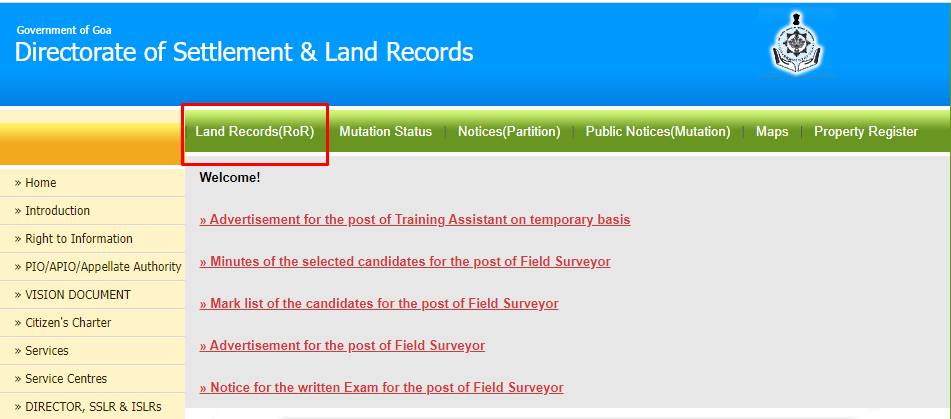
- A new page will appear after selecting the land records (ROR) category. Choose the options ‘Form 1 & Form XIV’.
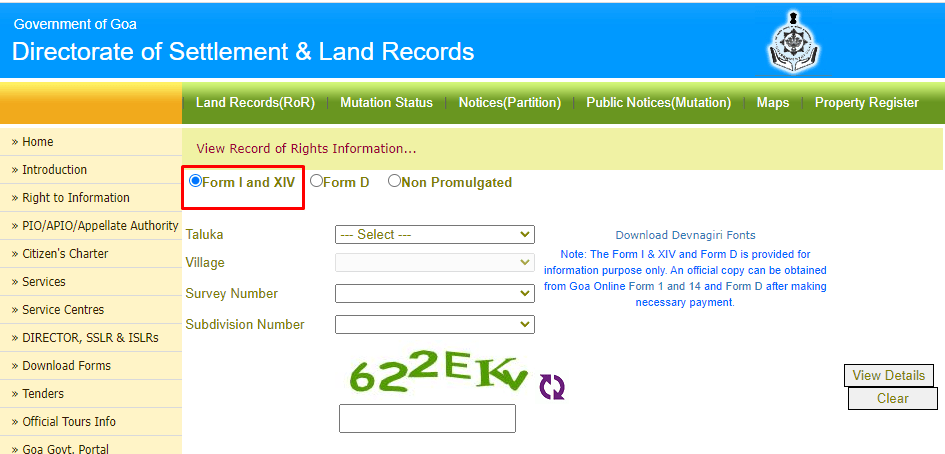
- Fill out the details such as Taluka, village name, survey number, and subdivision number.
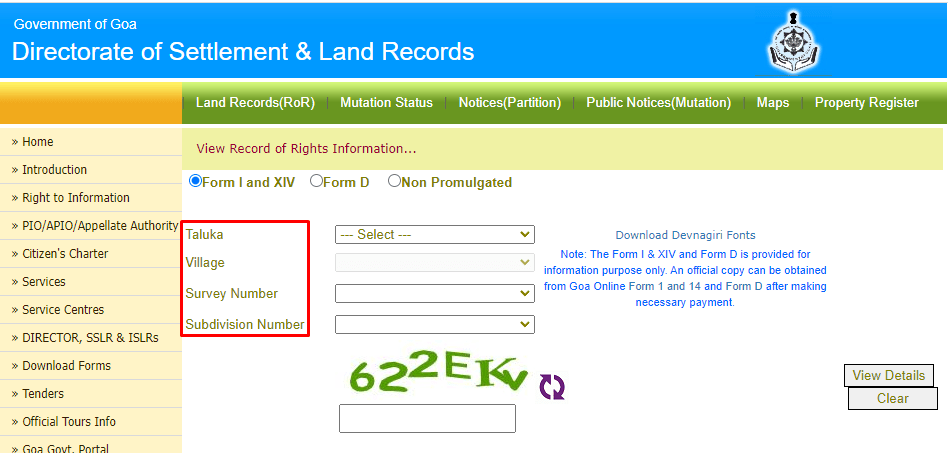
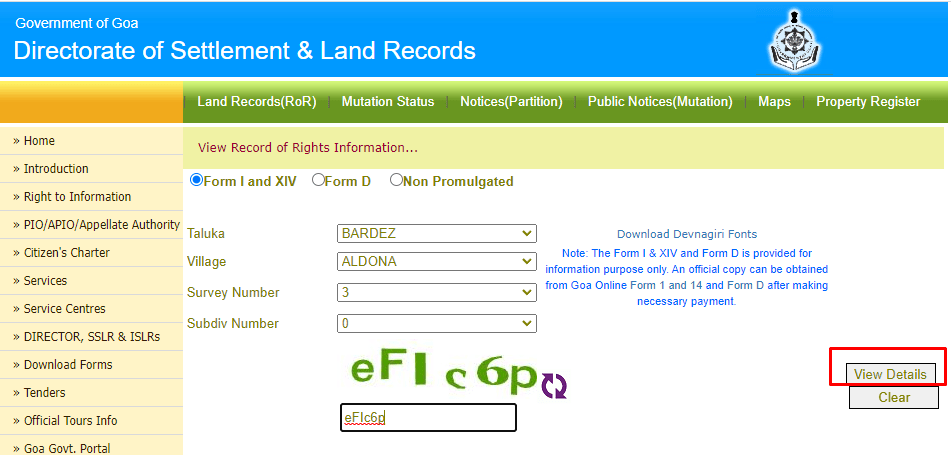
- Enter the ‘Captcha’.
- Click on the ‘view details’ link to see the rural information. You can also download the form.
How to View Form D Information Online: Land Records Goa (RoR)
- To view land records Goa for Form D information online. Follow the listed steps:
- Go to the official website, dslr.goa.gov.in/f114new.aspx
- Select the Land records(ROR) category to view Form D Goa data online.
- Click on the ‘Form D’ option and fill out the details, such as city, Pt_sheet, and Chalta number.
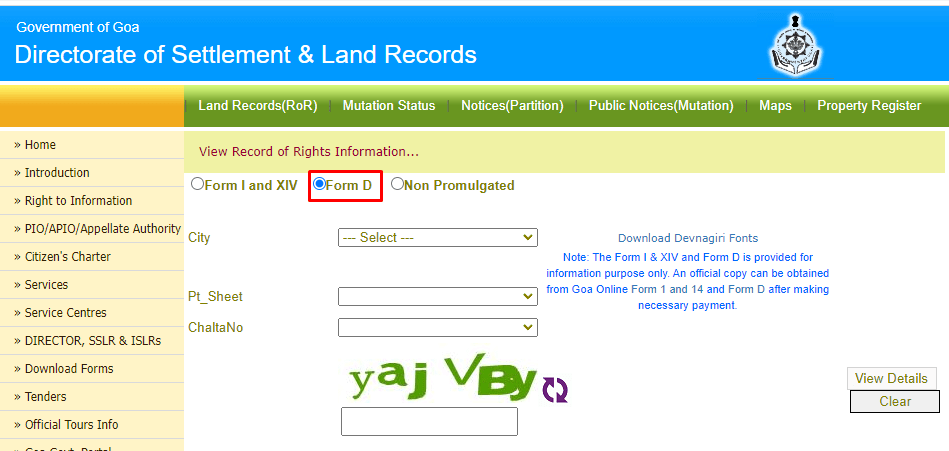
- Enter the ‘Captcha’.
- Select the ‘View Details’ option to see the city details.
How do I view the mutation status of Forms I & XIV, and Form-D?
- Steps to view the mutation status of Forms 1 & XIV and Form D for the land records of Goa are below:
- Forms 1 & XIV
- Go to the official website: dslr.goa.gov.in/f114new.aspx
- Click on the ‘Mutation Status’ option to check the status of Form 1 & XIV.
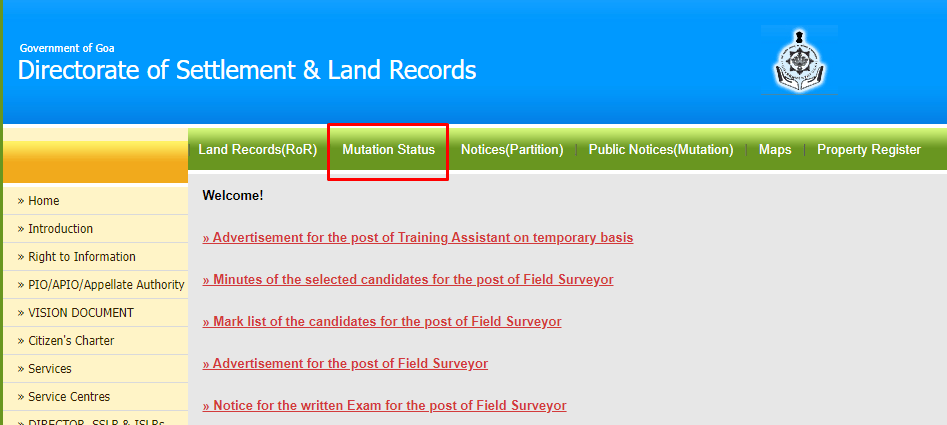
- Fill out the details, such as the taluka and mutation number.
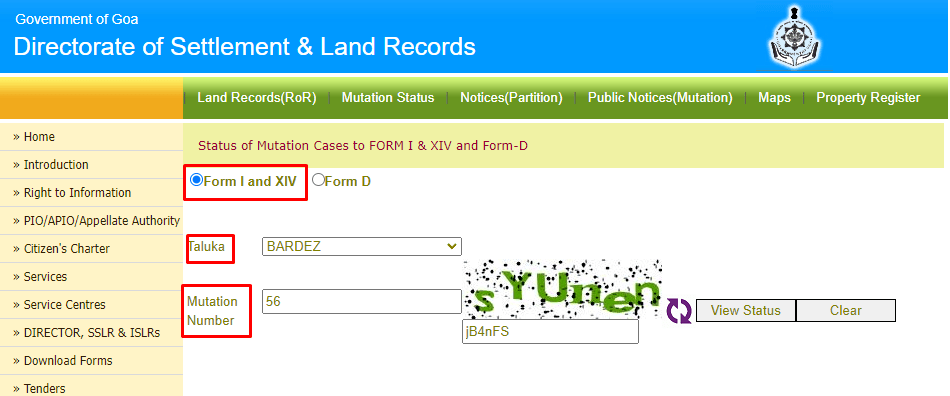
- Enter the ‘Captcha’.
- Click on ‘View Status’, to see the information.
Form D
- Go to the official website: dslr.goa.gov.in/f114new.aspx
- Click on the ‘Mutation Status’ option to check the status of Form D.
- Fill in the ‘Mutation Number’ under the Form D category.
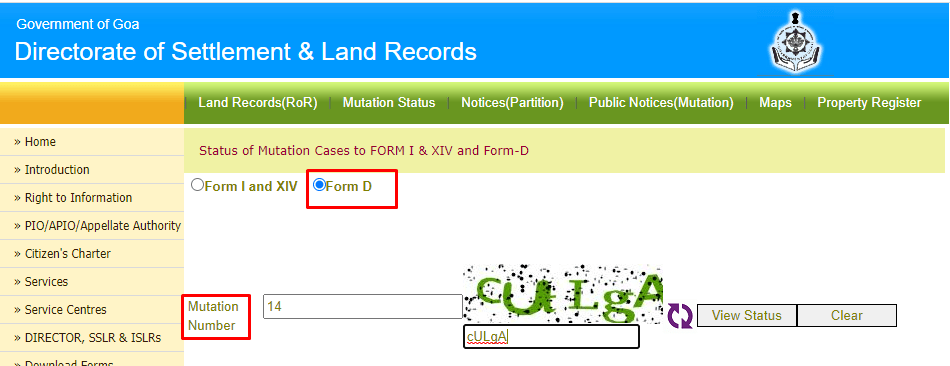
- Enter the ‘Captcha’.
- Click on ‘View Status’ to see the details.
How to View Goa Land Records Notices from DSLR Portal
- The Directorate of Settlement & Land Records Goa (DSLR) is tasked with securing the land records of Goa citizens. This comes under the law of the ‘Goa Land Revenue Code’, which was introduced in 1968.
- DSLR keeps tabs on land acquisition issues by making plans of action and reports. They revise and update the land records regularly. There are two methods by which you can view DSLR Goa land records notices.
- View Partition Notices
- Some of the steps are mentioned below to view partition notices for Forms 1 and XIV and Form D.
- Visit the official portal: dslr.goa.gov.in/f114new.aspx
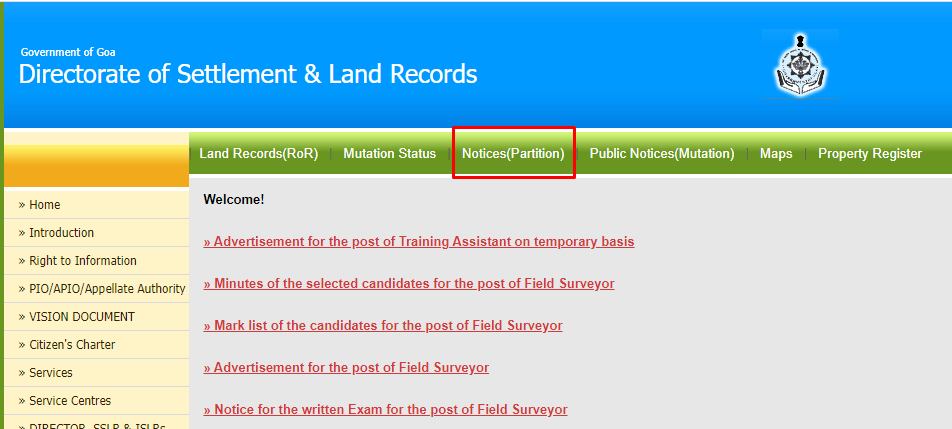
- Select the ‘Notices (Partition)’ category.
- According to your choice, select the required criteria like Form 1 and XIV and Form D.
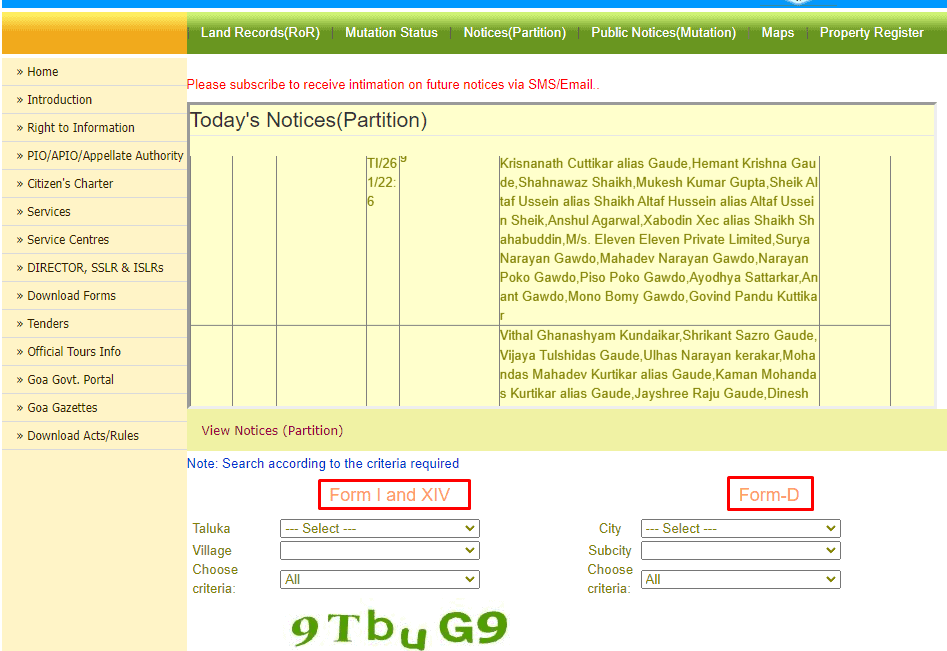
- Fill out the details, and click on the ‘View details’ option.
- View Mutation Public Notices
- Some of the steps are mentioned below to view Mutation Public Notices for Form 1 and XIV and Form D.
- Visit the official portal: dslr.goa.gov.in/f114new.aspx
- Click on the ‘Public Notices (Mutation)’ category.
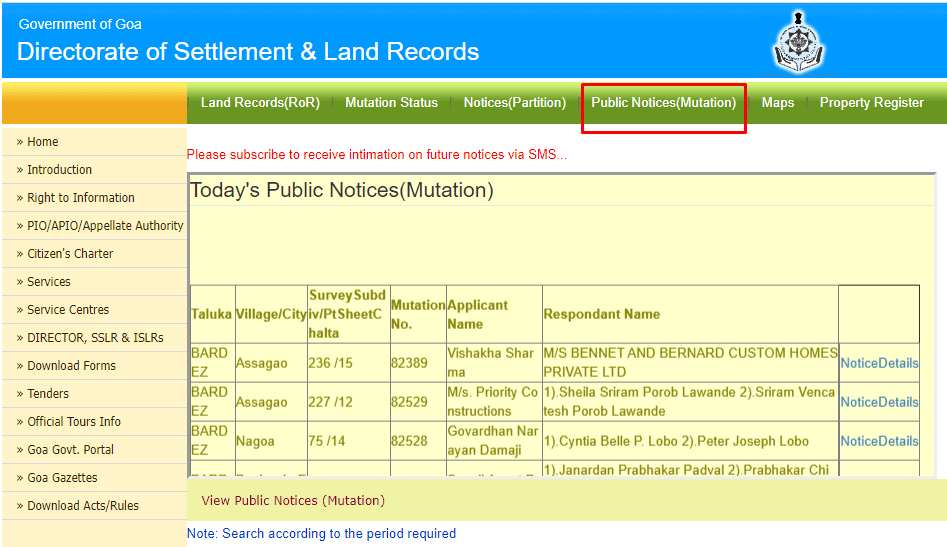
According to your choice, select the required criteria like Form 1 & XIV and Form D.
Other State wise Land Records in India
| Karnataka | Bhoomi Online RTC |
| Chhattisgarh | CG Bhuiya |
| Uttarakhand | Bhulekh UK |
| Punjab | PLRS |
| Madhya Pradesh | Bhulekh MP |
| West Bengal | Banglarbhumi |
| Odisha | Bhulekh Odisha |
| Bihar | Land Record Bihar |
| Jharkhand | Jharbhoomi |
| Tamilnadu | Patta Chitta |
| Maharashtra | Mahabhulekh |
| Telangana | Dharani |
| Gujarat | AnyROR |
| Assam | Dharitree |
How to Download Form 1 and 14 Goa Land Records Online
This is what most people mean when they search Form I & XIV Goa land records online, or the DSLR Goa land records login page – it’s the same portal and the same search, just written differently. To pull up Form 1 and 14, go to dslr.goa.gov.in and open the ‘Land Records (RoR)’ option, then select the Form I and 14 radio button on the page that follows. Choose your taluka and village from the dropdowns, enter the survey number and sub-division number exactly as they appear on any existing paperwork, complete the captcha, and click ‘View Details’. The reference copy of your Form 1 and 14 goa land records opens directly on screen, and from there most portals also offer a straightforward PDF download of the same record for your own reference.
Keep in mind that this downloaded PDF is meant for informational use. If you need a certified version, whether for a bank, a court, or a property registration, that request has to go through goaonline.gov.in, where the certified copy is generated with the applicable fee and carries the legal standing an informational PDF doesn’t.
Form D: Land Records for Urban Property in Goa
Form D is the equivalent of Form 1 and 14, but for urban property, and it’s issued by the city survey offices operating under DSLR. Instead of a taluka, village and survey number, an urban search asks for the city, the PT Sheet number, and the Chalta number, which together identify a specific urban plot the way a survey number does for rural land. On the DSLR homepage, selecting the Form D option and working through the same dropdown-and-captcha process brings up the record on screen.
As with rural records, a computerised copy of Form D can be obtained directly at a city survey office on payment of the applicable fee, and it can also be applied for online through goaonline.gov.in for anyone who’d rather not visit in person.
Form III and Form B: Records for Non-Promulgated Areas
Not every part of Goa has gone through the full settlement process that Form 1 and 14 or Form D assume. For villages or areas where the cadastral survey hasn’t been formally promulgated yet, the portal instead uses Form III for rural land and Form B for urban land. The search process for both mirrors the standard one, using taluka, village and survey details for Form III or city and PT sheet details for Form B, but the underlying record reflects a provisional rather than fully settled survey. If a standard Form 1 and 14 or Form D search comes back empty for a plot you know exists, it’s worth checking whether the area falls under this non-promulgated category before assuming the record simply isn’t digitised.
Goa Land Records Survey Plan and Bhunaksha Maps
Alongside the ownership records, the DSLR portal maintains the goa land records survey plan for both rural and urban land. Many people search for this using the terms Bhunaksha Goa, Bhu Naksha Goa or Goa Bhunaksha, borrowed from how other states name their cadastral map tool, even though Goa’s own map module isn’t officially branded that way on the portal. These maps show a plot’s boundary and shape as recorded in the cadastral survey, plotted against its survey number, and they’re a useful cross-check against the written record whenever a plot’s exact boundary or shape is in question.
These maps are also where Goa’s move toward a more precise, GIS-based survey shows up most directly. The state has been working to reconcile older, Portuguese-era boundary data with modern satellite and ground-survey information, and the survey plan available on the portal reflects that reconciled boundary wherever the work has been completed for a given village, rather than the original paper-era sketch alone.
To download a survey plan, open the Maps section on the DSLR homepage and choose between the rural and urban map options, since the two are handled separately. For a rural map, select the taluka, village, survey number and sub-division number, complete the captcha, and click ‘View Details’ to bring up the plan; the same fields as the Form 1 and 14 search apply here, so if you’ve already searched the record you’ll have the details on hand. Urban maps follow the equivalent PT Sheet and Chalta number process. Once the plan loads, a PDF download option is generally available, which covers the survey plan download pdf searches this topic gets regularly.
Goa Land Records by Name: Can You Search Without a Survey Number?
A fair number of people come to this topic wanting to search goa land records by name, the way some other states allow, and it’s worth being upfront that the DSLR portal is built primarily around the survey number system rather than an owner-name index. The standard Form 1 and 14 or Form D search asks for taluka, village and survey number (or city, PT Sheet and Chalta number), not a name field, so if you don’t have the survey number, the direct route isn’t available in the way it might be elsewhere.
If all you have is an owner’s name, the more reliable path is to work backwards to the survey number first: a sale deed, a property tax receipt, an old Form 1 and 14 copy, or an enquiry at the village saza or the nearest DSLR service centre can usually supply it, after which the standard search works normally. Some independent property-mapping tools have also built map-first search layers on top of Goa’s published survey boundaries, letting you locate a plot visually and read off its survey number, which is another practical workaround when the number itself isn’t already on hand.
How to Check Mutation Status on Goa Land Records
A mutation is the process of updating the Record of Rights, or RoR Goa, after a change in ownership, whether through sale, inheritance, gift, or partition, and checking mutation status Goa is one of the more commonly searched actions on the DSLR portal. To check, go to the mutation status section of the site, select your taluka, and enter the mutation case number along with the captcha before clicking ‘View Status’. The result shows the applicant’s name, the date the request was filed, the current stage of the mutation case, and, once complete, the certification date.
Mutation fees in Goa are modest and are usually paid through the same online application process when the mutation request is first filed, separate from any court-fee stamp charges that apply to the paperwork itself. If a mutation case has been pending for an unusually long time, following up directly with the taluka’s DSLR office is generally more effective than waiting on the portal status to update, since delays often come down to a document query at the department end rather than a system issue.
Goa has also been tightening the mutation, or Namantaran, process against land-grabbing and fraudulent transfers by linking applications to Aadhaar, which adds an identity-verification step to the filing but is generally a quick one for anyone whose Aadhaar details already match their existing land record. If a mutation gets stuck at this stage, it’s usually because a name or address doesn’t match exactly between the two records, which is worth checking before assuming there’s a deeper problem with the application.
How to Find Your Survey Number in Goa
Since the survey number is the key that unlocks almost every other search on the portal, it’s worth knowing where to find it if your existing paperwork doesn’t have it clearly listed:
- Check a sale deed: an existing sale deed usually carries the survey number and sub-division number together.
- Check an old Form 1 and 14 or Form D copy: any earlier land record printout will show the same details.
- Check a property tax bill: municipal or panchayat tax bills reference the survey number they were calculated against.
- Check a mutation notice: a past mutation notice will carry the survey number tied to the case.
- Contact your village saza office: the local saza office can look up a plot’s survey number against an owner’s name or approximate location.
- Visit the nearest DSLR service centre: staff there can help trace the survey number in person.
- Try an independent land-mapping platform: a few third-party tools have indexed Goa’s village maps with survey numbers overlaid, useful for narrowing things down visually before you take the number to the official portal for a certified record.
Checking Property Registration and Sale Deeds in Goa
Land records and property registration are handled by two related but separate systems in Goa. While DSLR maintains the Record of Rights itself, the actual registration of a sale deed goes through the Inspector General of Registration’s portal, ngdrsgoa.gov.in. To search for or register a sale deed, you’ll need to create an account on that portal, upload the relevant documents, and complete the applicable payment online before the registration process moves forward. Once a sale is registered there, the corresponding mutation still needs to be filed and processed through DSLR before the change in ownership is reflected in Form 1 and 14 or Form D, so the two systems work in sequence rather than as substitutes for each other.
Service Centres and Help for Goa Land Records
For anyone who’d rather not navigate the portal alone, whether because a search isn’t returning results or a certified copy needs to be collected in person, DSLR maintains a network of service centres across the state. The ‘Service Centres’ option on the portal homepage lists their addresses and contact numbers by taluka, and these centres can generally assist with everything from a straightforward Form 1 and 14 printout to guidance on filing a mutation application. For queries that go beyond what a service centre can resolve, the same portal lists contact details for the DSLR head office, which is the right point of escalation for anything involving a disputed or clearly incorrect record.
Goa Land Records and Property Tax: How They Connect
Land records and property tax are handled by separate authorities in Goa, but the two are closely linked in practice. Municipal corporations and panchayats calculate property tax based largely on the same survey number, sub-division, area and classification details that appear on Form 1 and 14 or Form D, which is why an outdated or incorrect land record can eventually show up as a mismatched tax bill. Keeping your Form 1 and 14 or Form D current, particularly after a mutation, sale or inheritance, isn’t just a legal formality; it also keeps the property tax records that reference it accurate, and avoids the kind of discrepancy that becomes harder to untangle the longer it sits unresolved.
Conclusion
Land records Goa runs on a survey-number system that takes a little getting used to if you’re coming from a state that searches by owner name, but once you have the taluka, village and survey number, or the city, PT Sheet and Chalta number for urban property, the DSLR portal at dslr.goa.gov.in covers most of what you’ll need: Form 1 and 14, Form D, survey plans, and mutation status, all from the same website.
For anything the portal can’t resolve directly, whether that’s tracking down a survey number you don’t have, getting a certified copy through goaonline.gov.in, or registering a fresh sale deed through ngdrsgoa.gov.in, the surrounding system of service centres, village sazas and the DSLR head office fills in the gap. Between the three, most land record needs in Goa can be handled without a lengthy office visit.
Frequently Asked Questions:
1. What are land records Goa?
Land records Goa are the official ownership, survey and classification records for property in the state, maintained by the Directorate of Settlement and Land Records (DSLR) under the Goa Land Revenue Code, 1968.
2. What is the official website for Goa land records?
The official portal is dslr.goa.gov.in, maintained by the Directorate of Settlement and Land Records, where you can search Form 1 and 14, Form D, survey plans and mutation status.
3. What is Form 1 and 14 in Goa land records?
Form 1 and 14, or Form I & XIV, is the Record of Rights for rural land in Goa. Form I covers survey number, area and land classification, while Form XIV covers ownership, tenancy and encumbrances.
4. How do I download Form 1 and 14 Goa land records online?
On dslr.goa.gov.in, open Land Records (RoR), select Form I and 14, choose your taluka, village, survey number and sub-division number, complete the captcha, and click View Details to view and download the record.
5. What is Form D in Goa land records?
Form D is the land record for urban property in Goa, searched using the city, PT Sheet number and Chalta number instead of a taluka and survey number.
6. Can I search Goa land records by name instead of survey number?
The DSLR portal is built around survey numbers rather than owner names, so a direct name search isn’t available. It’s usually faster to find the survey number first, from a sale deed, tax receipt or the local DSLR service centre, and then search normally.
7. How do I check my survey number in Goa?
Check an existing sale deed, Form 1 and 14 copy, property tax bill or mutation notice, or contact your village saza office or the nearest DSLR service centre for help locating it.
8. How do I check the Goa land records survey plan?
On dslr.goa.gov.in, open the Maps section, choose rural or urban, enter the taluka/village/survey number (or city/PT Sheet/Chalta number for urban), complete the captcha, and view or download the survey plan.
9. Where do I register a sale deed in Goa?
Sale deeds in Goa are registered through the Inspector General of Registration’s portal, ngdrsgoa.gov.in, separate from the DSLR land records system.
10. What are Form III and Form B in Goa land records?
Form III and Form B are used for rural and urban land respectively in areas where the cadastral survey hasn’t been formally promulgated yet, and they’re searched the same way as Form 1 and 14 or Form D.
11. Where can I get help with Goa land records in person?
DSLR maintains service centres across the state’s talukas, listed with addresses and contact numbers on the portal, for anyone who needs in-person help with a search or application.